United States v. Nixon is often remembered as the case that made Richard Nixon hand over the tapes. That memory catches the outcome, though the opinion's real constitutional move was more exact. On July 24, 1974, the Supreme Court refused to let presidential confidentiality harden into an absolute barrier against evidence demanded by a criminal trial.[1][2] Read closely, the case does not dissolve executive privilege. It recasts privilege as a qualified claim that can survive ordinary politics and still fail when a court shows a specific need for identified evidence in the fair administration of justice.[1]
That narrower reading matters because Watergate produced two temptations at once. One temptation treated the President as constitutionally untouchable whenever internal White House conversations were at issue. The other treated the case as a pure morality play in which a bad presidency naturally collapsed. The opinion lands somewhere more useful. It recognizes a genuine interest in candor inside the executive branch, then refuses to let the White House become the final judge of whether relevant criminal evidence may ever leave the White House.[1][2]
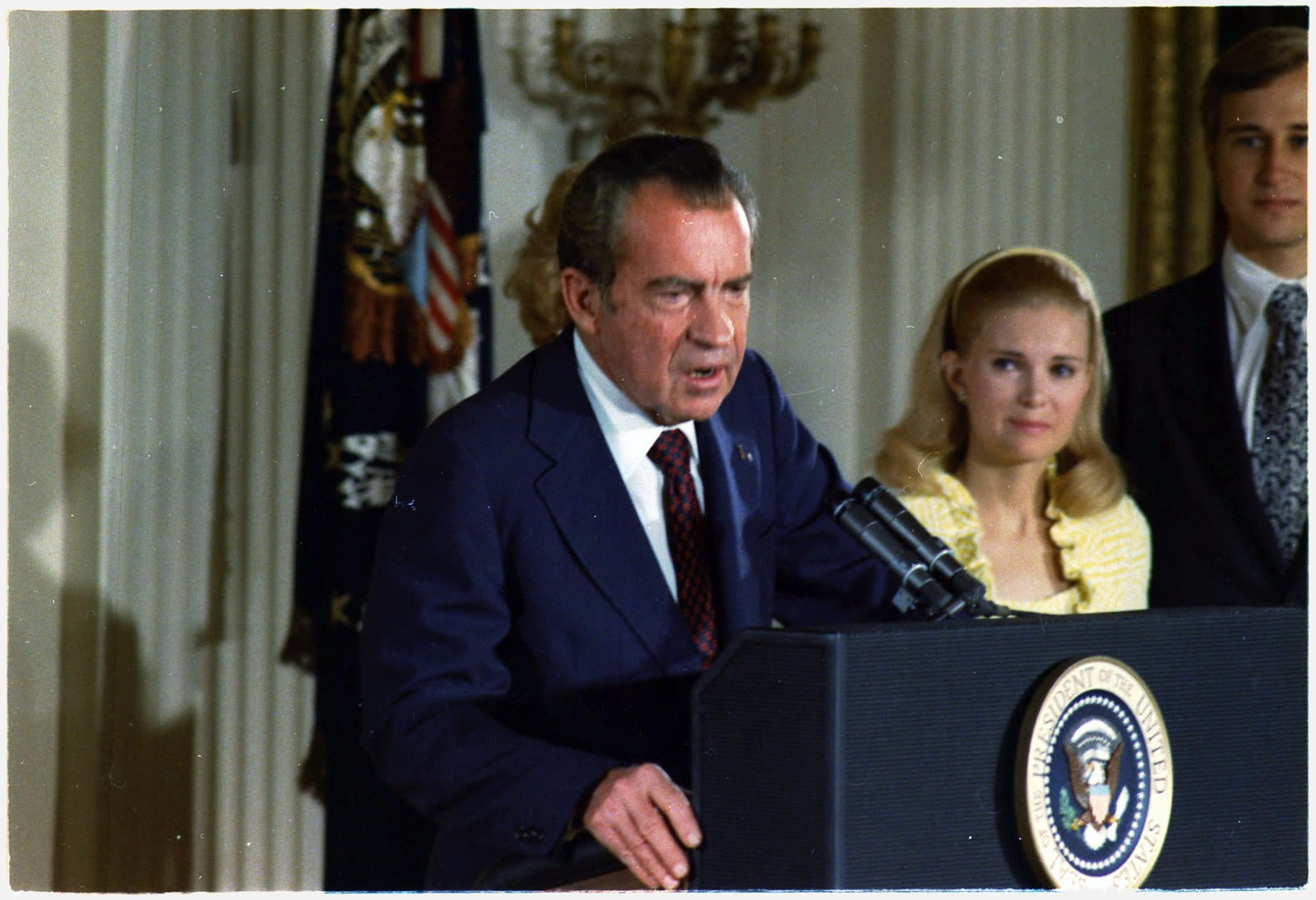
Image context: the cover image shows Nixon's farewell to Cabinet members and White House staff on August 9, 1974. It works here because the article's argument is about sequence: the Court's evidentiary ruling on July 24 did not instantly remove Nixon, but it forced the dispute back onto the terrain of tapes, transcripts, and provable conduct, making the last week of the presidency visibly short.[5][6]
Timeline anchors: how a burglary became a separation-of-powers case
- June 17, 1972: five men are arrested inside Democratic National Committee headquarters at the Watergate complex, beginning the chain of investigation that eventually reaches the Oval Office.[5]
- July 16, 1973: Alexander Butterfield reveals the existence of Nixon's secret White House taping system before the Senate Watergate Committee, turning suspicion into a records fight.[4][5]
- April 18, 1974: Special Prosecutor Leon Jaworski subpoenas specified tape recordings and documents for the criminal case against former presidential aides.[1]
- July 8, 1974: the Supreme Court hears oral argument in United States v. Nixon.[2]
- July 24, 1974: the Court rules unanimously, with Justice Rehnquist not participating, that the President must comply with the judicial process laid out in the opinion.[1][2]
- August 5, 1974: the White House releases the June 23, 1972 tape later known as the "smoking gun."[3]
- August 8-9, 1974: Nixon announces his resignation and leaves office the next day.[5][6]
These dates matter because they show that the case was never a free-floating lecture on executive power. It emerged from a specific evidentiary chain: a burglary, congressional investigation, discovery of the taping system, a criminal prosecution, a subpoena for named materials, and only then a Supreme Court test over privilege.[1][4][5]
What the opinion actually rejects
The White House argued for a broad presidential privilege grounded in separation of powers and the need for confidential advice.[1] The Court did not dismiss that interest as imaginary. Chief Justice Warren Burger's opinion accepts a presumptive constitutional value in confidential presidential communications, especially where candid advice and effective decision-making are concerned.[1] That concession is important because it explains why the ruling remains durable. The justices did not reach their result by denying the Presidency any need for privacy.
The decisive line came later. The Court separated a generalized claim of confidentiality from a claim tied to military, diplomatic, or national-security secrets, then held that in this criminal setting "the generalized assertion of privilege must yield" to demonstrated evidentiary need.[1] That short sentence carries the whole case. It means the President may assert confidentiality, but cannot automatically win by asserting it. The judiciary must weigh the claim against the court's obligation to secure relevant evidence for a pending criminal trial.[1][2]
Just as important, the Court did not order a theatrical public dump. It instructed the district court to conduct an in camera review of the subpoenaed materials and separate genuinely relevant evidence from the rest.[1] That procedural detail is easy to miss, yet it shows how controlled the ruling was. The Court preserved space for confidentiality, but placed the screening function in judicial hands rather than presidential hands.
Why the decision is narrower than the myth and stronger than the defense
The popular myth says United States v. Nixon abolished executive privilege. The opinion does nothing so sweeping. It leaves room for a constitutionally grounded confidentiality interest and explicitly notes the special weight of military and diplomatic secrecy.[1] The stronger defense myth says the case should have ended once separation of powers was invoked. The opinion rejects that too, because an unqualified privilege would let the President determine the evidence boundary in a criminal case that implicated presidential aides and presidential conduct.[1][2]
That is why the case became such a consequential institutional precedent. The Court kept the branches separate by refusing to let one branch conclusively decide what evidence another branch may inspect in the exercise of core judicial power. In that sense, the opinion is not anti-presidential. It is anti-self-judging. It treats constitutional status as a reason for careful balancing, not as a license to block adjudication outright.[1]
Why the ruling compressed August 1974
The decision mattered because it moved the fight from abstract privilege language back to hard evidence. Nixon Library records for the Watergate trial tapes identify the June 23, 1972 conversation between Nixon and H. R. Haldeman that later became known as the smoking gun.[3] In that exchange, the President approved a plan to have the CIA tell the FBI to narrow the Watergate investigation on national-security grounds, a move historians and archivists read as direct proof that the cover-up reached the President far earlier than his public posture allowed.[3][4]
Once the Court forced compliance with judicial review, that conversation stopped being a rumor about what might be on the tapes. It became a document problem. The White House released the tape on August 5, and the political consequences followed with unusual speed.[3][5] Republican support weakened, impeachment looked increasingly unavoidable, Nixon announced resignation on August 8, and the East Room farewell photograph from August 9 captured the visible end of the argument.[5][6]
The case therefore belongs inside the chronology of resignation, not outside it. Senate hearings helped build pressure. The special prosecutor converted pressure into a subpoena. The Court converted the subpoena dispute into a rule of law. The tape release then converted law into a final political reckoning.[1][3][5]
Why the case still matters
The lasting value of United States v. Nixon lies in how little it needed to claim in order to matter so much. The Court did not say presidential communications have no constitutional protection. It said a generalized confidentiality claim cannot outrank criminal justice automatically when a court has identified relevant evidence and designed a controlled review process.[1][2] That narrower holding has proved stronger than a broader anti-presidential slogan would have been.
Read this way, the opinion's historical force sits in its sequence. Watergate created a crisis of trust. The Court answered with an evidentiary rule. That rule pushed presidential secrecy back inside legal procedure, where claims had to be weighed, materials reviewed, and relevant portions produced.[1] Once that step was taken, constitutional drama gave way to documentary proof. That is why the case remains more than a Watergate epilogue. It is the decision that kept executive privilege from becoming a shield that authenticated itself.
Sources
- U.S. Government Publishing Office, United States v. Nixon, 418 U.S. 683 (official U.S. Reports text with subpoena history, privilege analysis, and the Court's holding).
- Oyez, United States v. Nixon (argument date, decision date, vote, facts, and holding summary).
- Richard Nixon Presidential Library and Museum, Watergate Trial Tapes (trial-tape chronology and the June 23, 1972 "smoking gun" conversation record).
- National Archives, "Listening to Nixon: An Archivist's Reflections on His Work with the White House Tapes" (how the taping system worked, Butterfield's 1973 disclosure, and the archival significance of the tapes).
- U.S. Senate, "The Watergate Committee" (committee chronology, televised hearings, and the August 1974 collapse of Nixon's support).
- Wikimedia Commons, President Richard Nixon's farewell to his cabinet and members of the White House staff (image source page for the East Room farewell photograph used in this article).