
John F. Kennedy's July 25, 1961 report on the Berlin crisis is often remembered for what came after the opening minutes: reserve call-ups, larger defense spending, and a renewed push for civil defense and fallout shelters.[3][4] The archival clip embedded below matters because it preserves the more delicate move that had to come first. Before Kennedy asked Americans to absorb a longer confrontation with the Soviet Union, he had to make Berlin legible on television. He had to explain why one exposed city, more than a hundred miles inside the Soviet-controlled zone, had become an American problem.[1][3]
That is what gives the footage its historical weight. The clip is short, only the first two minutes preserved on the U.S. National Archives YouTube channel, and its tone is notably restrained.[1] Kennedy does not begin with thunder. He begins by reconstructing sequence: the Vienna meeting of June 3-4, 1961, Khrushchev's warnings, the Soviet aide-memoire on Berlin, subsequent threats, and the consultations that followed with NATO allies.[3][5][6] The crisis enters the living room not as panic but as accumulation. The viewer is told that a remote danger has already been moving toward decision.
That framing mattered in the summer of 1961. The Berlin problem had already been festering for years, but the Vienna summit sharpened it into a timetable. As the State Department's historical summary puts it, Khrushchev renewed pressure on the status of Berlin, while the United States prepared to defend Western access and presence in the city.[5] Kennedy's television address therefore had two jobs at once. It had to reassure. It also had to condition the public for a contest that could become expensive, prolonged, and visibly military.
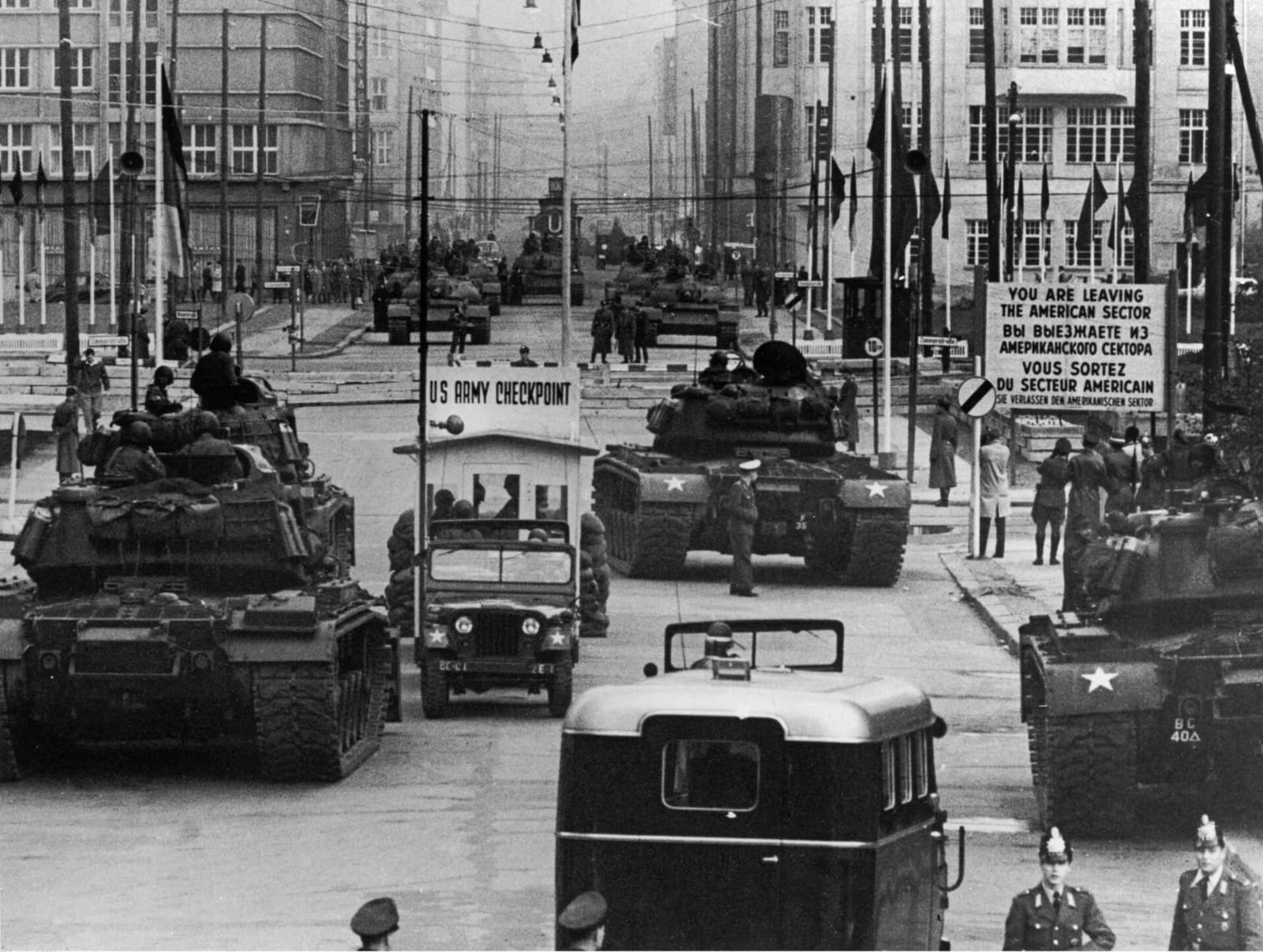
Image context: the lead image uses the Wikimedia Commons file of U.S. and Soviet tanks facing off at Checkpoint Charlie in October 1961. It fits this article because the speech's central logic was not abstract anti-communism. It was controlled insistence on rights of presence and access. By late October, those same rights had become a literal armored geometry in Berlin's streets.[6]
Historical context: from Vienna to television, then from television to the wall
Kennedy's speech came out of the failed effort to stabilize Berlin at Vienna. In the private June 4 conversation published in Foreign Relations of the United States, Kennedy stressed the difference between any future peace treaty and Western rights of access to Berlin, while Khrushchev warned that force would be met by force if those rights were challenged after a treaty with East Germany.[5] That exchange is important because it already contains the speech's central problem. The United States was not threatening to conquer new ground. It was trying to maintain legal and political claims inherited from 1945.
By 10 p.m. on July 25, 1961, Kennedy took that problem to national television.[4] The FRUS editorial note on the speech summarizes its structure clearly: after reviewing events since Vienna and emphasizing the Soviet threat to Berlin, Kennedy laid out six military steps and a set of civilian-defense measures.[4] The speech was therefore never only a rhetorical signal to Moscow. It was also an administrative briefing to the American public. Berlin would require money, manpower, and psychological preparation.
The timing proved grimly exact. Less than three weeks later, on August 13, 1961, East German authorities sealed the sector border with barbed wire and began building what became the Berlin Wall.[5] The wall did not end the crisis. It changed its visual form. In October 1961, a U.S.-Soviet tank standoff at Checkpoint Charlie made clear that access rights and symbolic credibility were still live, dangerous questions.[5][6] That later escalation is why the July 25 broadcast deserves renewed attention. The opening television explanation was one of the moments when Americans were taught how to understand the confrontation before its most iconic images had fully arrived.
Video provenance
The embed below is the official U.S. National Archives upload titled "President Kennedy Speaks about Soviet threats to Berlin." Its YouTube description identifies the material as part of the Records of the U.S. Information Agency and links the clip to National Archives Identifier 47362.[1][2] The description also notes an important limit: only the first two minutes are available for viewing.[1] That partial survival is part of the clip's value. What remains is not a polished retrospective documentary. It is the speech's opening act, preserved as institutional record.
Close reading: how the clip turns geography into obligation
The first thing to notice is that Kennedy opens by narrating procedure, not outrage. He recalls the Vienna meeting from "seven weeks ago tonight," then lists warnings, speeches, threats, and consultations.[3] The cadence is deliberate. A hot crisis is being translated into an orderly chain of causes. This matters because it gives the administration room to appear calm without seeming passive. The voice on screen is already preparing the audience for sacrifice, but it does so by sounding as though the situation has been measured.
The second thing to notice is the role of scale. Kennedy says the immediate threat is in West Berlin, but he refuses to leave it there.[3] The city is described as an isolated outpost and immediately recast as a worldwide test. That verbal move anticipates the policy logic that follows in the full speech: Berlin is not important only because of Berlin. It matters because retreat there would reverberate through NATO, through other contested regions, and through the credibility of U.S. commitments more broadly.[3][4]
Then comes the most revealing visual turn. In the transcript, Kennedy introduces a map and explains that West Berlin sits 110 miles behind the Iron Curtain.[3] The archival clip is valuable because it preserves this as televised instruction rather than as a sentence on paper. A map on television does political work. It compresses distance, exposes vulnerability, and transforms an enclave into a lesson. Kennedy is not asking viewers to admire a doctrine. He is teaching them why a small, encircled city can still generate military obligation.
That map sequence also clarifies the speech's legal grammar. Kennedy moves from geography to rights: Western presence in Berlin, he says, derives from Allied victory over Nazi Germany, and access across East Germany is bound up with those same postwar arrangements.[3] This is one reason the clip remains more useful than a generic anthology excerpt. It shows that the administration's case was not only ideological. It was juridical and spatial. The argument on television is that the United States did not wake up craving confrontation in central Europe; it was being challenged on rights it claimed were already established.
The opening two minutes also illuminate the later reserve and shelter sections in a new way. Without the map and the legal explanation, the rest of the speech might sound like overreaction or abstract Cold War signaling. With them, the later program becomes easier to read. Kennedy was not merely inflating rhetoric. He was building a ladder from television pedagogy to domestic mobilization. FRUS summarizes the second half as six military steps plus civilian-defense measures.[4] The opening clip is the hinge that makes those measures politically intelligible.
There is another reason this short fragment matters. The tone is almost anti-dramatic. Later memory of the Cold War can make every Berlin moment feel like the edge of apocalypse. Kennedy's manner here is cooler than that. He is trying to domesticate the crisis without trivializing it. The performance is neither casual nor theatrical. It is managerial, almost instructional. That style tells us something about liberal Cold War governance at the start of the 1960s. The state wanted citizens who could absorb prolonged tension as a condition of ordinary political life.
Why this archival fragment still matters
The speech did not stop the wall, and it did not dissolve the contest over Berlin.[5] In that sense it failed to produce the neat outcome a modern viewer may want from crisis rhetoric. Its historical significance lies elsewhere. It helped define the terms on which the United States would live with the crisis: no easy rollback, no surrender of access, and no promise that the confrontation would stay distant from domestic budgets and households.[3][4][5]
That is why the clip belongs in the archival spotlight mode. It catches a state teaching its citizens how to think spatially about power. Watch the fragment now and the most striking feature is not belligerence. It is explanation. Kennedy takes a city that many Americans would never see, places it on a map, links it to inherited rights, and then prepares the public for a world of reserves, shelters, and visible military resolve. In the months that followed, Berlin filled with barbed wire, concrete, and tanks.[5][6] The opening television lesson had already prepared the frame in which those images would be understood.
Sources
- U.S. National Archives, "President Kennedy Speaks about Soviet threats to Berlin," official YouTube upload from the Records of the U.S. Information Agency.
- National Archives Catalog, "President Kennedy Speaks about Soviet threats to Berlin" (National Archives Identifier 47362).
- Miller Center, "July 25, 1961: Report on the Berlin Crisis" - transcript of Kennedy's radio and television address.
- Office of the Historian, Foreign Relations of the United States, 1961-1963, Volume XIV, Berlin Crisis, 1961-1962, Document 81 - editorial note on Kennedy's July 25 address and its military and civilian-defense measures.
- Office of the Historian, "The Berlin Crisis, 1958-1961" - historical overview of Vienna, the July 1961 response, the August 13 wall, and the later tank standoff.
- Wikimedia Commons, "File:US Army tanks face off against Soviet tanks, Berlin 1961.jpg" - public-domain U.S. Army photograph used as this article's lead image.