The Great Mississippi Flood of 1927 is often compressed into a single image of runaway water, as if the event were simply the river proving it was stronger than its levees. That memory misses the part historians need most. The flood became historically decisive through sequence: months of saturation, a confidence structure built around levees, the Mounds Landing crevasse in late April, a relief system that sorted people by race and labor status, and then a federal redesign of the lower river.[1][2][3]
Seen that way, 1927 was not just a natural disaster followed by cleanup. It was an event in which hydraulic failure and social control moved together. Water crossed levees, but authority crossed lines too: local boards were overwhelmed, the Red Cross became the practical relief machine, Herbert Hoover became the national coordinator of a largely voluntary response, and Congress answered the catastrophe the next year with a far more expansive federal river project.[1][3][4]
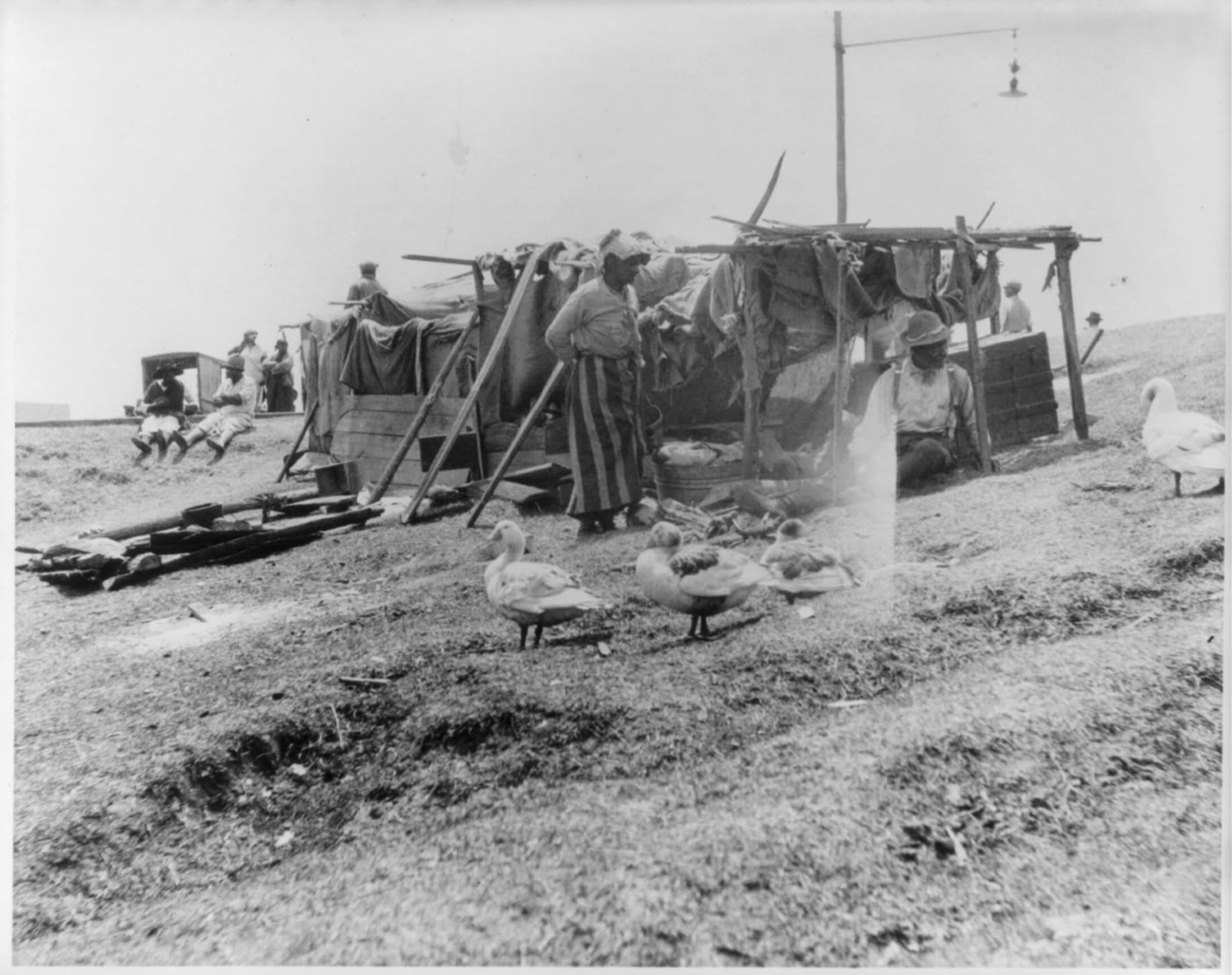
Image context: the cover photograph, made by the American Red Cross on the Greenville levee in 1927, matters because it shows where the disaster really lingered. The lower Mississippi story did not stop at a breached embankment. It continued in improvised living quarters, camp discipline, relief distribution, and the decision about who could leave, who had to stay, and who would rebuild the system afterward.[2][5]
Timeline anchors: when the river stopped being a local flood
- 15 April 1927: on Good Friday, the Memphis Commercial Appeal warned that the Mississippi was in its "mightiest rampage" even as the public was being reassured that the levee system would hold.[1]
- 22 April 1927: according to the Mississippi Encyclopedia, the levees broke just upriver from Greenville at Mounds Landing, opening a crevasse about half a mile wide and roughly one hundred feet deep.[1]
- Late April to May 1927: water spread across the Delta; near Vicksburg, the river system became nearly eighty miles wide, and communities far from the main channel were suddenly inside the disaster zone.[2]
- April to August 1927: Arkansas and other lower-river states stayed under flood pressure for months; Arkansas sources describe the Mississippi remaining at flood stage for a record 153 days.[3]
- 1928: Congress passed the Flood Control Act of 1928, replacing a narrower levee-centered approach with a more comprehensive lower-Mississippi control regime.[1][3]
Those markers show why the event should not be narrated as a one-day rupture. The decisive historical unit is larger: a basin-wide flood became a camp system, a relief test, and then a state-building moment.[1][3][4]
Before the break: a river system already running out of margin
The flood had a dramatic breach, but it did not begin with that breach. Arkansas and Mississippi accounts both stress accumulation before collapse. Heavy rains in the upper Midwest had already loaded the river, and then the lower basin was hit again. The Encyclopedia of Arkansas describes April 1927 as a month of record rainfall in Arkansas, with the ground saturated, tributaries full, and backflow running into rivers that ordinarily drained away from the Mississippi.[3] The Mississippi Encyclopedia records the public mood on 15 April: fear was visible, yet the Army Corps of Engineers still projected confidence that the levees confining the river would stand.[1]
That tension matters because the old lower-Mississippi policy was not simple negligence. It was a theory. The river would be trained, narrowed, and disciplined chiefly through embankments. In that frame, the levee was not only a structure but a promise: if enough earth stood between the river and the Delta, settlement and agriculture could keep expanding on the protected side.[1][3] The importance of 1927 is that the river did not merely overtop a local weak point. It discredited the idea that levees alone could carry the whole burden of control.
What Mounds Landing changed
The break at Mounds Landing turned danger into catastrophe because it converted height into lateral reach. The Mississippi Encyclopedia dates the decisive Greenville-area crevasse to 22 April 1927 and describes it as roughly half a mile wide.[1] The National Park Service gives the consequence in spatial terms: after the levee failed, floodwater reached towns nearly sixty miles from the river, and near Vicksburg the water field extended almost eighty miles wide, all the way toward Monroe, Louisiana.[2]
That is the moment to hold in view. A river crisis became an inland sea. Houses, rail lines, plantations, town centers, and roads were no longer dealing with a swollen bank; they were dealing with a new temporary geography.[2][3] The flood stopped being "the river is high" and became "the map is different."
This is also why the usual before-and-after phrasing can mislead. The crevasse did not mark the end of one event and the beginning of recovery. It created a different operational phase altogether. Once water spread that far, relief ceased to be a matter of repairing a line. It became a matter of feeding, housing, transporting, policing, and medically supporting very large numbers of displaced people for an uncertain duration.[3][4]
Why the flood's real historical site was the refugee camp
The most important correction to popular memory is social rather than hydraulic. The flood is often pictured as a force of nature that struck everyone alike. The records used by the National Park Service, the Mississippi Encyclopedia, and the Encyclopedia of Arkansas describe something more structured. Camps were segregated. Conditions varied sharply. Food distribution and work obligations were unequal. In many places planters and local white authorities tried to keep Black labor tied to the land even after the water had made ordinary life impossible.[1][2][3]
The National Park Service summary for Vicksburg states the point plainly: segregated refugee camps were created, many were marked by forced unpaid labor and unequal food distribution, and the aftermath accelerated the Great Migration as thousands of African American families left the South permanently.[2] The Mississippi Encyclopedia adds scale, estimating that perhaps 330,000 Black flood victims became refugees and that 154 relief camps operated across the affected region, with camp residents pressed into levee work.[1] The Encyclopedia of Arkansas sharpens the mechanism further: in some Arkansas camps, planters supervised entry and release, sharecroppers needed passes, and some Black laborers were forced at gunpoint to continue work on threatened levees.[3]
That is why the Greenville levee photograph works as more than an atmospheric header. It is evidence of where flood history continued after the water spread. Families were not simply waiting for dry land. They were being organized inside an emergency order that reproduced existing hierarchies while pretending to suspend them.[2][5]
The relief apparatus itself was also revealing. John M. Barry's Gilder Lehrman essay notes that the Red Cross fed more than 600,000 people, some for a year, while more than 300,000 lived as refugees in tent cities.[4] Barry also emphasizes that this relief was funded privately; direct federal spending for food, clothing, and shelter did not carry the response.[4] That split between national attention and limited federal welfare is essential to the event reconstruction. The flood made the nation look south, but it did not yet make Washington act as a modern social state.
How the disaster became a federal river project
Yet 1927 did produce a stronger federal state, just not first in the form of direct aid. It produced one through engineering, planning, and command over the river itself. The Mississippi Encyclopedia and Arkansas reference works both treat the Flood Control Act of 1928 as the decisive aftermath.[1][3] After 1927, the lower Mississippi was no longer to be managed through a levee-only confidence story. Floodways, locks, dams, and runoff channels entered the core design logic.[1] The disaster, in other words, forced federal acceptance that some water had to be staged, diverted, and spatially managed rather than imagined away behind ever-higher banks.[1][4]
Barry makes the same point retrospectively when he notes that later lower-river floodways allowed vast areas to go under water by design rather than by surprise.[4] That does not mean 1927 solved the river. It means the catastrophe reset the terms of the argument. Before the flood, the river problem was often phrased as whether the embankments could be made high enough. After the flood, the river problem had to be phrased as a system question: where could pressure be dispersed, who controlled the decision, and what scale of federal responsibility was now unavoidable?[1][3][4]
Herbert Hoover's role belongs in this section too. Arkansas and Mississippi reference works both note that the flood raised his national profile because he was assigned to coordinate local and voluntary relief operations.[1][3] He did not create a welfare state out of the disaster, but he did become the public face of energetic national management. That political gain mattered. The flood helped demonstrate that disaster coordination could manufacture national leadership even when direct federal relief remained limited.[3][4]
Why 1927 still reads as more than a flood story
Read as an event reconstruction, the Great Mississippi Flood is not only a story about water beating earthworks. It is a story about how a hydraulic emergency became a social sorting machine and then an engineering settlement. The Mounds Landing crevasse matters because it broke the spatial fiction that the river could be kept in one place by levees alone.[1][2] The camps matter because they show that disaster governance followed the grain of race, labor, and property rather than replacing it with neutral relief.[1][2][3] The 1928 act matters because it converted those lessons into permanent federal authority over the lower river.[1][3]
That is the sequence worth remembering. First came saturation, then the breach, then displacement, then camp management, and only after that the redesigned river. Once the flood is arranged in that order, 1927 stops looking like a spectacular interruption and starts looking like one of the moments when the United States rebuilt a whole piece of state capacity under pressure.
Sources
- Mississippi Encyclopedia, "Mississippi River Flood, 1927" (Good Friday warning, Mounds Landing crevasse, camp scale, and the 1928 federal redesign).
- National Park Service, "Mississippi River Flooding" (Vicksburg crest, Mounds Landing consequences, segregated camps, and migration aftereffects).
- Encyclopedia of Arkansas, "Flood of 1927" (record April rainfall, Arkansas camp controls, 153-day flood stage, and Hoover-led relief politics).
- Gilder Lehrman Institute of American History, John M. Barry, "The Great 1927 Mississippi River Flood" (Red Cross relief scale, private funding, and the policy shift toward floodways).
- Library of Congress, "(Mississippi River flood)" (American Red Cross photograph of refugees living on the Greenville levee, used as the article image).