On 10 December 1948, the United Nations General Assembly adopted the Universal Declaration of Human Rights as Resolution 217 A (III) by a vote of 48 in favor, none against, and 8 abstentions.[5] The document is often remembered as a noble poster or an opening chapter in later treaty law. Read closely, it is sharper than that. The Declaration is a postwar operating text built to answer three linked questions at once: who counts as a bearer of rights, what kind of life human dignity requires, and how far state sovereignty can go before it ceases to be an excuse and becomes part of the problem.[1][2][3]
That architecture is visible in the order of the text itself.[1] The preamble begins with war, barbarism, fear, want, and the risk of rebellion against tyranny. The early articles establish universal personhood, equality, remedy, due process, movement, conscience, speech, and political participation. The middle articles then widen the field into social security, work, rest, education, culture, and material welfare. The final articles turn toward order, duties, limits, and an explicit prohibition on using the Declaration to cancel the rights it has just announced.[1][4] The result is not a loose anthology of good values. It is a deliberate argument about what a decent post-1945 world would have to protect.
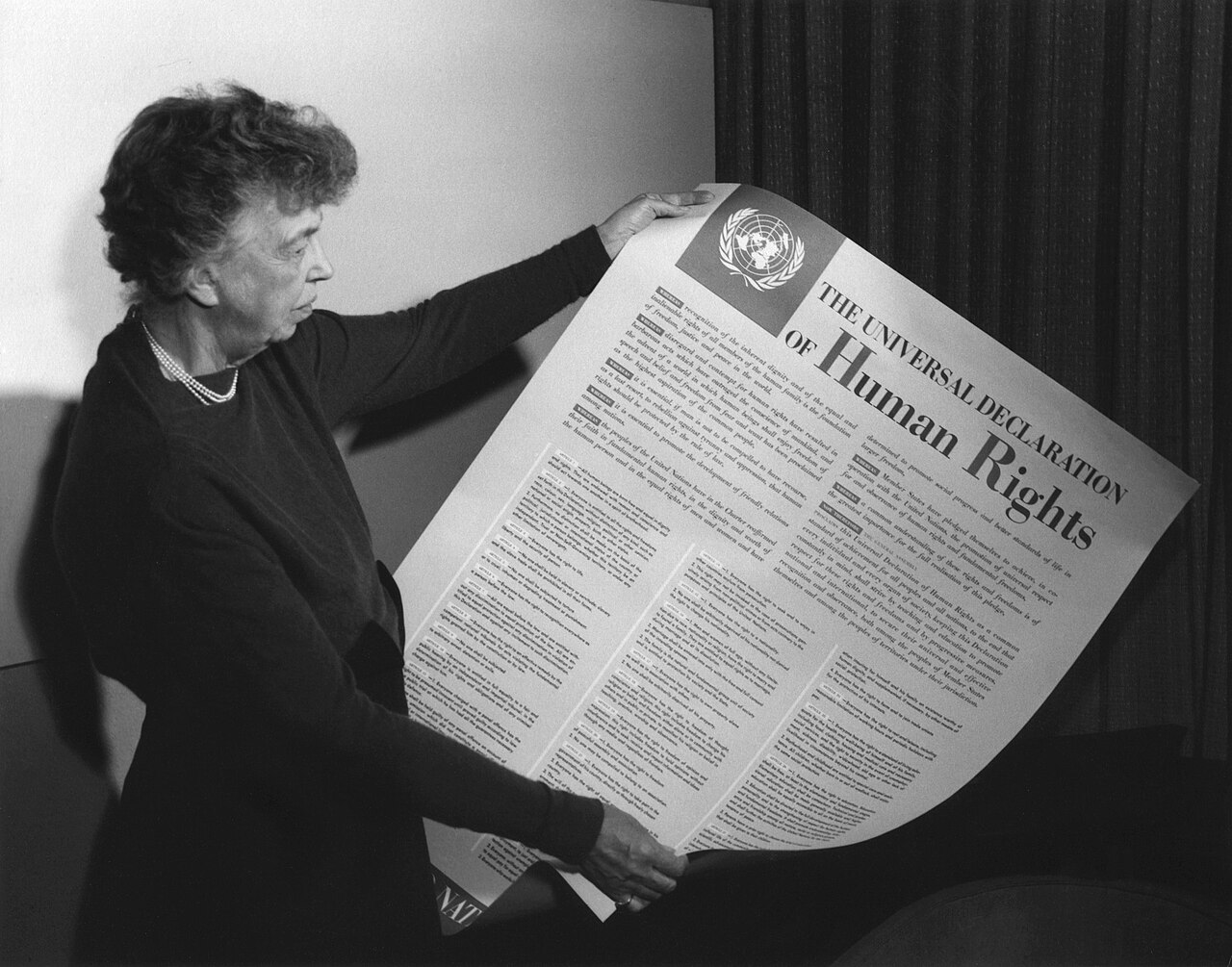
Image context: the cover uses the November 1949 photograph of Eleanor Roosevelt holding an English-language poster of the Declaration at Lake Success, New York.[6] The image works because this article is about portability. The UDHR mattered not as a private draft or one more diplomatic communiqué, but as a text that could be displayed, translated, taught, and invoked across jurisdictions.
Timeline anchors
- 1946: the General Assembly reviewed a proposed declaration of fundamental rights and sent the matter into the UN human-rights drafting process.[2]
- Early 1947: the Commission on Human Rights authorized work on a preliminary draft of what it called an International Bill of Human Rights.[2]
- 10 December 1948: the General Assembly adopted the UDHR in Paris as Resolution 217 A (III) by 48-0-8.[5]
- November 1949: Eleanor Roosevelt was photographed publicly holding the Declaration poster at Lake Success, a reminder that the document was meant for civic circulation as much as diplomatic record.[6]
- 1976: the International Covenant on Civil and Political Rights and the International Covenant on Economic, Social and Cultural Rights entered into force, elaborating many rights first gathered together in the 1948 Declaration.[4]
These dates matter because the UDHR did not appear as timeless wisdom. It moved through draft, argument, adoption, display, and later legal elaboration.[2][4][5]
1. The preamble makes human rights a response to barbarism, rebellion, and failed political order
The first useful move in a close reading is to stay with the preamble longer than most summaries do.[1] It does not begin with a serene theory of natural liberty. It begins with the wreckage of the recent past. The text says contempt for human rights produced barbarous acts that outraged the conscience of humankind, and it frames the desired future as one in which people may live with freedom of speech and belief as well as freedom from fear and want.[1] That four-part opening already tells the reader something crucial: the Declaration is trying to answer fascism, war, terror, and mass deprivation together, not one at a time.
The next turn is even harder-edged.[1] The preamble says that if people are not to be driven, as a last resort, to rebellion against tyranny and oppression, then human rights must be protected by the rule of law. This is not decorative language. It means rights are being justified not only as moral goods but as conditions of political survival. A world that leaves dignity unprotected does not merely become unjust; it becomes unstable.
That matters for the sovereignty question. The preamble links rights to the UN Charter, to cooperation among member states, and to "progressive measures, national and international" for securing recognition and observance.[1] Inference begins here. The Declaration does not abolish states, and it does not pretend institutions can be bypassed. But it refuses the older assumption that a state's internal treatment of persons is fully sealed from international judgment.[1][2] The postwar lesson, as the document writes it, is that sovereignty without a rights floor is too dangerous to leave morally self-policing.
2. Articles 1-2 define personhood more broadly than a national bill of rights usually does
The Declaration's second major move is visible in the opening articles.[1] Article 1 states that all human beings are born free and equal in dignity and rights. Article 2 then bars distinctions not only of race, sex, language, religion, political opinion, property, birth, or status, but also distinctions based on the political or international status of the country or territory to which a person belongs, whether independent, trust, non-self-governing, or otherwise limited in sovereignty.[1]
That wording is more expansive than it can look at first glance. The bearer of rights here is not a citizen of one protected nation. It is the human being as such, including people living under dependent, occupied, or otherwise constrained political arrangements.[1] The text therefore tries to make personhood travel. A government cannot easily answer the Declaration by saying that the wrong kind of territory, subjecthood, or constitutional status lies outside the moral perimeter.
The drafting history makes this universality feel less automatic and more worked for. The UN's own history page credits Hansa Mehta of India with helping change the opening formulation from "all men" to "all human beings" in Article 1.[2] That detail matters because it shows how the document's universalism was fought over at the level of single words. It was not enough to assume masculine language would stretch by implication. The drafters had to make the category explicit.[2]
The effect runs beyond symbolism. Article 6 says everyone has the right to recognition everywhere as a person before the law, and Article 7 adds equal protection against discrimination.[1] Together, those provisions turn abstract dignity into a claim about legal visibility. A person must count in law before any other listed freedom can become durable.
3. Articles 22-26 insist that dignity has a material and social side
This is the part of the Declaration that modern readers often underread. Many people remember the UDHR as a catalogue of anti-state liberties: no arbitrary arrest, freedom of expression, fair trials, religious liberty. Those rights are there.[1] But the document does not stop at the point where police power ends. Article 22 says everyone, as a member of society, has the right to social security and to the realization of the economic, social, and cultural rights indispensable for dignity and the free development of personality, through national effort and international cooperation and in line with each state's organization and resources.[1]
That sentence is one of the text's most revealing compromises. It does not promise identical welfare regimes everywhere. The clause about organization and resources leaves room for uneven capacity and different institutional forms.[1] Yet the article still says dignity is not exhausted by courtroom procedure and noninterference. Human flourishing also depends on social provision.
The next articles make the point impossible to miss. Article 23 includes work, fair conditions, protection against unemployment, equal pay for equal work, just remuneration, and the right to form trade unions. Article 24 adds rest and leisure. Article 25 reaches food, clothing, housing, medical care, social services, and security in unemployment, sickness, disability, widowhood, old age, and loss of livelihood. Article 26 makes elementary education free and compulsory and treats education as a tool for the full development of the human personality and for respect across nations and groups.[1]
The drafting context helps explain why these articles survived the process. A UN Chronicle essay on Eleanor Roosevelt's role says she had to push a reluctant U.S. State Department to accept a definition of human rights that included social, economic, and cultural rights rather than only civil and political ones.[3] That matters because it reveals the Declaration's middle section as intentional, not leftover padding. The document was built to say that postwar freedom had to include bread, work, school, and social protection alongside speech, conscience, and the vote.[1][3]
4. Articles 28-30 give the Declaration its hard institutional edge
The closing articles are where the text stops sounding like a list and starts sounding like a constitutional warning.[1] Article 28 says everyone is entitled to a social and international order in which the rights in the Declaration can be fully realized. Article 29 says everyone has duties to the community and permits legal limitations only for respecting the rights of others and meeting the just requirements of morality, public order, and general welfare in a democratic society. Article 30 then closes the trapdoor: nothing in the Declaration may be interpreted as giving any state, group, or person a right to destroy the listed rights and freedoms.[1]
That sequence matters. Rights need institutions, order, and reciprocal limits, yet the language also anticipates the classic danger that "order" will become the excuse for emptying the Declaration out. The text therefore allows structure while refusing self-cancellation. States remain central actors, but they are denied the final interpretive privilege of saying that security, ideology, or collective purpose dissolves the rights floor altogether.[1]
This closing architecture also helps explain the Declaration's afterlife. The UN's foundation page describes the UDHR as the basis of a large later body of human-rights law, including the two 1966 Covenants that entered into force in 1976 and together with the Declaration form the International Bill of Human Rights.[4] The bridge character of the 1948 text is the point. It was not yet a treaty, but it was built in a way that could be carried forward into treaty form.
That is why the UDHR still reads with unusual force. It turns the memory of wartime barbarism into a legal and political problem, expands the rights-bearing subject beyond sex and sovereign status, treats dignity as materially social rather than merely procedural, and ends by warning that no state, faction, or individual may invoke public order as a license to erase the text's own commitments.[1][2][3][4] Read that way, the Declaration stops looking like a poster that later lawyers happened to admire. It becomes a compact postwar answer to the question of how human beings were supposed to count after 1945.
Sources
- Office of the High Commissioner for Human Rights, Universal Declaration of Human Rights (official text PDF).
- United Nations, History of the Declaration (drafting sequence and the Hansa Mehta wording change in Article 1).
- United Nations, Compelled to Act: Eleanor Roosevelt, a Fearful World and an International Vision of Human Rights (on Roosevelt's role in keeping social, economic, and cultural rights inside the project).
- United Nations, The Foundation of International Human Rights Law (the Declaration's role in later treaties and the International Bill of Human Rights).
- United Nations Dag Hammarskjold Library, Universal Declaration of Human Rights - UN Human Rights Documentation (adoption record, resolution number, and 48-0-8 vote summary).
- Wikimedia Commons, File:Eleanor Roosevelt UDHR.jpg (FDR Presidential Library & Museum source page for the November 1949 photograph used here).
Editor’s Pick Review
This pick wins the add-on slot because it gives a primary-source article real architecture. Instead of treating the Universal Declaration as a commemorative object, it follows the document’s sequence: the preamble’s answer to barbarism and rebellion, Articles 1-2’s portable personhood, Articles 22-26’s social thickness, and Articles 28-30’s institutional hard edge. The result is conceptually dense but readable, with source links, dates, vote counts, treaty afterlife, and drafting details all carrying the argument rather than decorating it.
The image policy score is strong as well. Eleanor Roosevelt holding the UDHR poster is an immersive, topic-specific archival photograph that visualizes the article’s core claim about portability, public circulation, and postwar legal imagination; it avoids diagrams, abstract symbolism, and generated imagery entirely. The Chinese translation keeps the close-reading structure intact while sounding like composed Chinese historical prose, including clear handling of legal-political terms and a coherent paragraph rhythm.