The Bracero Program is often remembered through the field rather than the gate: men bent over lettuce or cotton, wartime labor shortages, and the long afterlife of seasonal migration between Mexico and the United States.[1][2] That memory is incomplete. The program became historically powerful because it was not just a promise that Mexican workers could cross north for temporary jobs. It was a routing system. Governments, growers, and labor officials built a repeatable chain that started with bilateral recruitment, moved through reception centers and transport, and ended with workers assigned to employers who had already been certified as short of labor.[1][3]
That chain explains why the program survived far beyond its emergency birth in 1942.[1][2] A temporary labor agreement can disappear once the crisis that justified it fades. An administrative machine is harder to unwind. Once growers learned to rely on predictable contract labor, and once the two governments had procedures for recruiting, screening, moving, and assigning workers, the program acquired an institutional momentum of its own.[1][2][3] The point is not that shortage rhetoric was fake. The point is that shortage alone does not explain a system that issued 4.6 million contracts between 1942 and 1964 and became the largest contract labor program in U.S. history.[1][2]
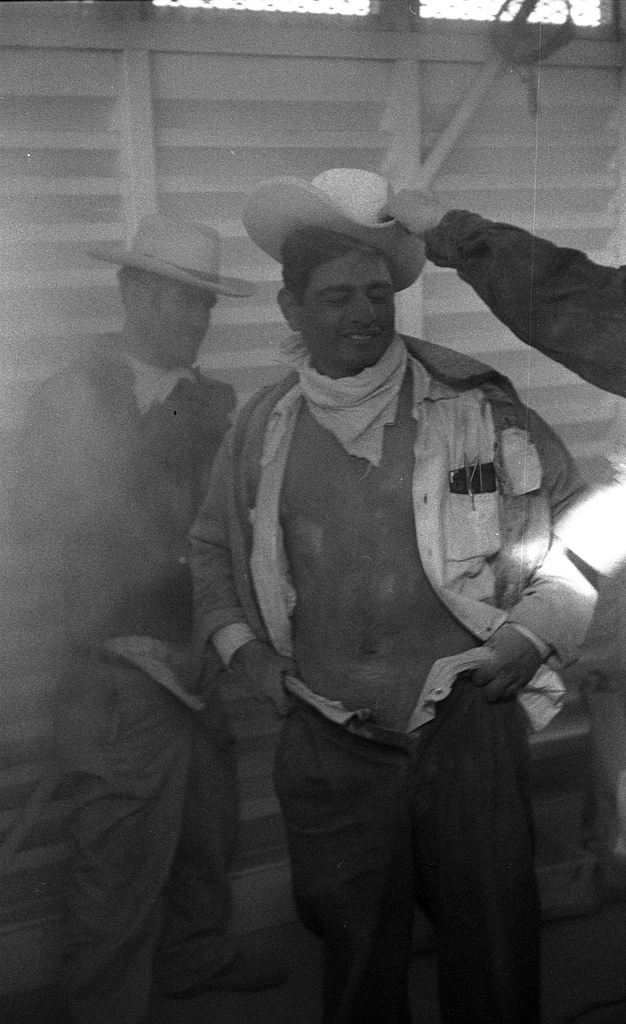
The cover image catches the mechanism at exactly the right place.[5][6] It does not show a harvest. It shows a worker at the El Centro, California immigration station in 1958, inside the processing regime that sorted bodies before they ever reached the fields.[6] The Bracero Program promised labor to growers, but it delivered that labor through inspection, questioning, transport, and containment.[3][5][6]
Timeline anchors
- August 4, 1942: the United States and Mexico conclude the temporary intergovernmental agreement for Mexican farm labor on U.S. farms after wartime labor-shortage arguments intensify.[1][4]
- 1942-1947: the emergency wartime farm-labor phase expands through the war years and becomes more embedded in agricultural planning.[1][2]
- 1951: Congress formalizes the program with Public Law 78, extending and regularizing what had begun as an emergency arrangement.[1]
- Mid-1950s: the Department of Labor is transporting workers recruited by the Mexican government to U.S. reception centers and assigning them to growers certified as having labor shortages.[3]
- 1956: the Rio Vista Bracero Reception Center in Texas processes about 85,000 braceros in one year, showing the scale of the reception-center infrastructure.[7]
- 1958: the Library of Congress image record captures fumigation and related processing at El Centro, California.[5][6]
- 1964: the program ends after lasting well beyond World War II and the immediate emergency that first justified it.[2][4]
These dates matter because they show a sequence larger than one wartime fix. The program began as an answer to labor scarcity, hardened into an administrative routine, and ended only after two decades of dependence, criticism, and political pressure.[1][2][3][4]
1. Wartime shortage created demand, but bilateral control shaped supply
The first mechanism was not migration by itself. It was state-managed recruitment. The Smithsonian historical guide says the program was created in 1942 because many growers argued that World War II would produce labor shortages in low-paying agricultural jobs.[1] The Library of Congress classroom essay gives the same immediate setting in plainer language: wartime industries absorbed U.S. workers, farmers wanted labor, and the two governments jointly created the bracero program in response.[4]
What matters is the form of that response. The labor did not arrive through an open, unsupervised flow. The program depended on bilateral agreements between states.[1] That gave both governments leverage over the route. The Library of Congress notes, for example, that treatment in Texas became so poor that the Mexican government refused for a period to send workers there.[4] That detail is small, but it reveals the real structure. Supply was not purely a market outcome. It was channeled through a negotiated state corridor that could be widened, narrowed, or redirected.
This is the first reason the program became durable. Growers were not just asking for workers. They were asking for workers delivered through a system that filtered, scheduled, and recognized them as contract labor. That is a much more usable thing for employers than uncertain seasonal migration alone.[1][3][4]
2. The agreement turned labor into a standardized contract package
The second mechanism was contractual standardization. The same Smithsonian guide is especially useful here because it lists the safeguards that existed on paper: at least the prevailing local wage, employment for three-fourths of the contract period, free and sanitary housing, meals at reasonable prices, employer-paid occupational insurance, and transportation back to Mexico at the end of the contract.[1] Employers were supposed to hire braceros only in areas of certified domestic labor shortage and were not supposed to use them as strikebreakers.[1]
Those details show what the system was trying to do administratively. The program was not written as a casual invitation to cross the border and look for work. It bundled wage terms, housing rules, transport, and duration into a preassembled labor product. That bundle made the worker legible to the state and legible to the grower at the same time.[1][3] A farmer did not need to negotiate an entirely new labor relationship every harvest. The state had already designed a standard contract form and a standard intake route.
This also helps explain the program's longevity after the war. Once the machinery of contract labor exists, it begins to solve organizational problems for employers even when the original emergency has weakened. The 1951 passage of Public Law 78, as the Smithsonian guide notes, did not invent the system. It formalized a route that had already proved useful enough to preserve.[1]
3. Reception centers made the labor supply movable, sortable, and dependable
The third mechanism was the reception-center infrastructure itself. The Department of Labor history is unusually direct on this point: workers recruited by the Mexican government were transported by the Department to American reception centers, and there they were hired by growers who had been certified as suffering from labor shortage.[3] That is the program's operating sentence. It describes a labor market that has already been partially converted into logistics.
The Library of Congress summary of the Bracero photo set makes the same point from below. The sequence it describes is telling: workers say goodbye at home, travel north by bus and train, undergo medical exams, questioning, fumigation, and shots at the immigration processing center in El Centro, then move on to camp life and field labor.[5] The program's historical force sits precisely in that sequence. Between departure and harvest, a whole apparatus intervened to classify the worker, discipline the route, and hand over labor in a managed way.[3][5]
The Rio Vista Bracero Reception Center record at the Library of Congress shows how large that apparatus became. Its documentation describes dormitories, a kitchen and mess hall, a recreation hall, shower facilities, health-screening buildings, and other support structures, all tied to the processing of braceros for U.S. agriculture.[7] At its peak in 1956, Rio Vista processed about 85,000 workers in a single year.[7] At that scale, the Bracero Program stops looking like a loose labor arrangement and starts looking like infrastructure.
4. Weak enforcement made the machine cheap enough to keep
The final mechanism was the gap between rules on paper and enforcement on the ground. The Smithsonian guide is blunt: many of the program's protections were ignored in practice, while growers benefited from plentiful, cheap labor.[1] The Library of Congress classroom essay reaches the same conclusion from a different angle, noting that braceros were generally paid very low wages and often worked under conditions many U.S. citizens would not accept.[4]
That enforcement gap matters more than it may first appear. If the guarantees had been fully enforced every time, the program would still have delivered workers, but at a higher political and economic cost. The fact that the Department of Labor later had to improve wage determinations, reception-center facilities, and housing standards shows that criticism of the program was not incidental; it was built into the system's operation.[3] The route worked for growers partly because the state solved the recruiting and transport problem while leaving too much of the dignity-and-protection problem weakly policed.[1][3][4]
This is also why the program outlived the precise emergency that had created it. Once a labor system becomes both dependable and relatively cheap for employers, the original war rationale no longer has to do all the work. Administrative convenience and agricultural dependence take over.[1][2][3]
Why the program lasted
The Bracero Program endured because it converted a political claim about shortage into a governed labor corridor.[1][3][4] The bilateral agreements brought the two states into the same apparatus. Standard contracts defined what a bracero was supposed to receive. Reception centers turned recruitment into sorting and transfer. Grower certification translated local labor demand into a federal assignment process. Weak enforcement kept the whole thing attractive to employers even as criticism mounted.[1][2][3][4][7]
That is the sharper historical reading. The Bracero Program was not just Mexican migration during the war, and it was not just a story of farm labor in the abstract. It was a machine for routing people into seasonal work under conditions that were regulated enough to be legible and weakly enforced enough to remain profitable. That combination is why it lasted from 1942 to 1964.[1][2][3][4]
Sources
- National Museum of American History, The Bracero Program: A Historical Investigation - on the 1942 wartime origin, the 4.6 million contracts, Public Law 78, the program's paper safeguards, and the enforcement gap that favored growers.
- U.S. National Park Service, "A New Era of Farmworker Organizing" - on the program's original wartime purpose, its repeated extensions beyond World War II, the criticism it attracted, and its 1964 end.
- U.S. Department of Labor, "Chapter 5: Eisenhower Administration 1953-1961" - on the Department transporting workers recruited by the Mexican government to U.S. reception centers, grower shortage certification, and later efforts to improve wage determinations, housing, and facilities.
- Library of Congress, "Expansion and Expulsion" - on wartime labor shortages, the joint U.S.-Mexico creation of the program, poor treatment and low wages, and Mexico's refusal for a period to send workers to Texas.
- Library of Congress Prints & Photographs Online Catalog, "Bracero" - summary of the 1958 Earl Theisen photo set showing travel to California, medical exams, questioning, fumigation, shots, camp life, and field labor.
- Library of Congress Prints & Photographs Online Catalog, "(Image from LOOK - Job 58-4316 titled Bracero)" - source page for the 1958 El Centro processing photograph used as this article's cover image.
- Library of Congress Prints & Photographs Online Catalog, "Rio Vista Bracero Reception Center, 901 North Rio Vista Road, Socorro, El Paso County, TX" - on the preserved reception-center complex, its health-screening and dormitory infrastructure, and its 1956 processing scale.