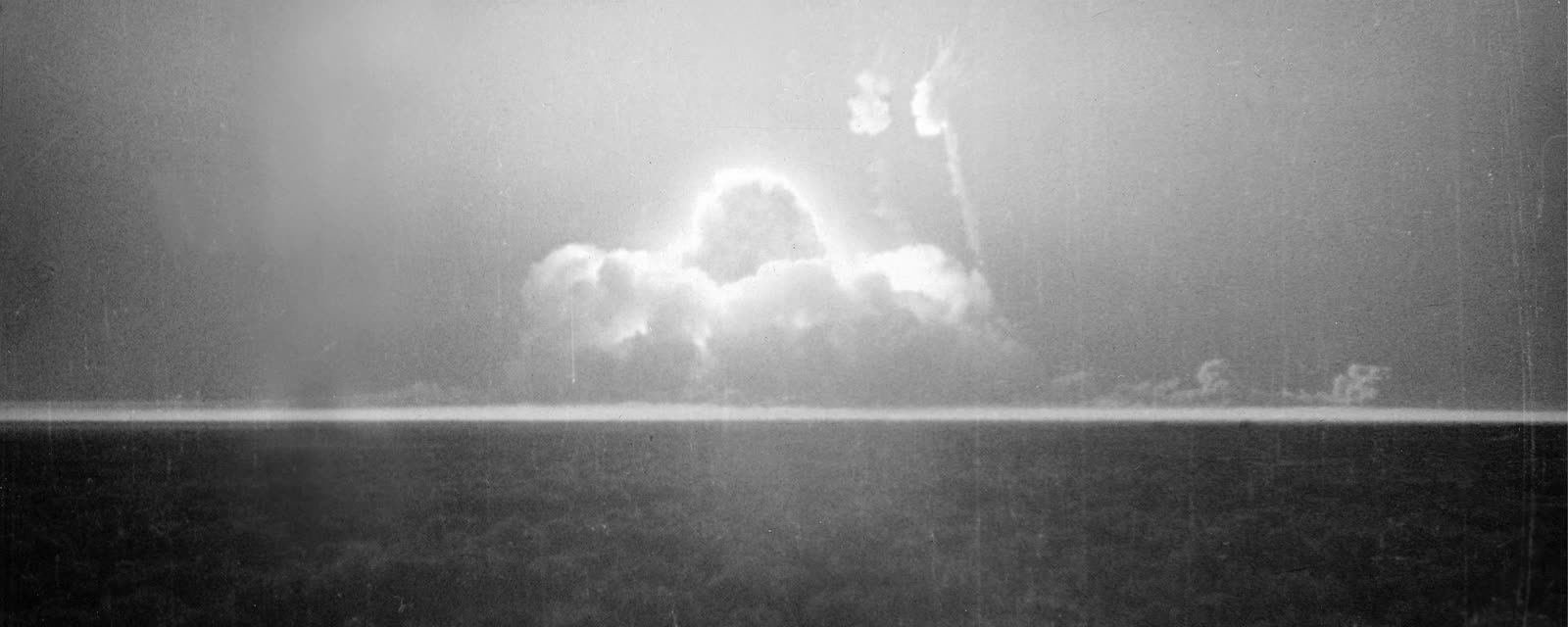

The Trinity test at 5:30 a.m. on 16 July 1945 is often remembered backward.[2][3][5] Public memory starts with the giant mushroom cloud and works its way down toward the tower, the instrumentation, the countdown shelters, and the problem that Manhattan Project scientists were actually trying to solve. The archival footage below helps reverse that order. It does not present Trinity as a ready-made icon of the nuclear age. It presents a watched experiment in the Jornada del Muerto desert: one device, one steel tower, one burst of light so intense that the camera temporarily loses the shape of what it is recording.[1][2][5]
That distinction matters because Trinity was not designed as a theatrical public event. It was a proof shot for the plutonium implosion device nicknamed "Gadget," assembled near the McDonald ranch house and hoisted to the top of a 100-foot firing tower before dawn.[2][5] The official OSTI history page and the National Park Service both emphasize the same basic sequence. Years of research converged on one remote New Mexico range; the device detonated just after dawn; the explosion exceeded some expectations; and the blast marked the beginning of the atomic age in the language of the institutions that later preserved the site.[2][3] Yet the archival clip adds something institutional summaries cannot. It restores contingency. Before there was doctrine, there was uncertainty about yield, weather, timing, and whether the implosion design would work as intended.[2][5]
The clip also matters because the Trinity story should not be sealed inside the frame of technical success. The National Park Service's Trinity and Downwinders pages place a necessary boundary around celebratory memory: the explosion exposed nearby and downwind communities to dangerous radiation, and fallout reached Native American communities, farmers, and livestock over hundreds of miles.[3][4] That is why the footage remains historically alive. It records the instant a scientific and military threshold was crossed, but it also points toward an aftermath that the camera cannot itself contain.
Image context: the cover image uses the Los Alamos archival photograph reproduced on the National Park Service's Trinity page. It fits this essay because it holds the blast inside an actual landscape rather than inside later poster-like mushroom-cloud shorthand. The low horizon and overexposed center keep attention on the event as a desert test with local witnesses, not a free-floating symbol.[3]
The embedded video is AtomicHeritage's 2016 upload "Trinity Test (Additional Footage)," posted with credit to the Los Alamos National Laboratory Archives.[1] That provenance is exactly what an archival spotlight needs. This is not a modern explainer assembled after the fact. It is preservation footage of the detonation itself, presented with enough historical distance that a viewer can study the visual problem of Trinity: how a test designed in secrecy became legible through a camera that could register brightness, dust, and motion, but not the full human meaning of what it had captured.[1][2]
Historical context: Trinity was a proof shot built out of tower height, timing discipline, and uncertainty
The Manhattan Project did not arrive at Trinity because it wanted one dramatic sunrise in the desert. It arrived there because the implosion design for a plutonium weapon had to be tested under controlled conditions before the United States committed it to war.[2][5] The OSTI history page is useful on the operational sequence: by 5:00 p.m. on 15 July, the assembled Gadget had been hoisted onto the 100-foot firing tower, and observers were distributed among shelters and distant vantage points before the pre-dawn countdown.[2] The Nuclear Museum history page fills in the engineering logic. Gadget was a plutonium implosion device, closer in principle to the later Nagasaki bomb than to the gun-type uranium bomb used on Hiroshima, and Trinity was the moment when that more complex design had to prove that compression, timing, and detonation geometry would hold.[5]
The site itself was part of the argument. The Jornada del Muerto desert south of Los Alamos was chosen for isolation, flat terrain, and the practical need to conduct a dangerous experiment away from dense population centers.[2][5] Even so, the event was never as self-contained as the phrase "remote test site" can make it sound. The National Park Service notes that the flash and cloud were visible more than 280 miles away.[3] Distance lowered immediate witness density; it did not create a sealed chamber. Trinity was remote in military planning terms, not in environmental consequence.
That is one reason the tower matters so much. Later visual memory prefers the cloud because the cloud became the reusable sign of atomic power. The tower belonged to the test phase. It measured the event against human construction. Once the blast erased it, the camera ceased to show a device mounted for experiment and began showing a force that had already outrun its scaffolding. In that sense, the tower is the hidden protagonist of Trinity history. The entire setup existed so the bomb could be raised into the open, instrumented, and compared against predictions. The flash destroyed the very object that had made those comparisons possible.[2][5]
What the footage shows that text alone cannot: a horizon line, a swallowed tower, and shock arriving after light
The archival clip is only a few seconds long, but its visual order is historically revealing.[1] At first the eye receives a blanking flash and an expanding white core near the horizon. The tower is not dramatically toppled or gradually consumed. It is simply gone into brightness. Then the image begins to differentiate itself: a low, broad fireball, a thickening cloud mass, and a dust skirt spreading outward close to the ground. The shot is so stripped down that the desert horizon becomes the viewer's only stable reference. That simplicity is what makes the footage powerful. It does not offer a patriotic frame, a narrator, or a sequence of reaction shots. It offers one line of land and one event that immediately exceeds the scale of ordinary objects.[1]
The clip also teaches timing in a way prose summaries cannot. Light arrives first. The blast wave is a later physical fact. On the OSTI page, eyewitness language and the official chronology already imply that sequence: the detonation comes first, then the huge blast wave, then the felt bodily experience of a force that travels out from the tower.[2] In the footage, that order becomes intuitive. The viewer sees luminosity before the event can be measured as pressure. Trinity therefore appears not as an abstract number of kilotons but as a problem in delayed comprehension. Vision announces the event before the body can fully catch up.
The broad horizon in the footage adds another historical truth. Trinity was not visually impressive because the frame is crowded with machines. It is impressive because there is so little there besides the blast. The New Mexico range looks almost empty, which throws more weight onto the fact that the cloud still seems to occupy the whole scene.[1][3] That emptiness is deceptive. The test depended on years of laboratory work, road-building, instrumentation, security, logistics, and last-minute weather judgment.[2][5] The image seems simple because the complexity has been pushed offscreen.
Close reading: the cloud rises like an experiment still arguing with itself
One of the most striking things about the footage is how un-finished the explosion looks.[1] Later nuclear iconography often presents the mushroom cloud as a clean emblem: stem, cap, domination. The Trinity clip is rougher. Its first visible shapes are lumpy, low, and unstable. The fireball swells unevenly; the base remains dense and dirty; the larger cloud form gathers itself only after the initial overexposure has started to settle. That roughness matters because it keeps the viewer close to the status of the event on 16 July 1945. This was not yet an established genre of image. It was a test whose visual language had not been standardized by repetition.
The camera's limitations become part of the document. Brightness bleaches detail, and the tonal range struggles to hold both the incandescent center and the dark ground plane in one coherent register.[1] Instead of reducing the footage's value, that failure sharpens it. Trinity becomes visible here as an event that pushed recording technology toward saturation. The archive does not preserve a perfect picture of the detonation. It preserves a machine trying to keep up with a blast that was brighter, larger, and more sudden than any ordinary industrial image.
The Nuclear Museum account helps explain why the roughness in the frame belongs to the history rather than to accidental poor quality. Estimates before the shot differed, and the eventual yield came in at between 15 and 20 kilotons on the museum page, while the OSTI page gives the finally calculated figure as 21 kilotons.[2][5] The exact published number is less important here than the larger point both sources support: Trinity was approached under real uncertainty. The footage therefore records more than a successful detonation. It records the end of suspense about whether this particular design would produce a chain reaction on the scale planners feared and desired.
Legacy: the clip records the beginning of an age and the outward spread of its costs
If Trinity is viewed only as the first successful atomic test, the archive hardens into triumphal origin story.[2][5] The National Park Service material forces a broader reading. Its Trinity page states plainly that local people who lived near or downwind from the blast were exposed to dangerous levels of radiation, and its Downwinders page traces that harm into cancers, thyroid disease, infertility, sterility, stillbirths, and congenital health defects reported over years and decades.[3][4] The blast that appears for a few seconds in archival footage was, in lived history, an event with a much longer tail.
That does not mean the footage should be rejected as mere spectacle. It means the footage has to be read with the right moral scale. What the camera shows is real and historically indispensable: the tower's disappearance, the first visible expansion, the emergence of the cloud. What it cannot show by itself is the range of communities exposed beyond the test boundary or the way one successful experiment reordered military planning, diplomacy, environmental risk, and public fear.[2][3][4][5] The job of archival writing is to join those scales without pretending they are the same kind of evidence.
That is why Trinity remains worth watching in 2026. The clip is short, nearly silent, and visually stark, but it captures a threshold better than later symbolism can. The atomic age did not begin as a polished abstraction. It began in one desert with a tower, a countdown, an implosion device, a flash that outran the camera, and a shock wave moving into a landscape that was never empty enough to contain the consequences.[1][2][3][4][5]
Sources
- AtomicHeritage, "Trinity Test (Additional Footage)," YouTube video, published April 7, 2016. Video courtesy of the Los Alamos National Laboratory Archives.
- U.S. Department of Energy OSTI OpenNet, "The Trinity Test, July 16, 1945" - official Manhattan Project history page on the tower setup, countdown, blast wave, and calculated yield.
- U.S. National Park Service, "Trinity" - site history noting the 5:30 a.m. detonation, 38,000-foot cloud, 280-mile visibility, and radiation exposure to downwind communities.
- U.S. National Park Service, "Downwinders" - on fallout from the July 1945 Trinity test and long-term harms reported by exposed communities.
- National Museum of Nuclear Science & History / Atomic Heritage Foundation, "Trinity Test - 1945" - on the Jornada del Muerto site, the implosion design of Gadget, the 100-foot tower, and pre-test uncertainty.