Frederick Douglass's July 5, 1852 oration is often reduced to one line and one mood. People remember the question, "What, to the American slave, is your 4th of July?" and they remember the answer as a blast of righteous exposure.[1] That memory is not wrong. It is incomplete. Read as a whole, the speech is much more carefully built than a single denunciation suggests. Its force comes from sequence. Douglass does not begin with estrangement and stay there. He first grants the founders courage, then marks the distance between their inheritance and Black life in the present, then widens the speech into an inventory of institutions that keep slavery alive, and finally turns back toward the Constitution as a text that need not belong to the slave power.[1][3][4]
That structure is why the oration still feels alive. The speech is not only a moral rebuke. It is also an argument about ownership. Douglass refuses the national holiday as presently staged, but he does not surrender the language of liberty to white Americans. He separates the Declaration's promises from the republic's practices and insists that the contradiction be seen in public.[1][2]
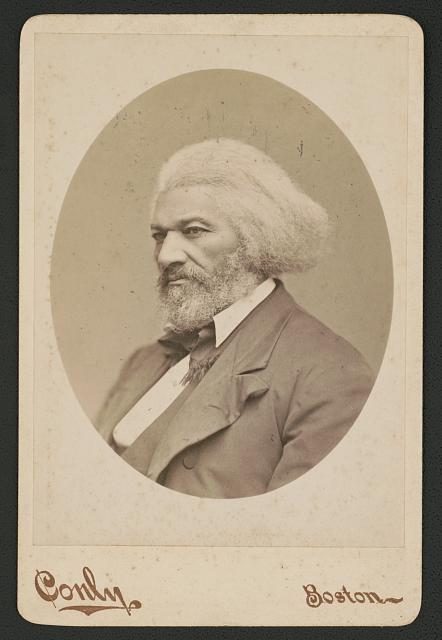
The lead image is a later Library of Congress portrait record derived from an 1876 negative and printed in the 1880s.[6] It does not show Corinthian Hall on the morning of July 5, 1852. It belongs here for a different reason. This article is about the construction of Douglass's public authority, and this speech is one of the moments when that authority becomes unmistakable: ceremonial opening, rupture, evidence, then constitutional repossession.[1][6]
Timeline anchors: the speech sits inside a political repositioning, not outside it
- December 3, 1847: the first issue of The North Star appeared in Rochester, where Douglass made his home and built an anti-slavery publishing base.[3][4]
- May 9, 1851: Douglass publicly broke with William Lloyd Garrison over political action against slavery; soon after, he renamed the paper Frederick Douglass' Paper.[3][4]
- July 5, 1852: Douglass delivered the oration at Rochester's Corinthian Hall before an audience of nearly 600 people, invited by the Rochester Ladies' Anti-Slavery Sewing Society.[2][5]
- 1855: Douglass republished an extract of the speech in My Bondage and My Freedom, helping fix certain passages in public memory.[5]
These dates matter because they keep the oration from floating free as a timeless text. By 1852, Douglass was not simply an ex-slave summoned to provide moral witness. He was already a newspaper editor, a major abolitionist strategist, and a man who had moved away from Garrison's insistence that the Constitution was inherently pro-slavery.[3][4] The speech therefore comes at a hinge: between anti-slavery moral agitation and a more assertive claim that the nation's own political language can be used against slavery rather than abandoned to it.[1][3]
First movement: Douglass opens inside the patriotic frame before he breaks it
The most important formal fact about the speech is that Douglass does not begin with contempt. He starts by praising the revolutionary generation for courage, risk, and political imagination.[1] He calls the signers brave men, treats the struggle against Britain as a genuine act of resistance, and grants the audience the emotional weight of the anniversary.[1] That opening is not a courtesy paragraph to be skipped on the way to the famous section. It is the trapdoor on which the rest of the oration depends.
Why does it matter? Because Douglass wants the contradiction to emerge from inside the civic ritual itself. If he had opened by dismissing the Revolution as fraud from the beginning, white listeners could have filed him under simple negation. Instead he first shows that he understands the inherited script perfectly well. He knows why the day matters. He knows why Americans treasure it. Only after that does he ask the devastating question: what relation do he and those he represents have to "your national independence"?[1]
The speech's famous exclusion works because of pronouns and timing. Library of Congress material on the event underlines that Douglass insisted on speaking on July 5, not July 4, and that the date also carried a New York Black freedom history because July 5, 1827 marked public celebration of slavery's abolition in New York State.[2][5] That timing matters. Douglass is not merely standing outside the holiday; he is re-siting it. He lets white America keep July 4, then uses July 5 to test what the holiday means after the fireworks, when the enslaved are still enslaved.
This is where the most remembered line lands. In the Rochester transcript he says that the founders' inheritance "is shared by you, not by me" and soon after declares, "This Fourth July is yours, not mine. You may rejoice, I must mourn."[1] The power comes not only from anger, but from staging. Douglass has first walked into the ceremony, accepted its stated principles, and only then shown that the ritual depends on excluding the enslaved from the community that claims those principles.
Second movement: the speech widens from moral shock into an institutional inventory
The oration would not have lasted so long if it only said that slavery was evil. Douglass assumes that proposition and then keeps moving. Once he has broken the ceremony's moral self-satisfaction, he starts naming the machinery that makes the contradiction durable. The speech surveys the domestic slave trade, churches, politicians, courts, and especially the legal regime that lets one human being be hunted as property.[1][2]
That is why the 1850 Fugitive Slave Act matters so much in the speech's background. The National Park Service page places the address squarely after the Compromise of 1850 and stresses that the strengthened federal law expanded the legality and compulsion of recapturing people who had escaped slavery.[2] Douglass's denunciation therefore does not drift in the abstract. He is speaking after a major federal recommitment to slave power. When he says the national celebration is hypocrisy, he means a republic that proclaims liberty while tightening the interstate enforcement architecture of bondage.[1][2]
This middle stretch is what gives the speech its granularity. Douglass does not let the audience treat slavery as a distant Southern stain while northern institutions remain clean. He keeps pointing to circulation: commerce, law, party politics, and church complicity.[1] In that sense the speech reads less like a sermon than like a public audit. The moral charge is intense, but it is carried by enumeration. The republic is not failing in one place. It is reproducing slavery through linked institutions.
The Library of Congress blog on the speech is useful here because it reminds readers that the full text printed in Frederick Douglass' Paper is broader than the excerpt most often anthologized.[5] Read whole, the speech spends much more energy on evidence, accumulation, and public exposure than casual memory suggests. That is one reason it still works on rereading: Douglass is not merely venting. He is prosecuting.
Third movement: the constitutional turn is what keeps the speech from ending in pure estrangement
The part of the oration that modern readers most often underplay comes late. After the attack on hypocrisy, Douglass turns toward the Constitution and rejects the claim that the document must be read as a slaveholding charter.[1] He says slavery has no rightful warrant there and calls the Constitution, when properly interpreted, a "GLORIOUS LIBERTY DOCUMENT."[1]
That line can look surprising if the speech is remembered only as an incandescent denunciation. It becomes less surprising once the political chronology is restored. The National Park Service chronology notes that in 1851 Douglass openly broke with Garrison over political action and over the claim that the Constitution itself was pro-slavery.[3] Britannica also notes that during his Rochester years Douglass had initially remained loyal to Garrison's position before moving away from it.[4] The July 5 speech belongs to that shift. It is not just an anti-slavery address. It is a declaration that the republic's founding texts need not be abandoned to the slave system.[3][4]
This matters because it clarifies the speech's deeper aim. Douglass does not want simply to expose America and leave the matter there. He wants to isolate the slave regime from the language in whose name it governs. The Declaration and the Constitution are not identical, and Douglass does not flatten them into one seamless text. But he uses both as pressure points. The Declaration provides universal political principle; the Constitution, in his later anti-Garrisonian reading, can be reclaimed as a legal instrument whose purposes do not require slavery.[1][3][4]
That late constitutional turn also explains why the oration is more than a jeremiad. A jeremiad laments national failure by measuring the present against a covenant. Douglass does that. But he also performs something more tactical. He splits "America" into rival claimants: the revolutionary inheritance, the constitutional text, the slaveholding state, and the abolitionist future. The speech's brilliance lies in refusing to let the last of those be treated as foreign to the first two.
Why the speech lasts
The strongest reading, then, is not that the oration endures only because of one unforgettable denunciation. It lasts because Douglass controls tempo and ownership.[1][5] He begins close enough to patriotic consensus that the audience cannot dismiss him as alien. He then detonates the ceremony from within by forcing the pronouns into public view. After that he widens moral outrage into a concrete map of institutions, and finally he refuses to leave the nation's political language in the hands of the slave power.[1][2][3][4]
That sequence still feels modern because it is a model for how to handle a compromised inheritance. Douglass neither accepts the holiday at face value nor abandons the language of freedom to hypocrisy. He makes the audience sit inside the contradiction long enough to see that the problem is not failed sentiment. The problem is a republic whose rituals and institutions have been made to serve opposite moral ends.[1][2]
Seen this way, the July 5 oration is not only a speech of accusation. It is a speech of repossession. Douglass takes the founding archive seriously enough to weaponize it against the republic that claims it most loudly and honors it least faithfully.
Sources
- University of Rochester, Frederick Douglass Papers Project, Oration, Delivered in Corinthian Hall, Rochester, by Frederick Douglass, July 5th 1852 - full speech text in PDF.
- National Park Service, "What to the Slave is the 4th of July?" - event context, invitation history, and the 1850 Compromise background.
- National Park Service, "Chronology of the Life of Frederick Douglass" - timeline entries for The North Star, the 1851 break with Garrison, and the July 5, 1852 speech.
- Encyclopaedia Britannica, "Frederick Douglass" - biography with Rochester years, newspaper history, and the shift away from Garrison's constitutional view.
- Library of Congress, "What, to the American Slave, Is Your 4th of July?" - publication history, July 5 significance, and contemporary reporting on the speech.
- Library of Congress Prints & Photographs Division, "(Frederick Douglass)" - source record for the archival portrait photograph used here.