The Triangle Shirtwaist fire is often remembered as a moral flashpoint: young immigrant women trapped above Washington Place, bodies falling from upper windows, and a horrified city finally admitting that industrial growth had outrun human safety.[1][3][6] That memory is justified, but it still leaves a historical question open. Why did this particular factory fire produce such a large death toll so quickly, and why did it push New York from grief into a sustained program of state intervention between 1911 and 1914?[1][2][4][7]
The strongest answer is structural. The Triangle blaze became historically decisive because several weaknesses lined up in sequence. A crowded garment floor and weak worker bargaining power made the workplace brittle before any flame appeared. A late-afternoon ignition then outran the building's internal warning capacity. Escape routes failed one after another: the ninth floor received no timely alert, one key exit was locked, the fire escape collapsed, and city ladders could not reach the top floors. Because all of this unfolded in full view above a busy Greenwich Village street, the catastrophe became a public spectacle before officials could reduce it to a private accident report. The state then entered the story through investigation, new law, and a much stricter understanding of what factory owners owed the people inside their buildings.[1][3][4][5][6][7]
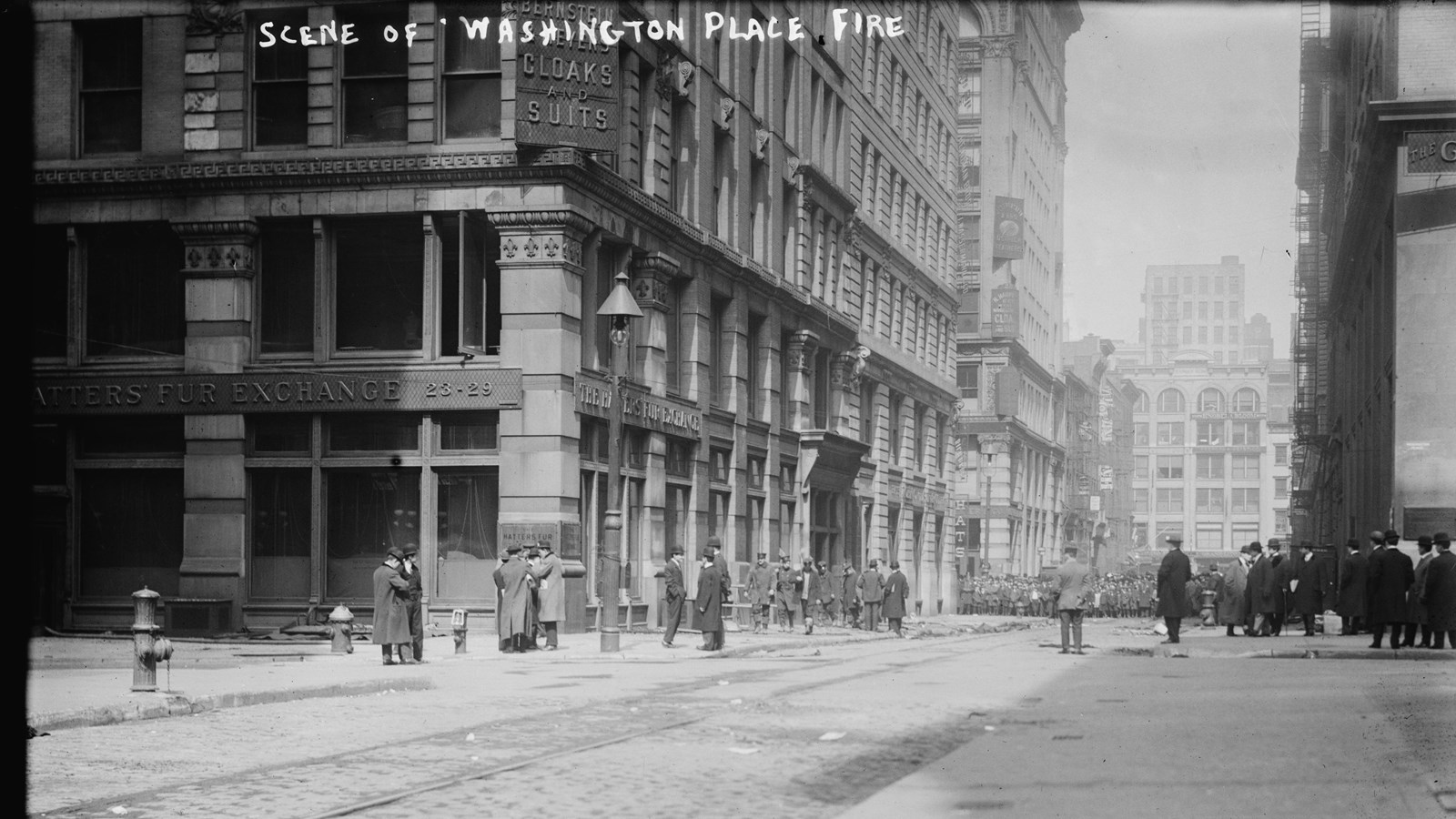
Image context: the cover photograph shows crowds gathered outside the Asch Building after the fire.[1] It belongs here because the article's main claim is that Triangle changed politics when factory danger stopped being confined to a workroom and became visible from the street.
Timeline anchors
- 1909: Triangle workers are caught in the broader garment-industry strike known as the Uprising of the 20,000, which wins some gains across the trade but does not fully secure safety or union power inside Triangle itself.[1][2]
- March 25, 1911: Fire tears through the eighth, ninth, and tenth floors of the Asch Building near closing time, killing 146 workers out of about 500 employees.[1][3][5][6]
- April 11, 1911: A grand jury indicts owners Isaac Harris and Max Blanck after testimony about locked doors and blocked escape routes pushes criminal responsibility into the courts.[4]
- June 30, 1911: New York creates the Factory Investigating Commission, giving the state a formal vehicle for turning outrage into inspection and legislation.[5][7]
- 1912-1914: The commission's work produces a tighter factory safety and health code, including stronger requirements around fire protection, sanitation, machine guarding, and elevator safety.[5][7]
First mechanism: the workplace was already brittle before the fire started
Triangle was not a freak exception to an otherwise healthy labor system. Cornell's reconstruction presents it as a characteristic Manhattan sweatshop: low wages, long hours, dangerous conditions, and a subcontracting structure that let owners distance themselves from the daily terms under which many people actually worked.[2] The factory occupied the top three floors of the Asch Building and employed hundreds of workers, most of them young immigrant women and girls from Southern and Eastern Europe, many of them Jewish.[1][3] In other words, the labor force was dense, precarious, and easy to replace.
That matters because safety in such a setting was never a separate technical question. It was entangled with speed, surveillance, and control. A shop organized to maximize output from crowded rows of sewing machines had little slack for drills, clear aisles, independent worker voice, or expensive redundancy.[2][3][6] The 1909 garment strike showed that many women in the trade were willing to fight, but the Triangle factory remained a non-union shop.[2][3] So before the fire began, the workers were already operating inside a structure where management retained wide power over pacing, exits, and shop-floor routine.
This is the first reason the disaster scaled so fast. The factory was not merely unlucky on March 25, 1911. It was vulnerable by design.[2][3]
Second mechanism: ignition outran warning
The fire itself began in a way that industrial history has made grimly familiar. According to the National Park Service, sparks from a discarded match or cigarette ignited a scrap bin full of cloth cuttings on the eighth floor.[1] In a loft draped with flammable fabric, the blaze spread with extraordinary speed; within about five minutes, the eighth floor was consumed.[1] That rapid spread is the second key mechanism. Once cloth remnants, hanging material, and close-packed workstations turned a small ignition into a racing fire, survival depended on warning and redundancy.
Triangle had very little of either. Workers on the tenth floor were alerted in time to move upward and across to the roof, where neighboring NYU law students helped pull them to safety with ladders bridged between buildings.[1] But people on the ninth floor did not receive a timely warning before the fire arrived.[1] The building had no internal fire alarm system the workers could trigger, and the emergency hose failed to operate.[1] So the factory lost precious minutes at exactly the point when minutes mattered most.
At that stage, the elevators briefly became the building's best escape technology. Two operators made repeated trips and saved at least 150 people.[1] Yet the article-worthy point is not heroism by itself, though the heroism was real. It is dependence. When a fast loft fire strips away alarm, hose, and orderly stair use, rescue narrows to whatever improvised device remains available. Elevators could save some workers, but not a whole floor of panicked people once heat, smoke, and crowd pressure intensified.[1][5][6]
Third mechanism: escape routes failed one after another
The most famous detail in the Triangle story is the locked door, and it deserves its prominence, but only if it stays inside the larger sequence. Testimony gathered after the fire described workers unable to open the route that should have led them toward safety, while another staircase had already become unusable as the flames advanced.[1][4] Cornell's trial summary is especially important here because it shows how central this point became in court: prosecutors treated the locked-door issue as a direct link between shop-floor discipline and death, while the defense worked to create doubt about the owners' knowledge of the locking at that exact moment.[4]
The workers who could not get through the door were then pushed toward weaker alternatives. Some headed for the elevators; others tried the fire escape. That fire escape, however, was structurally inadequate. The National Park Service describes it as rickety, and the timeline materials at Cornell record that it collapsed during the emergency, throwing more people to their deaths.[1][5] Outside the building, city firefighting capacity also hit a hard limit. Ladders reached only to the sixth floor, hoses could not effectively reach the trapped workers above, and life nets proved useless against falls from roughly a hundred feet.[1][5][6]
This is why the fire reads less like one error than like a stacked failure system. A fast blaze might still have left a large number alive if doors opened freely, stairs stayed clear, alarms spread quickly, and exterior rescue could reach the upper stories. Triangle offered the opposite combination. Once the first few safeguards failed, each remaining option had to carry more weight than it was built to carry.[1][4][5][6]
Fourth mechanism: the street turned factory danger into a civic scandal
Many industrial disasters stay partly hidden from the broader public because they happen underground, far from the city center, or behind gates that separate witnesses from the event. Triangle did not. The Asch Building stood in Manhattan, and the workers died in front of crowds that could see smoke, bodies at the windows, and the limits of official rescue in real time.[1][3][6] That visibility is the fourth mechanism. It made the fire legible as a civic failure rather than a narrow private loss.
The mourning that followed quickly moved into organized pressure. Cornell's materials show grief turning into protest almost at once, with unions and reform groups gathering testimony, mobilizing supporters, and insisting that dangerous workshops could no longer be treated as routine urban facts.[4] The Department of Labor's history of the Factory Investigating Commission adds scale to that conversion: on April 5, 1911, more than 100,000 people joined a funeral procession up Fifth Avenue while hundreds of thousands more watched.[7] A Committee on Safety emerged from the mass meeting culture that followed, carrying emotion into lobbying.[7]
This public stage also helps explain why Frances Perkins remained so central to later memory. The National Park Service notes that she witnessed the fire and later carried its lesson into a career built around the state's responsibility to protect ordinary workers.[1] Rose Schneiderman and the ILGWU pushed from another direction, making the disaster a labor issue as well as a reform issue.[1][4] The fire therefore widened the coalition for state action. It was not only a union grievance, not only a charitable emergency, and not only a criminal case. It became all three at once.
Fifth mechanism: criminal acquittal did not stop regulatory expansion
One of the most revealing things about Triangle is that criminal law and regulatory law moved on different clocks. Harris and Blanck were indicted on April 11, 1911, and the prosecution centered much of its case on the locked doors and negligent factory conditions.[4] Yet a jury acquitted them in December 1911, after defense attorney Max Steuer created enough doubt about what the owners knew and when they knew it.[4] If the story ended there, Triangle would still matter as a tragedy, but not as a major state-building episode.
The story did not end there because public blame had already shifted beyond the single verdict. The Factory Investigating Commission, created on June 30, 1911, had a broader mandate: inspect the conditions under which manufacturing was carried on, summon witnesses, and convert exposed hazards into a legislative program.[7] The Department of Labor's institutional history describes the commission as the most thorough workers' safety and health study yet attempted at that scale, and notes that between 1912 and 1914, 13 of 17 bills it submitted became law.[7] Those measures addressed fire protection, ventilation, sanitation, machine guarding, and elevator safety.[7] Cornell's timeline tracks the same transformation from fire to commission to repeated statutory change.[5]
This is the deeper historical pivot. Triangle mattered because it helped recast the factory as a place where the public interest was directly at stake.[4][7] After the fire, unsafe exits, poor inspection, overloaded floors, and weak emergency systems could no longer be defended as matters internal to a private business. The state claimed them as subjects for inspection and rulemaking.
Why the fire still reads larger than one factory
The best way to understand Triangle, then, is to keep the whole chain in view. Sweatshop labor relations made the workforce exposed. A scrap-bin ignition and heavy cloth made the fire fast. Missing warnings, a locked exit, a collapsing fire escape, and limited vertical rescue made the fire lethal. Public visibility made the deaths politically unbearable. Investigation and legislation made the response durable.[1][2][3][4][5][6][7]
That sequence is why the Triangle fire still feels larger than one terrible afternoon. It was a factory blaze, but it also became a demonstration of how private production methods can create public obligations. The lesson that emerged in New York between 1911 and 1914 was not sentimental. It was institutional: when work is crowded, flammable, supervised, and vertically stacked, safety cannot be left to custom and owner discretion alone. It has to be built into law.
Sources
- National Park Service, "Triangle Shirtwaist Factory (Brown Building)" - building history, fire sequence, locked exit, rescues, and reform aftermath.
- Cornell ILR School, "Sweatshops & Strikes" - Triangle's pre-fire labor conditions, subcontracting structure, and the 1909 Uprising of the 20,000.
- Cornell ILR School, "Fire!" - overview of the March 25, 1911 fire, worker demographics, and the non-union setting.
- Cornell ILR School, "Investigation & Trial" - indictment, locked-door testimony, and the acquittal of Harris and Blanck.
- Cornell ILR School, "Timeline of Events: Fire!" - timeline anchors, rescue limits, and legislative milestones after the disaster.
- Occupational Safety and Health Administration, "The Triangle Shirtwaist Factory Fire" - concise summary of the safety failures and the fire's workplace-safety legacy.
- U.S. Department of Labor, "The New York Factory Investigating Commission" - public mourning, commission creation on June 30, 1911, and the 1912-1914 reform program.