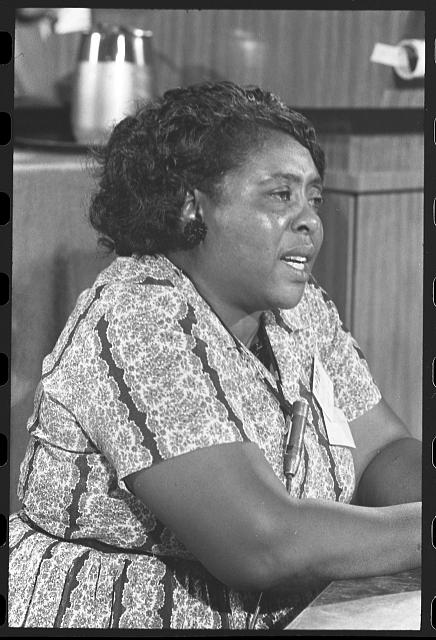
The Library of Congress photograph of Fannie Lou Hamer at the 1964 Democratic National Convention catches her at the moment when local struggle had already outgrown its assigned geography.[6] She is seated, composed, and visibly ordinary in the most important sense: she does not look like the kind of person the national Democratic Party expected to become a constitutional problem. That is a useful way into her history. Hamer's force did not come from celebrity entering Mississippi politics from above. It came from a sharecropper and timekeeper in Sunflower County converting the routine humiliations of local white rule into a national test of democratic legitimacy.[1][3][4]
That conversion did not happen all at once. It moved through three linked stages. In August 1962, Hamer tried to register to vote in Indianola and lost her plantation job and home for doing so.[1] In June 1963, she was jailed and brutally beaten in Winona after defending fellow activists at a segregated bus-stop lunch counter.[2] In August 1964, as a leader of the Mississippi Freedom Democratic Party, she carried that accumulated local history into Atlantic City, where the national party tried to contain her testimony and then offered a compromise small enough to preserve white control.[3][4][5]
The sharp historical question is therefore not simply why Hamer became famous. It is why this particular sequence gave her such unusual political power between 1962 and 1964. The strongest answer is that Hamer made Mississippi impossible to keep local. She took the plantation, the county courthouse, the jail cell, and the segregated state party apparatus, and forced each one onto a national stage without softening what they looked like from below.[1][2][3][4][5]
Image context: the cover uses a real 1964 Library of Congress photograph of Hamer at the Democratic convention in Atlantic City.[6] It fits this article because the central argument is about scale and translation. The woman in the convention hall is carrying Ruleville and Winona with her.
Timeline anchors
- October 6, 1917: Fannie Lou Townsend is born in rural Mississippi to a sharecropping family and later grows up in the plantation economy of the Delta.[1][3]
- August 31, 1962: Hamer joins a bus trip from Ruleville to the county courthouse in Indianola to attempt voter registration; soon afterward she is evicted and fired for refusing to withdraw her application.[1]
- June 9-12, 1963: Returning from a voter-education workshop, Hamer is arrested in Winona and beaten in jail, suffering injuries with lasting effects.[2][5]
- August 1964: Hamer helps lead the Mississippi Freedom Democratic Party challenge in Atlantic City, where her testimony turns Mississippi's local coercion into a national political crisis.[3][4][5]
First pressure point: Ruleville turned citizenship into a material risk
Hamer's later fame can make it easy to forget how grounded her leadership was in the ordinary coercive structure of Delta life. SNCC's biographical reconstruction emphasizes that when organizers arrived in Sunflower County in 1962, Hamer was already unusual within her local setting because she was literate and had become a timekeeper on the B. D. Marlowe plantation after years of cotton work.[1] That detail matters. She did not emerge from outside the agricultural order; she emerged from a position inside it that let her see how power traveled through wages, transport, dependency, and white surveillance.
The first registration trip therefore deserves to be read as more than a brave bus ride. In August 1962, eighteen local Black residents traveled from Ruleville to Indianola to try to register.[1] Armed white men were present at the courthouse; the process itself was designed to intimidate and filter; and the return trip made clear that the consequences would follow them home.[1] According to SNCC's account, the bus driver was arrested on the way back for driving a bus the "wrong color," a reminder that even movement between plantation town and county seat could be criminalized when Black people used it for politics.[1]
The historical importance of this moment lies in what happened next. Hamer was ordered to withdraw her registration effort or lose her place on the plantation. She refused. She was fired and put off the land, and when she took shelter elsewhere, white men shot into the house where she was staying.[1] That sequence is why Ruleville belongs in the title. The movement question in Mississippi was never only whether a person could fill out a registration form. It was whether that person could survive the landlord, the employer, the sheriff, and the local white network that treated Black political action as insubordination against the entire social order.[1][3]
This is the first reason Hamer's rise mattered. She made the cost of citizenship visible in a place where white authority depended on keeping that cost natural, private, and dispersed.
Second pressure point: Winona made state violence impossible to romanticize
If Ruleville established the price of trying to vote, Winona established the price of insisting on dignity after that first step. The SNCC Digital Gateway's event reconstruction of the June 1963 jail beatings is especially useful because it keeps the episode concrete.[2] Hamer and other activists were returning from a Citizenship School workshop in South Carolina when the bus stopped in Winona. Several members of the group attempted to use the lunch counter. Police were waiting; arrests followed almost immediately; and Hamer left the bus to defend the others despite a warning shouted from outside.[2]
What followed was not spontaneous disorder. It was organized punishment. The activists were separated. Teenager June Johnson and Annell Ponder were beaten, and Hamer herself was carried to a cell where police forced Black prisoners to strike her with a blackjack until one was too exhausted to continue and another had to take over.[2] The Winona page records Hamer's own later judgment that this was the most horrifying experience of her life.[2] The Library of Congress Law Library blog adds the physical aftermath: permanent damage to her eye, legs, and kidneys, injuries that stayed with her for the rest of her life.[5]
Historically, Winona matters because it stripped away the softer language with which segregationist authority often tried to describe itself. The Mississippi system could present courthouse tests as administrative procedure, registration denial as technical qualification, and plantation retaliation as private employment discipline. In Winona, the state appeared with clubs and cells. There was no plausible story of mutual misunderstanding left.[2][5]
That matters for Hamer's biography because it changed what her voice could do. Before Winona, she was already a strong local leader and a remarkable singer who steadied others in moments of fear.[1] After Winona, when she spoke about democracy, she was not offering an abstraction or borrowing authority from movement theory. She was speaking with the body of a witness to what Mississippi required in order to keep Black people away from the ballot. The violence gave her speech a frightening clarity.
Third pressure point: Atlantic City turned a local witness into a national legitimacy test
By 1964, Hamer's authority had become larger than the place that first produced it. The National Park Service summary puts the turn plainly: she co-founded the Mississippi Freedom Democratic Party during Freedom Summer and traveled to Atlantic City to challenge the legitimacy of Mississippi's all-white Democratic delegation.[3] The National Archives voting-rights overview explains why the challenge mattered. The regular Mississippi Democratic Party barred Black participation, and the MFDP arrived with elected delegates insisting that a party claiming to represent Mississippi could not remain credible while excluding most of its Black citizens from the political system.[4]
This was the second scale shift in Hamer's history. Ruleville had exposed how white power worked locally. Atlantic City asked whether the national Democratic Party would continue to treat that local order as acceptable collateral. Hamer's testimony before the Credentials Committee made the question harder to avoid because she did not present Mississippi as an unfortunate regional embarrassment. She presented it as a democratic contradiction. The SNCC biographical page preserves the line that carried far beyond the convention hall: "Is this America", she asked, describing a place where people were threatened daily because they wanted to live as decent human beings.[1]
The Johnson White House understood the danger. The National Archives' Prologue essay on LBJ and the convention notes that President Lyndon B. Johnson staged an impromptu press conference in order to cut away from Hamer's live testimony on the networks.[5] That act is historically revealing. It shows that the administration did not treat her as a marginal delegate delivering local grievance. It treated her as someone capable of creating a national public-relations defeat for the party.[5] The attempt at interruption failed in the deeper sense: the testimony was replayed, discussed, and absorbed as proof that the country's democratic language and its Mississippi tolerances could no longer sit comfortably together.[3][5]
The compromise that followed confirmed the point. The National Archives voting-rights page records that the MFDP was offered only two at-large seats, an arrangement that preserved the main authority of the segregationist delegation.[4] Hamer and the MFDP refused. This is crucial. The convention challenge is sometimes remembered as a moral speech followed by disappointment. That reading is too small. The refusal mattered because it showed that Hamer's project was not symbolic recognition. It was representational legitimacy. She was not asking to decorate the party's conscience. She was asking whether Black Mississippians counted as political members of the polity the party claimed to organize.[3][4][5]
Why Hamer's biography works best through three places
There are larger versions of Hamer's life, and they deserve their place: the Freedom Farm Cooperative, her later campaigns, her movement songs, her international travel, her role as a speaker whose cadences could move a room.[1][5] But the 1962-1964 microhistory centered on Ruleville, Winona, and Atlantic City remains the clearest way to see her historical force.
Ruleville shows the local machinery of disfranchisement as lived dependence.[1] Winona shows the naked violence available when that machinery was challenged.[2][5] Atlantic City shows what happened when a person formed inside those first two places forced a national party to answer for them.[3][4][5] Read together, the three scenes explain why Hamer still feels larger than biography. She did not simply narrate Mississippi to the rest of the country. She changed the scale at which Mississippi had to be judged.
That is why the convention photograph remains so strong.[6] It does not show a victim rescued into national politics. It shows a local organizer who brought the local with her, and who made it impossible for the national party to say that what happened in Sunflower County belonged only to Mississippi.
Sources
- SNCC Digital Gateway, "Fannie Lou Hamer" - August 1962 registration attempt, eviction from the Marlowe plantation, and Hamer's emergence as a local movement leader.
- SNCC Digital Gateway, "Beatings in Winona Jail" - June 1963 arrests, jail assault sequence, and oral-history-based reconstruction of the Winona violence.
- U.S. National Park Service, "Women in the African American Civil Rights Movement: An Historic Context" - biographical context on Hamer, the MFDP, and the Atlantic City convention challenge.
- National Archives, "Black Americans and the Vote" - overview of the MFDP challenge, the two-seat compromise, and the voting-rights significance of the 1964 convention fight.
- National Archives, "LBJ Fights the White Backlash" - convention politics, Johnson's attempt to divert live coverage, and the public-relations impact of Hamer's testimony.
- Library of Congress Prints and Photographs Division, "Fannie Lou Hamer, Mississippi Freedom Democratic Party delegate, at the Democratic National Convention, Atlantic City, New Jersey, August 1964."