The Tomb of the Unknown Soldier is easy to misread because it looks finished. White marble, fixed hilltop, formal guard, familiar inscription: the site can seem like a monument that arrived in complete form and has merely been maintained ever since.[1] The history is more dynamic than that.
What gave the Tomb its force was not stone by itself. It was a chain of public acts that taught Americans how to use one unidentified body as a national stand-in: selection in France, the voyage home, lying in state in the Capitol Rotunda, burial on Armistice Day, the later discipline of guard duty, and finally the decision to keep faith even when one of the later "unknowns" was no longer unknown.[1][2][3] Read that way, the Tomb is less a grave than a ritual machine for a democracy trying to mourn war without pretending every loss can be individually resolved.
Timeline anchors
- December 1920: Congressman Hamilton Fish Jr. proposes legislation for one unknown American from World War I to be buried at Arlington as a national representative of the unidentified and missing war dead.[1][2]
- October-November 1921: four unidentified American dead are exhumed in France, one is selected by Sgt. Edward F. Younger, and the casket is brought home aboard the USS Olympia.[1][2]
- November 10-11, 1921: the Unknown lies in state in the Capitol Rotunda, then is buried at Arlington during the Armistice Day ceremony.[1][2][3]
- March 1926 / July 1937: military guard duty begins, first by day and then on a 24-hour basis, turning visitation into a continuously ordered ritual.[1][2]
- 1958 / 1984: Unknowns from World War II, Korea, and then Vietnam are added to adjoining crypts, widening the Tomb's representative scope beyond World War I.[1][2]
- 1998-1999: DNA identifies the Vietnam War Unknown as Air Force 1st Lt. Michael J. Blassie; the emptied crypt is rededicated to America's missing servicemembers from that war instead of refilled.[1][2]
The sequence matters because the Tomb's meaning was built in stages. Each stage widened the circle of identification while also admitting that some losses would remain unresolved.
The problem in 1920 was democratic mourning
Arlington's own history page starts in the right place: modern war produced large numbers of dead who could not be identified with certainty, even after burial systems improved.[1] By World War I the United States had aluminum identity discs and a dedicated Graves Registration Service, yet the scale of violence still left families facing uncertainty.[1] That uncertainty was not only bureaucratic. It was emotional and political. A republic that promised equal honor to its citizens needed some public way to honor those whose names could not be recovered.
France and Great Britain had already created one answer in 1920 by burying unknown war dead on Armistice Day in Paris and London.[1][2] The United States chose a different route at first, repatriating identified bodies when families requested it.[1] But that policy still left unidentified American dead without the same intimate path home. Hamilton Fish Jr.'s proposal in December 1920 was designed to solve exactly that symbolic gap: one unknown body would represent all the missing and unidentified of the war, not by narrowing grief to one family, but by making the body unavailable to any single claim.[1][2]
That is the first key to the Tomb's power. The Unknown mattered because he was not allowed to belong to a state, a church, a town, or a bloodline. His anonymity did not weaken public feeling; it enlarged the field of attachment.
The 1921 journey turned anonymity into a public event
The selection ritual in France is the second key. In October 1921, four unidentified American dead were exhumed from different military cemeteries and brought to Châlons-sur-Marne.[1][2] Officials deliberately rearranged the caskets before Sgt. Edward F. Younger chose one with a spray of white roses, a small act that gave the final selection ceremonial clarity while preserving the anonymity on which the whole idea depended.[1]
From there, the Tomb's meaning was produced through movement. The casket traveled by rail and caisson to Le Havre, crossed the Atlantic on the USS Olympia, arrived at the Washington Navy Yard on November 9, and lay in state in the Capitol Rotunda on November 10.[1][2][3] Architect of the Capitol records the World War I Unknown among the individuals who have lain in state there, placing the event inside the ceremonial core of the federal state.[3] The location mattered. A body without a name was being given the same architectural dignity as heads of state and national leaders.
About 90,000 people came through the Rotunda to pay respects before the funeral.[1] That figure helps explain why the Unknown could never be merely a military object. The crowd transformed the casket into a national meeting point between strangers. No one in that line knew which family had lost this man. That was the point. The ritual let each visitor approach a particular coffin while thinking about uncounted other absences.
The next day, November 11, 1921, the horse-drawn caisson procession to Arlington and Warren G. Harding's funeral ceremony completed the conversion.[1][2] The Unknown was no longer only an unidentified casualty of the Meuse-Argonne or another French battlefield. He had become a national grammar of mourning: silence, procession, medals, foreign honors, public witness, burial.
The guard made grief repeatable
The Tomb's third act came after the burial, when visitation had to be stabilized.[2] In popular memory, the sentinel seems ancient, almost inseparable from the monument itself. In fact, the guard was layered onto the site in response to behavior. The Army first added a daily civilian guard in 1925 after reports that visitors were treating the tomb disrespectfully; soldiers from nearby Fort Myer replaced that detail in March 1926.[2] Continuous guard duty did not begin until July 1, 1937.[2]
That chronology changes the interpretation of the site. The guard was not decorative ceremony added to an already complete memorial. It was the mechanism that converted grief from a single annual observance into disciplined public time. The sentinel's repeated pattern, later formalized through the 21-step routine, organized how visitors approached the grave and how the nation imagined fidelity to the dead.[1] Arlington explicitly explains the symbolic logic: 21 steps, 21 seconds, the weapon shifted toward the public side, the 21-gun-salute association.[1] The routine does not identify the Unknown. It honors the fact that he cannot be identified.
This is why the Tomb became so durable. A statue can be admired and then left alone. A guarded tomb asks for return, attention, and behavioral adjustment. It creates witness not once, but every day.
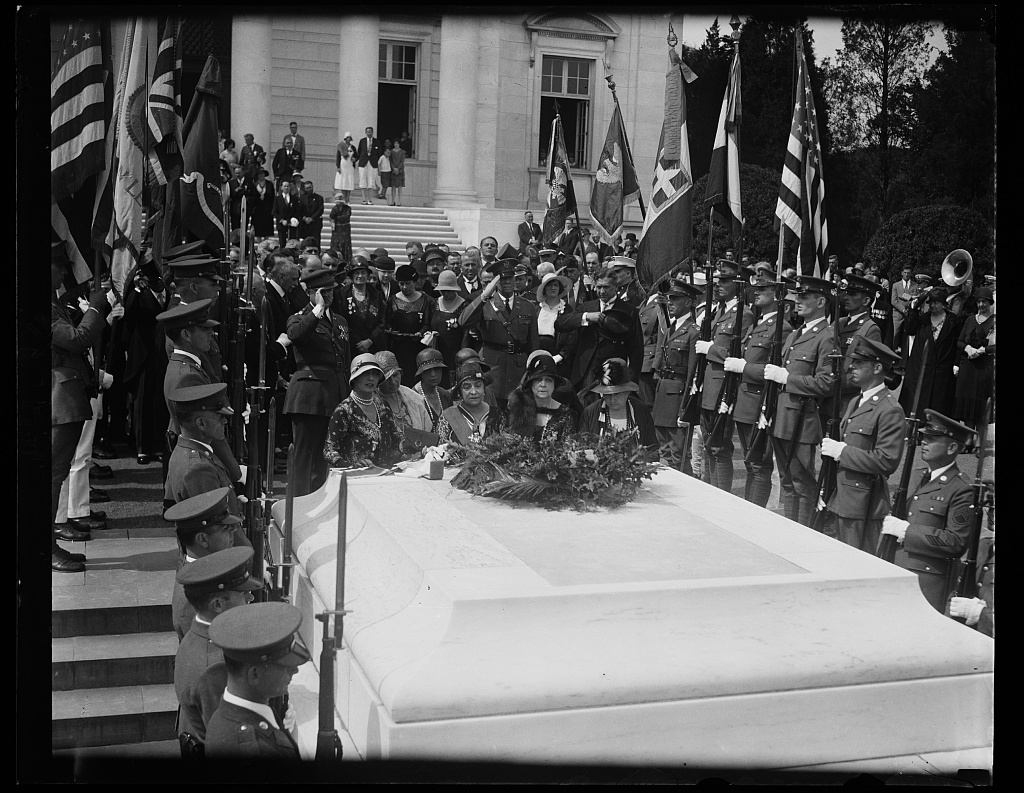
By 1930, the site was already attracting highly legible acts of public mourning. The Library of Congress photograph used here shows Missouri war mothers and Gen. John J. Pershing paying tribute at the Tomb.[4] The image matters because it captures the Tomb in use: private grief entering a national script, military authority standing beside civilian loss, and the monument serving as a place where families whose own dead were elsewhere could still perform mourning in public.
The memorial survived by changing what "unknown" meant
The later additions from World War II, Korea, and Vietnam might look like simple expansion, but they reveal the Tomb's deeper flexibility.[1][2] In 1958, the United States interred Unknowns from World War II and Korea beside the World War I dead after another elaborate process of exhumation, selection, lying in state, and burial.[1][2][3] The monument now represented not one war but a broader category of military sacrifice that exceeded positive identification.
The Vietnam case exposed the limits of that model and, paradoxically, preserved it. By 1984, forensic science had advanced so far that only one set of recovered American remains from the Vietnam War had not been fully identified when the government chose to bury a Vietnam Unknown at Arlington.[1][2] Fourteen years later, DNA testing identified those remains as Air Force 1st Lt. Michael J. Blassie, and the body was returned to his family for reinterment in St. Louis.[1][2]
At that point the state faced a choice. It could try to preserve the old visual symmetry by placing another unknown in the crypt, or it could admit that the memorial's logic had changed. The choice made in 1999 was the more historically intelligent one: the empty crypt was rededicated to "America's Missing Servicemen" from the Vietnam era rather than refilled.[2] That move preserved the Tomb by shifting the focus from unidentified remains alone to a larger promise of remembrance and accounting.
This is the strongest evidence that the Tomb is not just a burial site. Burial can end a story. Commemoration often has to remain open. Once identification technology improved, the monument could no longer rely on ignorance as its organizing principle. It survived by honoring absence itself: the missing, the unresolved, the still-unreturned.
Why the Tomb still works
A century after the 1921 burial, official histories still describe the Tomb as a site of national memory and fidelity, which is accurate but incomplete.[1][2] The deeper reason the place still works is structural. It braids together three things that modern states usually keep apart: intimate grief, military honor, and public ritual.
The Arlington page makes clear that millions still visit, that wreath-laying remains open not only to presidents and dignitaries but also to school groups and ordinary members of the public.[1] That openness is crucial. The Tomb is authoritative without being socially closed. It lets official ceremony and civilian mourning occupy the same ground.
Read in 2026, the Tomb of the Unknown Soldier looks less like a timeless object than a carefully repaired sequence. First came the representative body in 1921. Then the repeated guard. Then the widened scope in 1958 and 1984. Then the corrective rededication in 1999, when the empty crypt began to signify missing service members rather than an unidentified body.[1][2] The monument kept its force because each generation adjusted the form without abandoning the obligation underneath.
That is why the site endures. The marble matters, the inscription matters, the sentinel matters, but the real achievement lies in the grammar they hold together: a nation can admit that some war deaths remain nameless, some losses remain unsettled, and remembrance still requires a place, a pattern, and a public act.
Sources
- Arlington National Cemetery, "Tomb of the Unknown Soldier" — background, WWI creation, guard ritual, later additions, and wreath-laying context.
- U.S. Army, "Tomb of the Unknown Soldier Centennial: A Brief Timeline of the Tomb of the Unknown Soldier" — 1920-1999 chronology, selection ceremony, guard orders, and later interments.
- Architect of the Capitol, "Lying in State or in Honor" — Capitol Rotunda entries for the World War I Unknown and later Unknowns.
- Library of Congress, "War mothers honor unknown soldier" — 1930 photograph of Missouri war mothers and Gen. John J. Pershing at the Tomb.