Jane Addams is often remembered at the far end of her fame curve: Nobel Peace Prize laureate in 1931, public moral authority, founderly figure in American social work.[1] That afterlife is real, but it can blur the method that made her important in the first place.
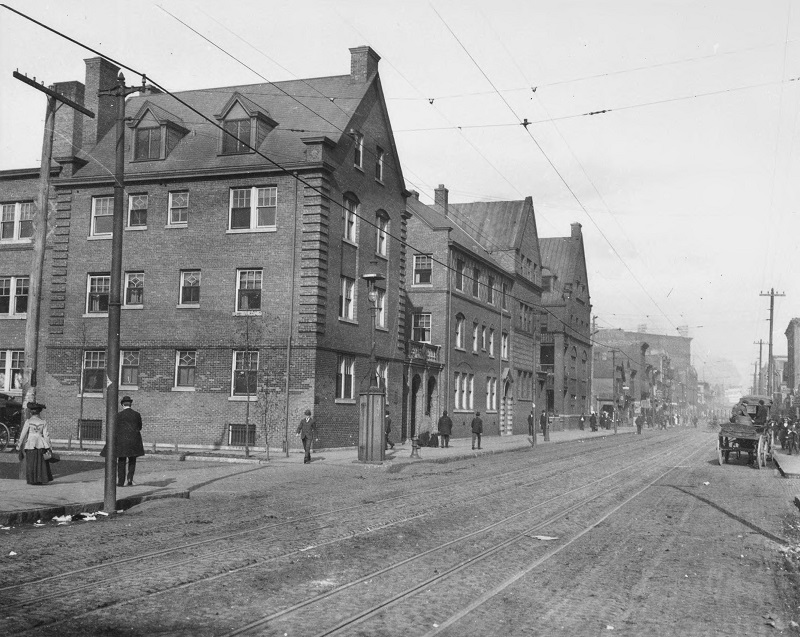
The sharper story begins earlier, on Chicago's Near West Side, with one practical decision. After Addams and Ellen Gates Starr visited Toynbee Hall in London in 1888, they opened Hull-House in 1889 in the Nineteenth Ward, a district crowded with immigrant labor, sweatshops, unstable wages, and poor sanitation.[1][2] The house mattered not because benevolent women moved into a poor neighborhood, but because Addams treated proximity as a way of gathering civic intelligence.
That is the useful microhistory in 2026. Hull-House did not simply dispense uplift. It listened, recorded, translated, and then pressed the city and state to answer what the neighborhood had already made visible.
Timeline anchors
- 1888: Addams and Starr visit Toynbee Hall in London and begin imagining a settlement house in Chicago.[1]
- 1889: Hull-House opens in the Nineteenth Ward on South Halsted Street.[1][2]
- 1893: investigators tied to the U.S. Bureau of Labor and Hull-House residents conduct intensive ward surveys from April 6 to July 15, gathering household and wage data door to door.[3]
- 1895: Hull House Maps and Papers publishes those investigations and turns neighborhood observation into a public document.[3]
- 1910: Addams publishes Twenty Years at Hull-House, reflecting on settlement work as a deliberate social method rather than ornamental charity.[4]
- 1931: Addams receives the Nobel Peace Prize, a late honor that can obscure how local and empirical the early Hull-House project actually was.[1]
The chronology matters because it shows a sequence: first residence, then trust, then information, then institutional leverage.
Halsted Street changed the unit of analysis
The Jane Addams Papers Project gives the cleanest short version of the origin story. Addams and Starr returned from Europe with broad cultural ambitions, but once Hull-House opened they found that neighbors needed day care, English instruction, and meeting space more urgently than poetry readings.[1] That change in emphasis was not a retreat from idealism. It was a methodological correction.
Addams's importance begins there. She did not assume that reformers could define neighborhood need from a distance. She and Starr learned by staying put long enough to be corrected. The same source stresses that Hull-House tried to work with the community rather than design programs for the poor in the older charitable style.[1] That distinction is the hinge of Addams's whole career. "Settlement" in her hands meant residence as an evidence practice.
The National Park Service description helps explain why that mattered in Chicago specifically. By the late nineteenth century, the ward around Hull-House was packed with working-class immigrants tied to steel, clothing, meatpacking, and sweatshop labor.[2] This was not a neighborhood where one sermon or one relief fund would solve the underlying problem. The trouble was structural: wages, housing, sanitation, childcare, legal vulnerability, and the pace of industrial city growth were all entangled.
Seen at that scale, Hull-House was less a refuge than a sensor. It was close enough to hear the daily friction of industrial urban life before those frictions were translated into acceptable official language.
Services were only the visible layer
Public memory often stops at the service list, and Hull-House had a long one. NPS notes legal aid, an employment office, childcare, and training in domestic and craft skills, then describes the later expansion into a 13-building complex with a gymnasium, theater, art gallery, libraries, pools, classrooms, a kindergarten, and dormitories.[2] Those institutions mattered. They were the physical means by which Hull-House made itself useful.
But the service list can also mislead. It makes the settlement sound like a competent neighborhood nonprofit before the age of nonprofits. The stronger reading is that each service doubled as a way of learning the neighborhood's operating constraints.
Childcare revealed the labor burden carried by mothers working irregular hours. Legal aid exposed how vulnerable immigrant workers were to contracts, wages, and landlords they could not easily contest. Meeting rooms showed which mutual-aid, labor, and immigrant associations already existed before reformers arrived. English classes were not just civilizing exercises; they were contact points where the settlement could discover which institutions the city had failed to make accessible.
This is where Addams differs from the ceremonial version of herself. Her genius was not saintly sympathy alone. It was an organizational habit of turning repeated local encounters into structured knowledge.
The 1893 surveys turned sympathy into evidence
The decisive turn in this microhistory comes with Hull House Maps and Papers.[3] Florence Kelley's Northwestern project page shows how much labor stood behind that 1895 book. The research ran for years, drew on multiple sponsors, and depended on the support structure of Hull-House. Most important, the key data collection phase in 1893 was startlingly concrete: four schedule men from the U.S. Bureau of Labor lived at Hull-House from April 6 to July 15, 1893, while Kelley, settlement residents, and investigators went door to door, into homes and sweatshops, recording ethnic origin, household size, wages, and weeks employed.[3]
That detail changes the meaning of Hull-House. The settlement was no longer only a house offering services; it had become a neighborhood field station. Addams's world moved from anecdote to mapped pattern.
The Northwestern page also notes that the resulting maps were modeled on Charles Booth's London poverty mapping and that the visual economy of those maps made them classics.[3] That is more than a nice design footnote. Maps gave reformers a way to move beyond moral testimony. They showed concentration, density, and distribution. They made the ward legible to outsiders who would never spend a week on Halsted Street.
This is why Hull-House was politically harder to ignore after 1895. Addams and her colleagues did not merely say that the neighborhood suffered. They produced a record of how people lived and worked in specific blocks and specific trades. The maps and papers gave Progressive reform a bridge between local witness and public argument.
Residents became a reform pipeline
The Jane Addams Papers Project emphasizes that Hull-House became a place where professional women such as Florence Kelley, Grace Abbott, and Alice Hamilton could work, test ideas, and then push them outward into city and national reform.[1] NPS makes the same point in institutional language: Hull-House workers moved into struggles over sanitation, housing, women's suffrage, and protective labor laws for women and children.[2]
That pipeline is the second reason Addams matters. Hull-House was not influential only because Addams herself became famous. It mattered because the settlement multiplied reform capacity. Residents saw unsafe garbage systems, exploitative factory conditions, and neighborhood overcrowding at close range, then carried those observations into reports, campaigns, and public offices.[2]
Addams's leadership style also helps explain why the place held together. The Papers Project notes her belief in cooperation and compromise, and her unusual skill at creating a community that could communicate settlement ideals to a wider public.[1] That made Hull-House more durable than a charismatic one-woman project. It had atmosphere, but it also had workflow.
In that sense the house worked like a conversion machine. It converted educated women's blocked career paths into neighborhood expertise. It converted neighborhood grievance into survey data. It converted survey data into arguments the state had to answer.
Why the memoir still matters
When Addams published Twenty Years at Hull-House in 1910, she was not simply writing nostalgia.[4] The memoir is useful because it shows that she herself understood settlement work as a philosophical and civic experiment, not a collection of touching episodes. Even the chapter titles listed on the Project Gutenberg edition make the point: "First Days at Hull-House," "The Subjective Necessity for Social Settlements," "Pioneer Labor Legislation in Illinois," "Immigrants and Their Children."[4] The settlement, in other words, was always connected in her mind to labor law, migration, and urban governance.
That retrospective frame matters because later commemoration can smooth the rougher edges away. Addams was not building a feel-good house of culture in the slums. She was helping invent a way for middle-class reformers to learn from neighborhoods without pretending that learning was politically innocent.
What this biography changes in 2026
Read as microhistory, Jane Addams becomes less sentimental and more operational. The central mechanism is simple enough to describe and hard enough to imitate:
- live near the problem long enough to be corrected by it;
- build services that reveal recurring constraints rather than merely soften them;
- document those constraints in forms that travel beyond the neighborhood;
- send people, arguments, and evidence outward until city and state institutions must respond.
That sequence is why Hull-House still feels modern. Many institutions can perform compassion. Fewer can convert local trust into usable public knowledge without flattening the people who supplied it.
The fame of the later Jane Addams should not be discarded, but it should be put in order. The Nobel in 1931 was the afterimage.[1] The decisive act had happened decades earlier, when Addams and Starr on Halsted Street learned that reform begins by letting a neighborhood rearrange your agenda, then by writing down what it teaches.
Sources
- Jane Addams Papers Project, "About Jane Addams" — biography, Toynbee Hall visit, 1889 Hull-House founding, neighborhood listening, resident reformers, and 1931 Nobel context.
- U.S. National Park Service, "Hull-House" — neighborhood context, service list, 13-building expansion, and reform activity tied to Hull-House workers.
- Florence Kelley in Chicago 1891-1899, "Hull House Maps and Papers" — 1893 data collection, 1895 publication, map method, and survey workflow.
- Jane Addams, Twenty Years at Hull House; with Autobiographical Notes (Project Gutenberg edition).