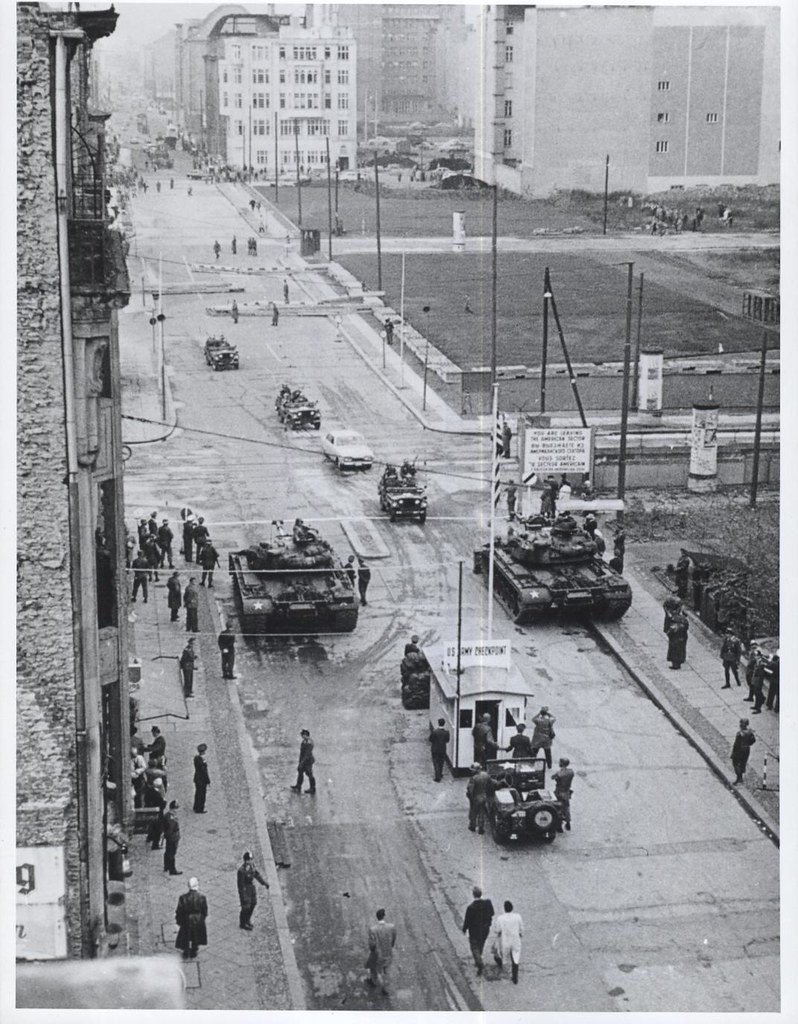
On October 27, 1961, American and Soviet tanks faced each other across Friedrichstrasse at Checkpoint Charlie, guns aligned down one of the narrowest symbolic corridors of the Cold War.[1][5] In later memory, the episode often shrinks into a single image: steel nose to steel nose, one wrong move away from a superpower firefight. That image is real, but it can mislead. The tank line was the surface expression of a more technical dispute.
The dispute was about who had the right to inspect, delay, or normalize Allied movement into East Berlin after the Wall went up on August 13, 1961.[1] The Americans were not trying to tear down the Wall at Friedrichstrasse. They were testing whether East German police could quietly convert an access point used by U.S. officials into a checkpoint under East German sovereign control. Once that question is centered, the crisis reads differently. It becomes a reconstruction of escalation by probe, then de-escalation by objective change.
The archival image used here was taken on October 26, 1961, one day before the tank confrontation, and it catches the crisis at its truest scale: U.S. diplomats being escorted by U.S. Military Police into East Berlin after an initial stop at the border.[8] That is the right visual key. Armor came later. First came argument by procedure.
Time anchors: how four days built the standoff
- August 13, 1961: East Germany seals the sector border and begins building the Berlin Wall.[1]
- October 22, 1961, 7:15 p.m.: Mission official E. Allan Lightner Jr. is stopped at Friedrichstrasse, refuses to show identification to East German police, waits for a Soviet officer, then proceeds with U.S. military escort.[2]
- October 25, 1961: General Albert Watson tells Soviet commandant Solovyev that an "explosive situation" has been allowed to develop because East Berlin police are illegally trying to control U.S. personnel entering the Soviet sector.[3]
- Late October 27, 1961: Soviet tanks move up opposite U.S. tanks at Checkpoint Charlie; by midnight the Soviet number reaches 30.[5]
- October 27, 1961, 10:03 p.m. Washington time: the State Department orders that further armored "probes" be deferred because they have already accomplished their purpose.[6]
- October 28, 1961, 10:30 a.m. Berlin time: Soviet tanks begin to withdraw; the U.S. reciprocates.[1][5]
- October 30, 1961: Washington concludes it has achieved a favorable result because the Soviets have effectively admitted responsibility for the Friedrichstrasse regime.[7]
Those markers show why the crisis should be reconstructed as a chain rather than a single flashpoint. The tanks were the fourth act, not the first.
1) The problem was paperwork only on the surface
The Office of the Historian's overview makes the broad issue plain: after the Wall went up, a dispute emerged over whether East German or Soviet guards were authorized to examine the travel documents of U.S. diplomats at the crossing.[1] That wording matters. The argument was not simply over convenience or etiquette. In Berlin's legal-political geometry, being checked by East German police implied that Allied rights were now mediated by East German authority. Washington's position was that the Soviets, not East German police, remained the relevant occupying power for this access question.[1][4]
Lightner's October 22 telegram shows the dispute in operational detail. He was stopped, asked for identification, refused, waited for a Soviet officer who did not appear in time, and eventually moved ahead with a U.S. military escort after nearly two hours of delay.[2] The East German police position, as reported in the cable, was straightforward: no civilian could enter without showing identification.[2] The American response was just as deliberate: refusal, insistence on the right of entry, and movement only under Allied military cover.
This is where the article's central inference begins. Taken together, the documents suggest that both sides understood the real issue as precedent. If East German police could make one U.S. official produce papers today, they could turn an occupation-rights question into a routine border procedure tomorrow. The result would not merely be inconvenience. It would be a small but consequential transfer of authority.[1][2][4]
2) Why the Americans answered with escorted probes
The famous mistake in popular retellings is to assume the tanks appeared because tempers simply flared. The record is colder than that. The American side answered the initial stop with repeated escorted entries, not because theatergoers mattered in themselves, but because repeated passage was the cleanest way to test whether the East German demand would stick.[2]
The Lightner cable records this almost mechanically. After the first escorted crossing, he repeated the performance; later additional U.S. and French mission cars also entered and returned.[2] The point was not sightseeing. The point was to deny the other side a settled new procedure.
By October 25, General Watson made the U.S. interpretation explicit to the Soviet commandant. His protest said the Soviets had allowed a "potentially explosive situation" to develop at Friedrichstrasse because East Berlin police were illegally attempting to control passage of U.S. personnel into the Soviet sector.[3] That phrase is useful because it shows Washington still locating responsibility one level above the East Germans. The Americans were signaling that this was a Soviet problem to fix.
The CIA archival image from October 26 helps the reconstruction here.[8] It does not show tanks. It shows escorted diplomats. That is the intermediate stage the later iconography tends to erase. Before Checkpoint Charlie became a tableau of armored brinkmanship, it was a contest over whether escort, not document inspection, would define Allied passage.
3) How a procedure fight became a tank encounter
The escalation to armor happened because each side tried to communicate control without firing. The Office of the Historian summary notes that U.S. tanks were stationed on the western side after the checkpoint dispute, and Soviet tanks then took up positions on the eastern side because Moscow feared the United States might either break through the checkpoint or move against the Wall itself.[1] Whether or not Washington intended anything so expansive, the Soviet response reveals how unstable the signaling environment had become.
FRUS document 196 gives the compressed sequence. Late in the afternoon of October 27, ten Soviet tanks advanced up Friedrichstrasse opposite the American tanks; by midnight the Soviet side had thirty there.[5] Clay immediately used the Soviet appearance to argue publicly that Moscow itself was responsible for the harassment of U.S. officials trying to enter East Berlin.[5]
That is another important reconstruction point. Clay was not only facing a military problem. He was making a political attribution argument in real time: if Soviet tanks were now physically backing the checkpoint regime, then Soviet responsibility could no longer hide behind East German police procedure.[5] In that sense, the standoff was both a risk and a proof.
Here the crisis begins to look less like uncontrolled drift and more like a calibration crisis. Each side wanted its signal understood. Neither side wanted the other side's local agents to establish facts on the ground. But both were also now working under a terrifying constraint: the signal had become armor.
4) The decisive turn came when Washington changed the objective
The most revealing document in the file is not the tank note itself but the instruction sent from Washington at 10:03 p.m. on October 27. It says the "probes to date have accomplished their purpose" and orders further probes with civilian officials in escorted vehicles to be deferred.[6] That is the hinge of the whole episode.
Once Washington wrote that line, the crisis objective changed. The point was no longer to keep raising pressure until a maximal procedural victory was extracted at the checkpoint. The point was to stop after enough had been demonstrated. One civilian official would still attempt a daily crossing, but the more provocative escorted and armored pattern was paused.[6]
That change makes sense only if Kennedy and the State Department believed the essential political fact had already been established. Three days later they said so openly. On October 30, Washington told Bonn and Clay that the President felt the United States had achieved a "favorable result" in provoking Soviet intervention in the Friedrichstrasse situation, and that this clear admission of responsibility now justified moving ahead on a reciprocal basis.[7] In plain terms: once Moscow had visibly owned the checkpoint problem, Washington no longer needed to prove the point with additional brinkmanship.
This is the strongest causal claim the documentary record supports. The tanks did not disappear because the underlying issue had been solved cleanly. They disappeared because the U.S. leadership decided that proof of Soviet responsibility was enough to bank as a political result.[1][5][6][7] That is not the same thing as victory, but it is the clearest explanation for why the escalation stopped where it did.
5) What the crisis actually settled, and what it did not
The standoff did not remove the Berlin Wall. It did not dissolve the legal ambiguities of divided Berlin. It did not produce a dramatic concession that made the Americans look triumphant. What it did was narrower and more durable: it clarified that access disputes of this kind could not be normalized through East German police initiative alone without immediately pulling Moscow into the frame.[1][4][7]
That is why Ambassador Thompson's message from Moscow matters. In his October 27 conversation with Gromyko, he said East German police had changed a practice that had existed for sixteen years.[4] The formulation shows what Washington believed it was defending: continuity of an established Allied-access regime against incremental redefinition. The checkpoint therefore mattered less as a geographic gate than as a legal edge.
The same point helps explain why the article resists treating the episode as pure apocalypse theater. The risk of war was real; the sources leave no doubt about that.[1][3][5] But the mechanism of escalation was bureaucratic before it was ballistic. Delays, escorts, protests, repeat entries, armored backing, reciprocal withdrawal: the whole sequence moved through procedures that had become existential because the city itself was legally and militarily overdetermined.
Why the image of tanks survives
The tank photograph survives because it compresses the Cold War into one frame. But the better historical question is what had to happen for tanks to become the language of a document-check dispute. The answer, reconstructed from the U.S. documentary record, is that a challenge over who could inspect Allied officials at Friedrichstrasse quickly became a test of recognition, occupation rights, and Soviet accountability.[1][2][3][4] Once Moscow visibly stepped in, the Kennedy administration could step back from repeated probes and call the essential point proven.[6][7]
That is why Checkpoint Charlie remains so instructive. It shows how superpower crises do not always begin with grand strategy in the abstract. Sometimes they begin with a line of police, a refused document, and a government deciding that if it yields on procedure, it may later lose on sovereignty.
Sources
- U.S. Department of State, Office of the Historian, "The Berlin Crisis, 1958-1961" — background on the Wall, access rights, the tank standoff, and the reciprocal withdrawal.
- Foreign Relations of the United States, 1961-1963, Volume XIV, Document 186, "Telegram From the Mission at Berlin to the Department of State," October 23, 1961 — Lightner's account of the October 22 stop and escorted crossing.
- Foreign Relations of the United States, 1961-1963, Volume XIV, Document 192, "Telegram From the Mission at Berlin to the Department of State," October 25, 1961 — Watson's protest that an "explosive situation" had developed at Friedrichstrasse.
- Foreign Relations of the United States, 1961-1963, Volume XIV, Document 194, "Telegram From the Embassy in the Soviet Union to the Department of State," October 27, 1961 — Thompson's report that East German police had changed a sixteen-year practice.
- Foreign Relations of the United States, 1961-1963, Volume XIV, Document 196, "Editorial Note" — Soviet tanks move up on October 27, 1961, rise to 30 by midnight, and begin withdrawing on October 28.
- Foreign Relations of the United States, 1961-1963, Volume XIV, Document 197, "Telegram From the Department of State to the Mission at Berlin," October 27, 1961 — Washington orders that further probes be deferred because they have accomplished their purpose.
- Foreign Relations of the United States, 1961-1963, Volume XIV, Document 201, "Telegram From the Department of State to the Embassy in Germany," October 30, 1961 — the President judges that the U.S. has achieved a favorable result by provoking Soviet intervention in the Friedrichstrasse issue.
- Central Intelligence Agency, "Checkpoint Charlie," Flickr archival photo page — image description identifying the October 26, 1961 escorted entry into East Berlin.