The Tet Offensive is often summarized in one blunt formula: a communist military failure that became a political turning point for the United States.[1][2] That formula is useful, though it can flatten the actual sequence. The sharper historical question is how a campaign that failed to trigger the nationwide uprising Hanoi wanted still managed to break the Johnson administration's story that the war was moving toward control.[1][2][4] The answer sits in timing, location, and perception. Tet carried the war into cities that had been central to the claim of progress, forced Americans to watch fighting in places they had been told were increasingly secure, and then stretched that shock through the prolonged battle for Hue and the widening sense of stalemate that followed.[1][2][5]
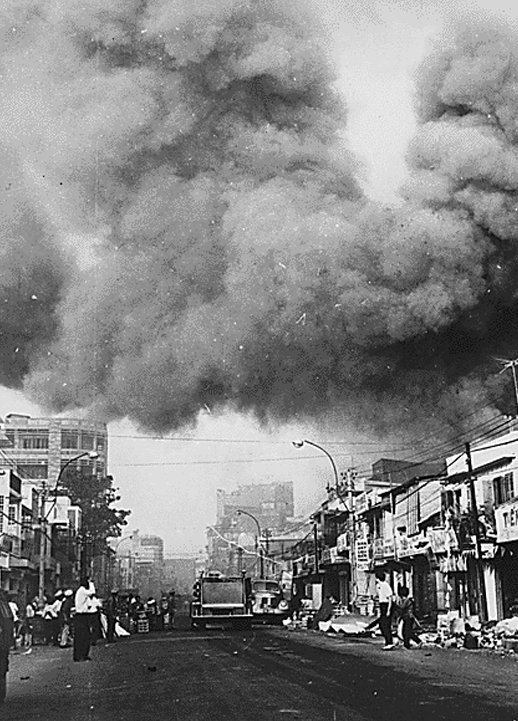
That is why the cover image works.[3] The black smoke over Saigon is not just a record of damage. It captures the article's central point: Tet changed the war when urban visibility outran official reassurance. Once the offensive made city fire, embassy alarms, and house-to-house combat part of the public memory of 1968, the administration could still argue that the enemy had paid a terrible military price. It was much harder to argue that the existing strategy had the war under control.[1][2][4]
Timeline anchors
- 1967-11-21: General William Westmoreland returns to Washington and delivers a highly optimistic National Press Club address, helping sustain the idea that U.S. strategy is making visible progress.[2]
- 1968-01-21: the battle of Khe Sanh begins, drawing American attention toward the northern frontier just before the wider offensive.[2]
- 1968-01-30 to 1968-01-31: North Vietnamese and Viet Cong forces launch coordinated Tet attacks across more than 100 towns and cities in South Vietnam.[1][2]
- 1968-01-31: communist units breach the grounds of the U.S. Embassy in Saigon, creating one of the offensive's most durable symbolic scenes.[2]
- 1968-02-27: Walter Cronkite broadcasts his now-famous judgment that the war appears headed toward stalemate, crystallizing a wider public mood already forming after Tet.[2]
- 1968-03-31: President Lyndon B. Johnson addresses the nation, concedes the scale of Tet's disruption, announces a partial bombing halt, and says he will not seek reelection.[4]
Those dates matter because they show that Tet was not one night of surprise followed by instant political collapse. It was a chain. Pre-offensive optimism, synchronized attacks, the embassy shock, the drawn-out struggle in Hue, and then the March political reckoning all had to accumulate before the offensive fully changed the war's meaning.[1][2][4][5]
1. The offensive hit the exact places that made the progress story believable
The Johnson administration had spent much of 1967 defending a war of attrition with a confidence that depended on distance. Body counts, pacification reports, and public statements from military leadership suggested that the United States and South Vietnam were wearing the enemy down even if final victory remained elusive.[2] The National Archives Museum page makes that contrast explicit by placing Westmoreland's late-1967 optimism directly beside the January attacks.[2] Tet was therefore dangerous before the first shots were fired in Saigon. It targeted the narrative frame in which the war was being sold.
The State Department historian's overview describes the offensive as a coordinated strike during the lunar new year against a wide range of targets in South Vietnam.[1] That breadth was the point. Hanoi and the Viet Cong did not need every attack to hold. They needed the offensive to demonstrate reach, to show that forces the United States claimed to be containing could still surface inside provincial capitals and major cities during a holiday cease-fire period.[1][2] Once that happened, the war stopped looking like a distant grind happening mostly at the edges. It looked porous.
This is why Tet's military outcome and psychological outcome diverged so sharply.[1][2] Communist forces suffered devastating losses, and the hoped-for general uprising never came.[1][4] Yet the offensive still broke something important, because it forced Americans to judge the war through breached urban confidence rather than through cumulative attrition data. A strategy can survive bad numbers for a time. It has a harder time surviving scenes that contradict its own picture of control.
2. Saigon mattered because the embassy breach turned insecurity into a public image
The fighting in Saigon did not mean that the city fell, and it did not mean that the embassy was captured in any durable way.[2][4] What it did mean is that a heavily guarded symbol of American presence could no longer be imagined as comfortably insulated from the war around it. The National Archives Museum highlights a memorandum from Walt Rostow informing Johnson of the embassy breach on January 30, 1968.[2] The memo matters less as a bureaucratic artifact than as evidence of how quickly the symbolic center of the war had become unstable.
The black-smoke photograph on the National Archives Tet page reinforces the same problem from another angle.[3] This is not jungle combat hidden from television. It is a capital city burning during a holiday that was supposed to stage a temporary pause. Once that image enters the story, official claims of progress have to fight the city's own skyline.
The pressure on interpretation grew because Saigon was not just another battlefield.[1][2] It was the place where the South Vietnamese state was supposed to look governable, where American personnel were concentrated, and where confidence in the urban order mattered most. If communist forces could create chaos there, even briefly, then the public could reasonably wonder what other assurances had been overstated. Tet's force came from that widening doubt.
3. Hue prevented the offensive from being dismissed as a short-lived raid
If Saigon supplied the shock, Hue supplied duration.[2][3][5] One temptation after the first communist losses was to describe Tet as a series of spectacular but doomed strikes that were already burning out. Hue complicated that reading. The Army's retrospective on the siege states that the attack on Hue was one of the strongest and most successful operations of the offensive and that the five-week battle there was the only case in which communist forces held a significant portion of a city for more than a few days.[5]
That distinction matters historically because it stretched Tet from a surprise into a campaign.[2][5] House-to-house fighting in Hue made the offensive look less like a temporary penetration and more like proof that the war's urban front was deeper and costlier than many Americans had been led to expect. The National Archives Tet page also points to Hue as central by describing it as the most crucial part of Hanoi's plan and by foregrounding refugee and battle imagery tied to the city.[3]
Hue therefore altered the political meaning of battlefield recovery. American and South Vietnamese forces could eventually retake ground and still lose the larger argument.[1][2][5] Every extra day of fighting inside the former imperial capital made it harder to restore the old claim that the enemy was nearing exhaustion. Tet did not have to hold cities forever to wreck confidence. It only had to show, in one especially important city, that the war could still turn urban, bloody, and protracted.
4. The credibility gap widened when battlefield recovery still required a new political explanation
The National Archives Museum page identifies the next turn clearly: once a Defense Department request for 205,000 additional troops leaked, many Americans concluded that the war was stalemated and that the administration had not been leveling with them.[2] This is where Tet became more than a tactical surprise. It became a crisis of trust.
Johnson's March 31, 1968 address to the nation shows the administration trying to live inside that contradiction.[4] The President insisted that the attacks had failed in their principal objectives, had not destroyed South Vietnam's government, and had not produced the general uprising the communists hoped for.[4] On the narrow battlefield point, he was right. Yet the same speech also acknowledged that Tet had caused "widespread disruption and suffering," made "half a million" people into refugees, and might mark 1968 as a year of decision in the war.[4] The speech's structure is the historical clue. Johnson was still arguing military resilience while already moving toward political de-escalation.
That is why the offensive changed the war before it changed the map. By March 31, the United States had repelled Tet's urban attacks, but it no longer possessed the same authority to explain the war in forward-moving terms.[2][4] Johnson limited bombing and withdrew himself from the coming presidential race not because Hanoi had won the campaign on the ground, but because Tet had made the existing strategy harder to sustain politically.[2][4]
The bounded conclusion
The Tet Offensive became a turning point because it forced Americans to judge the war by visible contradiction rather than by official accumulation.[1][2][4] The communist side did not achieve its most ambitious goals. The attacks failed to trigger a general uprising, and the battlefield cost to North Vietnamese and Viet Cong forces was severe.[1][4] Even so, Tet carried the war into urban spaces that mattered to the administration's credibility, turned the embassy breach in Saigon into a public symbol of insecurity, prolonged the crisis through the battle of Hue, and then exposed the gap between military recovery and political confidence.[2][3][5]
That is the most durable lesson of the sequence. A war can repel an offensive and still come out looking less winnable than before. Tet's real damage landed in the story the United States was telling about the war. Once that story broke, the military map alone could not put it back together.
Sources
- Office of the Historian, U.S. Department of State, "U.S. Involvement in the Vietnam War: The Tet Offensive, 1968."
- National Archives Museum, "Episode 7: Tet Offensive."
- National Archives, "Vietnam's Tet Offensive: 50 Years Later."
- LBJ Library, "The President's Address to the Nation Announcing Steps To Limit the War in Vietnam and Reporting His Decision Not To Seek Reelection, March 31, 1968."
- The United States Army, "Trapped, Soldiers endure brutal firefight during siege of Hue."