The Munich Agreement is so famous as a warning word that it can become strangely abstract.[3][4] "Munich" often means appeasement, weakness, or a failed attempt to buy time. That memory is not wrong, but it can flatten the thing that mattered most in late September 1938: the actual document. Read closely, the agreement does not sound like a balanced peace settlement. It sounds like a timed transfer order. The cession is treated as already accepted in principle, evacuation begins almost immediately, German troops move in by stages, and the surviving guarantee for what remains of Czechoslovakia is deferred into a later and weaker future.[1][2]
That sequence is the key. If you start with the rhetoric that followed Munich, you get a moral parable about false reassurance. If you start with the text itself, you get something more precise. The agreement does not begin by asking whether Czechoslovakia should surrender border territory. It begins after that question has effectively been settled, and then turns to administration: dates, maps, commissions, plebiscites, population options, prisoner releases, and staged occupation.[1] The political argument is embedded in the order of those clauses. The transfer was urgent; the guarantee was secondary.[1][2]
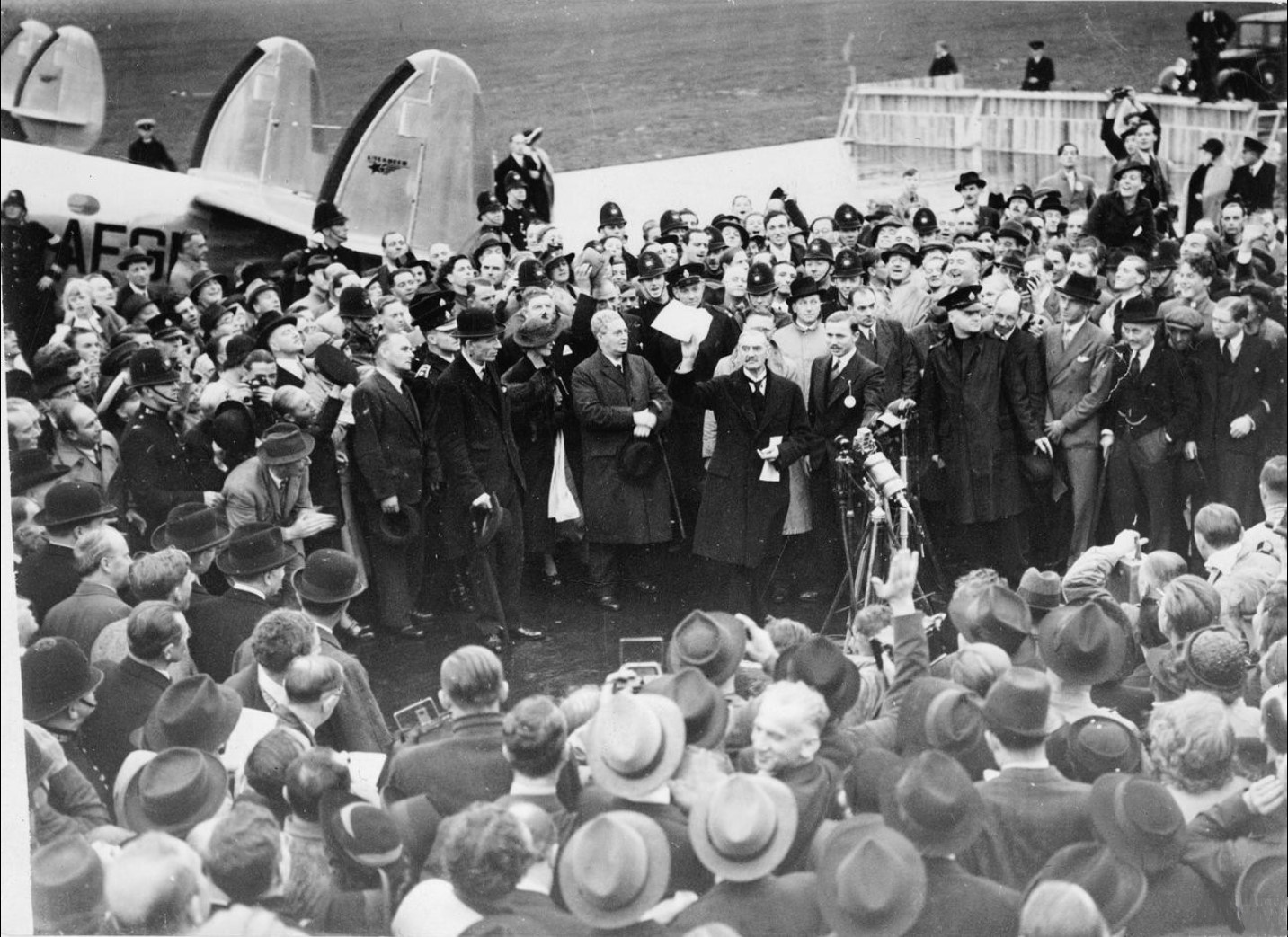
The lead image catches exactly the right historical mismatch.[6] It shows Neville Chamberlain at Heston Aerodrome on September 30, 1938, holding up the paper that entered public memory as proof of "peace for our time."[6] That sheet was the public emblem. The Munich text was the operating mechanism. One became reassurance in the photograph. The other set the border schedule on the ground.[1][6]
Timeline anchors
- September 21, 1938: under intense Anglo-French pressure, the Czechoslovak government accepts major territorial concessions in principle.[3]
- September 29-30, 1938: Germany, Britain, France, and Italy sign the Munich Agreement; Czechoslovakia is not a party to the negotiations.[3][4][5]
- October 1, 1938: evacuation and staged German occupation begin under the agreement's first operative clauses.[1][4]
- October 10, 1938: the main occupation schedule is to be completed.[1][4]
- Within four weeks of the agreement: Czechoslovakia must release Sudeten Germans from military or police service on request and free Sudeten German political prisoners.[1]
- March 15, 1939: Germany occupies the rest of the Czech lands, showing how little the Munich structure had secured.[3][5]
1. The text starts after cession has already been assumed
The most important sentence in the agreement may be the one that comes before the numbered clauses. The four powers declare that, "taking into consideration the agreement, which has been already reached in principle for the cession to Germany of the Sudeten German territory," they are now setting the terms that will govern that transfer.[1] That framing matters. The document is not written as a negotiation over whether cession should happen. It is written as the management plan for cession that has already been decided.
This is one reason the agreement reads so coldly. The argument about sovereignty has effectively been moved offstage. What remains onstage is implementation. That is also why the question of who was present matters so much. Britannica notes that the two Czech diplomats waiting in Munich were not admitted to the conference room or consulted on the agenda, while USHMM states plainly that Czechoslovakia was not a party to the negotiations and accepted the result only under heavy pressure from Britain and France.[3][4] The agreement's preface and the conference procedure tell the same story. Decision first, Czech consent afterward.
The Bundesarchiv summary makes the point with unusual bluntness, stating that the four powers decided the transfer "over the head of the Czechoslovak government."[5] That phrase is worth lingering over, because it clarifies the political form of Munich. This was not a multilateral settlement among equals. It was a major-power arrangement imposed on a state whose most defensible frontier and military infrastructure lay inside the territory being surrendered.[3][4][5]
2. The calendar is the real argument of the agreement
Once the agreement enters its numbered clauses, the logic becomes even clearer. Clause 1 says simply: "The evacuation will begin on 1st October."[1] Clause 2 adds that evacuation must be completed by October 10 and that the Czechoslovak Government will be held responsible for carrying it out without damage to existing installations.[1] Clause 4 then sets the matching occupation schedule: German troops begin entering on October 1, the marked territories are to be occupied in sequence over the next week, and the remaining predominantly German territory is to be determined and occupied by October 10.[1]
That is not the language of a settlement waiting for stability. It is the language of a surrender clock already in motion. Evacuation and occupation are twinned from the first day. The Czech state is responsible for handing over territory intact; the German army is authorized to enter on the same timetable.[1] The sequence does not create breathing room in which political guarantees might be tested before the frontier changes. It reverses that order. The frontier changes at once, and the question of safety is pushed to later language and later faith.[1][2]
Even the later administrative clauses reinforce the asymmetry. The agreement provides for population options, a German-Czechoslovak commission to sort the terms of transfer, and the release within four weeks of Sudeten Germans from military or police service as well as those imprisoned for political offenses.[1] These clauses may look technical, but they do political work. They continue to treat Czechoslovakia as the party that must adjust itself rapidly to a transfer whose larger premises it did not control.[1][4]
3. The "international" machinery came after the core concession, not before it
One easy way to misremember Munich is to assume that the international commission softened the agreement's coercive force. The text shows something narrower. Clause 3 says the conditions of evacuation will be laid down in detail by a commission composed of representatives of Germany, the United Kingdom, France, Italy, and Czechoslovakia.[1] Clause 5 gives that commission authority to determine plebiscite territories and conditions. Clause 6 lets it carry out the final determination of frontiers and even recommend minor modifications.[1]
This sounds procedural, and it was. But the procedure arrived after the decisive concession had already been made. The commission did not decide whether the Sudetenland would be ceded. It handled the remainder: which disputed areas would vote, how the occupation map would be refined, and how frontiers would be finalized after the main clock had begun.[1] In other words, the machinery was not neutral arbitration standing before force. It was supervised administration operating after the central transfer had already been accepted.[1][3]
That is why the commission should be read as part of Munich's structure rather than its remedy. It internationalized the execution of cession. It did not internationalize an equal bargaining table. The strongest evidence is again the order of the text itself. The dates come first. The administrative body comes after the dates.[1]
4. The guarantee for what remained of Czechoslovakia was deferred and conditional
Munich is often remembered as though territory was exchanged for a firm guarantee of peace. The annex shows something weaker. Britain and France entered the agreement, it says, on the basis that they stood by their earlier offer of an international guarantee for the new boundaries of the Czechoslovak state against unprovoked aggression.[2] Germany and Italy, however, would provide their guarantee only after the question of the Polish and Hungarian minorities in Czechoslovakia had been settled.[2]
That is the guarantee gap at the center of the document. The occupation timetable was immediate and explicit. The four-power guarantee was staggered and incomplete.[1][2] Part of the guarantee existed as an Anglo-French promise tied to altered borders; the German and Italian part was postponed until other territorial disputes had been resolved.[2] The structure is revealing. Munich secured the transfer first and treated the security of the remnant state as a later problem.
The afterlife of the agreement makes this reading hard to dismiss as overinterpretation. USHMM notes that German troops occupied the Sudeten regions between October 1 and 10, 1938.[4] Britannica and the Bundesarchiv both stress that the wider promise collapsed quickly, with Germany occupying the rest of the Czech lands in March 1939.[3][5] The later violation matters historically, but even before that violation the document's own design had already ranked transfer above guarantee.[1][2]
The bounded conclusion
Munich became a byword for appeasement because the later outcome was so devastating.[3][4] But its lasting importance also lies inside the wording of the agreement itself. The document assumed cession in advance, synchronized Czech evacuation with German occupation, pushed disputed details into an international commission after the main concession, and deferred the full guarantee for what remained of Czechoslovakia until later questions had been settled.[1][2]
That is why the Heston photograph is such a useful cover for the piece.[6] It preserves the instant when Munich was sold as paper reassurance. The text beneath that performance reads differently. It is an agreement in which the schedule of surrender is concrete and the security promise is delayed. If you want to know why Munich entered history as more than a failed mood, that is the place to start.
Sources
- The Avalon Project at Yale Law School, "Munich Pact September 29, 1938" - full text of the agreement, including the preface, Articles 1-8, the occupation schedule, and the evacuation obligations.
- The Avalon Project at Yale Law School, "Munich Pact: Annex to the Agreement" - the supplementary guarantee language showing Britain and France standing by a guarantee immediately while Germany and Italy deferred theirs until the Polish and Hungarian minority questions were settled.
- Encyclopaedia Britannica, "Munich Agreement" - conference context, the exclusion of the Czechoslovaks from the negotiating room, the October 1938 transfer, and the March 1939 destruction of what remained of Czechoslovakia.
- United States Holocaust Memorial Museum, "Munich Agreement" - concise institutional overview of the parties, the fact that Czechoslovakia was not part of the negotiations, and the October 1-10 occupation timetable.
- Bundesarchiv, "Münchener Abkommen" - German Federal Archives overview emphasizing that the transfer was decided over the head of the Czechoslovak government and tracing the rapid collapse of the settlement by March 1939.
- Wikimedia Commons, "File: MunichAgreement.jpg" - source page for the September 30, 1938 photograph of Neville Chamberlain at Heston Aerodrome used as this article's cover image.