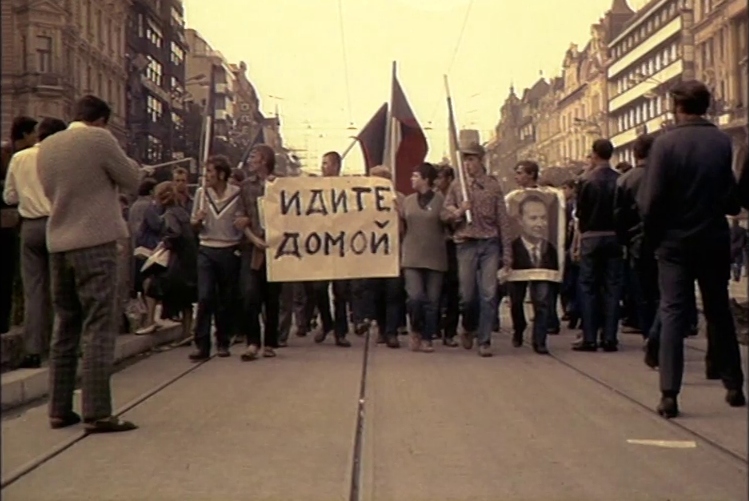
The Prague Spring is often remembered as a brave reform movement crushed by tanks.[1][4] That memory is correct, but it can still be too flat. The sharper historical question is why a reform program that still claimed loyalty to socialism became unacceptable so quickly to the Soviet leadership in 1968.[1][2][4] The answer lies in mechanism, not sentiment. Reform in Czechoslovakia stopped being manageable for Moscow when it ceased to look like a controlled internal adjustment and became a public, fast-moving process: censorship fell, debate escaped the party room, radio and print turned reform into everyday speech, and Soviet leaders began to read the whole experiment through the lens of bloc contagion and 1956.[1][2][3]
That is why the cover image works.[5] The protest signs matter as much as the soldiers. The Prague Spring did not become dangerous to the Kremlin only when troops crossed the border on August 20-21, 1968. It became dangerous earlier, when ordinary people could speak reform in public and when that speech could travel. Tanks ended the season, but the mechanism that made invasion thinkable was the widening public sphere before the invasion.
Timeline anchors
- January 5, 1968: Alexander Dubcek replaces Antonin Novotny as first secretary of the Communist Party of Czechoslovakia.[1][4]
- March 25, 1968: the U.S. Embassy in Prague reports that the real uncertainty now lies in the "scope of domestic democratization" and in how the Soviets will react to it.[2]
- April 1968: the Czechoslovak government issues its formal reform plan, while censorship is lifted and open debate expands.[1][3]
- August 20-21, 1968: Soviet-led Warsaw Pact forces invade Czechoslovakia and move quickly on Prague, transport links, and communications.[1][3]
- April 1969: Dubcek is forced from power, and the reform opening is closed down under a more conservative leadership.[1]
Those dates matter because they show that the Prague Spring was not a single moral drama that ran straight from hope to invasion. It moved in stages: leadership turnover, reform design, public acceleration, Soviet alarm, and then military suppression.[1][2][4]
1. The opening began as bounded reform inside socialism, not as a clean exit from it
One reason the Prague Spring still matters is that it was not initially framed as an anti-socialist revolution.[1][4] Britannica traces the crisis back to the early 1960s, when economic weakness, dissatisfaction in Slovakia, and growing unrest among writers and students eroded Novotny's authority.[4] The change at the top in January 1968 therefore came out of a real domestic crisis. Czechoslovakia's leadership was trying to rescue a stagnating system, not to abolish politics overnight.
The State Department summary makes the boundary clear. In April 1968 the government issued a formal reform plan that aimed to liberalize within the existing Marxist-Leninist framework and did not propose a full revolutionary overhaul of the state.[1] That point matters because it defines the original scale of the experiment. Dubcek's project was not yet a Warsaw Pact exit plan or a declaration of pluralist sovereignty in the Western sense. It was an attempt to soften rule, recover legitimacy, and make socialism livable enough to survive.
That bounded starting point is precisely what makes the later Soviet response historically revealing.[1][2] If Moscow had faced an immediate armed break or a formal withdrawal from the alliance, the logic of intervention would look more routine. Instead, it confronted a reform movement that remained officially socialist while changing the way authority circulated at home. The threat emerged from the form of political loosening, not from a signed geopolitical defection.
2. The decisive change came when censorship fell and reform escaped the party room
The Prague Spring became harder to contain once reform stopped being a platform and became a medium.[1][3] The State Department account says the Dubcek government ended censorship in early 1968, and that this new freedom produced broad-based public support for reform and a public sphere in which government and party policy could be debated openly.[1] That sentence is the core of the mechanism. The issue was no longer only what leaders wanted to do. The issue was that many more people could now participate in defining what reform meant.
The March 25, 1968 embassy telegram in Foreign Relations of the United States catches this shift while it was still underway.[2] The embassy judged that Prague would probably avoid reckless foreign-policy gestures, but said the real uncertainty was the eventual scale of domestic democratization and the Soviet response to it.[2] In other words, observers on the ground did not yet treat the main risk as an immediate military realignment toward the West. They treated it as the widening internal political process itself.
Radio Prague shows what that widening looked like in lived form.[3] One former journalist recalled that before the spring, writers knew what was unacceptable and practiced heavy self-censorship; during the Prague Spring, that censorship structure was scrapped.[3] This is not a decorative cultural detail. It explains why the reform wave accelerated. Once speech no longer stayed inside elite channels, reform could gain tone, audience, and momentum beyond what party managers could easily meter.
That also explains why the radio building became symbolically central in August 1968.[3] A regime can tolerate a memo more easily than a microphone. When reform becomes broadcast, it stops being only a policy correction and starts becoming a rival political rhythm. The Prague Spring crossed Moscow's tolerance line when public communication began to move faster than bloc discipline.
3. Moscow read that open public sphere as a contagion risk across the whole bloc
The Soviet leadership did not have to believe that Czechoslovakia had already left the alliance in order to decide that the experiment was intolerable.[1][2] The State Department overview says Soviet leaders remembered Hungary in 1956 and feared that if reforms in Prague went too far, other satellite states in Eastern Europe might follow, while Soviet republics such as Ukraine, Lithuania, Latvia, and Estonia might make their own demands for liberalization.[1] That is a contagion logic.
The FRUS telegram reinforces the same reading from another angle.[2] Embassy officials saw no sign that Prague wanted reckless foreign-policy adventures, yet they still treated Soviet reaction to domestic change as the core uncertainty.[2] Taken together, the two sources suggest a crucial boundary. Moscow's problem was not just Czechoslovakia as one country. It was the precedent of a communist state showing that censorship could be lifted, criticism could become public, and the party might still remain formally in charge for a while.
That fear helps explain why the eventual intervention was so broad.[1] The Kremlin was not merely trying to rebut one speech or reverse one administrative reform. It was trying to stop a political demonstration from becoming reproducible elsewhere. The Prague Spring threatened Soviet control because it implied that the bloc's internal rules could be loosened without an immediate collapse of order. That possibility was dangerous precisely because it looked imitable.
4. The invasion targeted circulation itself: cities, transport, and broadcasting
Once Moscow decided to intervene, it moved against the channels that had allowed reform to become public.[1][3] The State Department history says Soviet-led forces had already positioned troops under cover of Warsaw Pact exercises and, when they invaded on August 20-21, swiftly took control of Prague, other major cities, and communication and transportation links.[1] That is a map of political circulation. The occupiers did not aim only at ministries. They aimed at the infrastructure through which public agency moved.
Radio Prague's account makes the same pattern concrete.[3] On the morning of August 21, the station broadcast a party statement condemning the invasion, Prague citizens gathered outside the building, clashes followed, and by 8 a.m. Soviet soldiers had occupied the site.[3] The details matter because they show how fast invasion and communication collided. The radio building was not incidental theater. It was one of the places where the spring had become audible to the country.
The Soviet calculus also depended on an external assumption.[1] The State Department notes that, given U.S. involvement in Vietnam and established patterns of non-intervention in the Eastern Bloc, Soviet leaders correctly guessed that Washington would condemn the invasion but not intervene militarily.[1] That meant Moscow could act on its contagion fears without expecting a direct superpower showdown. Internal bloc discipline, not detente optics, got priority.
This is also why the aftermath mattered. The same State Department page says the invasion later fed what became known as the Brezhnev Doctrine, the claim that Moscow could intervene where communist rule appeared threatened.[1] The doctrine was not an afterthought. It was the ideological formalization of the mechanism the invasion had already enforced by force.
The bounded conclusion
The Prague Spring failed because bounded reform turned into an unbounded public process faster than Soviet bloc politics could absorb.[1][2][3][4] Economic frustration, student and writer unrest, and leadership change created the opening.[1][4] The removal of censorship then transformed that opening into a visible social field, where reform was no longer merely drafted by party officials but spoken, argued, and defended in public.[1][3] Moscow read that shift as a precedent that could travel across the bloc, decided that domestic democratization itself was the danger, and then used invasion to cut the lines through which reform had been circulating.[1][2]
There is a necessary limit to that conclusion. The Prague Spring was not yet a full Western-style democratic transition, and the sources do not support describing it as a settled plan to leave socialism or the Warsaw Pact.[1][2][4] That limitation is what makes the episode more revealing, not less. Czechoslovakia showed how much could become intolerable to Moscow before formal exit was even on the table. The red line lay not only at secession. It lay at the point where speech, reform, and public confidence began to outrun imperial supervision.
Sources
- Office of the Historian, U.S. Department of State, "Soviet Invasion of Czechoslovakia, 1968" - on Dubcek's reforms, the end of censorship, Soviet fears of bloc contagion, the invasion sequence, and the later Brezhnev Doctrine.
- Foreign Relations of the United States, 1964-1968, Volume XVII, "Telegram From the Embassy in Czechoslovakia to the Department of State, Prague, March 25, 1968" - on the uncertain scope of domestic democratization and the question of Soviet reaction.
- Radio Prague International, "The Prague Spring" - on the scrapping of censorship, the radio building as a focal point on August 21, 1968, and the occupation of the station by Soviet forces.
- Encyclopaedia Britannica, "Prague Spring" - on economic stagnation, student and writer unrest, the fall of Novotny, and the January-August 1968 chronology.
- Wikimedia Commons, "File:Prague-1968-protest.jpg" - source page for the archival protest photograph used as this article's cover image.