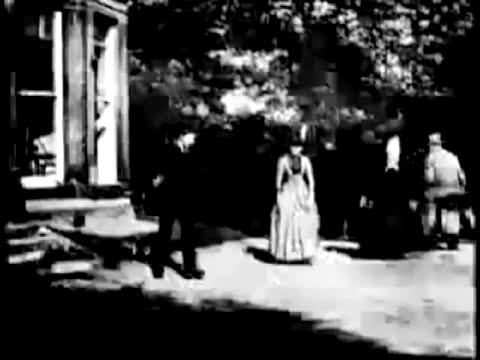
The oldest moving images are easy to treat as trophies: first this, earliest that, a two-second proof that cinema had technically begun. Roundhay Garden Scene deserves better than that. Its historical force does not come only from priority. It comes from scale. Before motion pictures became theaters, studios, stars, newsreels, and state archives, one surviving sequence shows four people trying to stay inside a small garden frame in Leeds on October 14, 1888.[2][4]
That modest setting is the point. Louis Le Prince was not filming a public ceremony or an industrial crowd. He was working with family and household proximity: Joseph and Sarah Whitley, his in-laws; his son Adolphe; and Harriet Hartley in the garden at Oakwood Grange.[2][4] The people in the frame do not act as though they are founding a medium. They circle, turn, and test the camera's narrow field as if the problem were practical: keep moving, remain visible, do not drift out of the machine's attention.
The sequence also sits before the familiar public origin story of cinema. The Lumiere brothers' Paris screenings in 1895 made projected moving pictures into a commercial public event, and Thomas Edison built an industrial apparatus around viewing machines and production. Le Prince's case is different. The National Science and Media Museum account stresses that Edison and the Lumieres dominated the later headlines, while Le Prince had already produced moving-picture work in Leeds years earlier.[3] That gap between technical achievement and public system is why Roundhay remains so strange. It is not the birth of the movie business. It is evidence that moving-picture possibility had already flickered in a private garden.
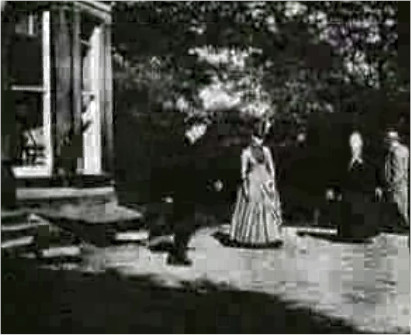
The survival chain is just as important as the scene. A Wikimedia Commons record for the National Science Museum's later copy of the sequence describes frames from Roundhay Garden Scene preserved from a 1930 copy.[2] In other words, we are not simply watching 1888. We are watching 1888 mediated by a later act of preservation after fragile originals had passed through family custody, museum handling, copying, and eventual digital circulation. The artifact is early cinema and archival history at once.
The Archival Film
The embedded clip is a YouTube upload of Roundhay Garden Scene.[1] The upload itself is not the archival authority; the provenance comes from the documented National Science Museum copy material and the National Science and Media Museum account of Le Prince's single-lens apparatus.[2][3] That distinction matters. A short online video can make the scene available, but the historical claim rests on the preservation record: a hand-built camera, paper-base photographic film, and a copied sequence preserved after the first material generation became precarious.
What The Frames Show
The first thing to notice is how little the clip tries to explain. There is no title card in the original image, no establishing geography, no public occasion, no staged gag with a payoff. Four figures move in a garden while the camera holds its place. The motion is slight, but it is not empty. Sarah Whitley appears to turn backward; Joseph Whitley's coat tails lift as he moves; the younger figures cross the field with a more deliberate awareness of the camera's boundary.[2][4]
That boundary is the real drama. The participants seem to know that the frame is small and the exposure brief. They are not performing a story so much as performing duration. The scene asks bodies to become visible over time, and the bodies answer by circling. This is why the film can feel oddly modern once the "oldest film" label is set aside. It is a record of people negotiating with a machine that can only recognize them under tight conditions.
The National Science and Media Museum account makes those conditions concrete at the right level: Le Prince's surviving single-lens camera was a bulky wood-and-brass machine that used paper-backed stripping film, a practical apparatus rather than a polished consumer device.[3] That is not a decorative technical detail. It explains why Roundhay looks like a fragile bargain between machine and action. The camera is not yet an invisible production tool. It is a physical constraint around which human motion must be organized.
The date deepens the emotional pressure. Sarah Whitley died on October 24, 1888, ten days after the garden scene was made, according to the Public Domain Review account.[4] The article should not turn that fact into melodrama, but it changes how the footage reads. The film's historical value does not depend on knowing her death date, yet that date shows how quickly ordinary movement can become archival absence. What looks like a casual turn becomes one of the last preserved motions of a specific person.
Why The Apparatus Matters
Le Prince's camera is not a footnote to the scene; it is part of the historical argument. The same National Science and Media Museum account links the single-lens camera to the Roundhay Garden and Leeds Bridge scenes, while Leeds Museums places those moving-image experiments inside Le Prince's late-1880s turn from a multi-lens design to the more practical single-lens system.[3][5] That cluster matters because it shows him testing different kinds of motion: domestic movement, individual performance, and urban traffic. Roundhay is intimate, but it belongs to a broader experiment in making movement repeatable as photographic evidence.
His camera was not only a recorder. It was a wager on a future system. The National Science and Media Museum account notes Le Prince's November 1888 British patent, and the Public Domain Review frames Roundhay as a motion-picture camera experiment rather than a mere still-photography sequence.[3][4] Le Prince was trying to solve more than one problem at once: capture, sequence, and eventual display. The surviving garden frames therefore occupy a threshold. They are not simply still photographs placed side by side, and they are not yet cinema as mass culture would soon know it. They are a working proof that time could be cut into images and reanimated.
That threshold also keeps the "first film" claim disciplined. The Public Domain Review calls Roundhay Garden Scene the world's first film made using a motion-picture camera, while the National Science and Media Museum account emphasizes Le Prince's priority without pretending that recognition arrived cleanly in his lifetime.[3][4] The distinction is useful. History is not a medal table. Earlier experiments in serial photography, optical toys, chronophotography, and projection all matter. Roundhay is decisive because something survives: a few seconds of camera-made motion whose production, apparatus, and later copying can be connected to named people and place.
The Garden Before The Industry
What the clip preserves, then, is not cinema fully born but cinema before it learned to introduce itself. There is no auditorium, no box office, no magazine review, no studio brand, no national audience. There is only a small group moving under experimental pressure. That makes Roundhay unusually good at correcting origin myths. It reminds us that media history often begins in partial systems: an inventor's workshop, a family property, a fragile strip, a later museum copy, and only much later a digital video window.
Leeds Museums' account rightly keeps Le Prince's later mystery in view: he vanished in 1890, before he could publicly consolidate his claim in the way later pioneers did.[5] That disappearance has made his story vulnerable to romance and conspiracy, but the stronger historical lesson is less sensational. Invention without durable institutions can become visible only through what survives. For Le Prince, survival means objects, copied frames, family testimony, museum records, and the short movement of people in a garden.[2][3][5]
That is why the video still matters. It does not overwhelm the viewer; it asks for careful attention. Watch the figures as people, not as props in a "first film" plaque. Watch the frame as a limit, not as a neutral window. Watch the archival chain behind the image, because the sequence reached us through copying and cataloging as much as through invention. Roundhay Garden Scene made cinema small before cinema became an industry. Its smallness is not a weakness. It is the evidence.
Sources
- Everything has its first time, "The First Movie ever made - Roundhay Garden Scene 1888 by Louis Le Prince," YouTube upload of the archival moving-image sequence.
- Wikimedia Commons, "File:Leprince-roundhay-framescopy-1930-nmpft.png" - record for frames of Roundhay Garden Scene by Louis Le Prince, from a 1930 National Science Museum copy.
- National Science and Media Museum, "The mystery of Louis Le Prince, the father of cinematography" - museum account of Le Prince's 1880s camera work, Roundhay and Leeds Bridge scenes, paper-backed stripping film, patents, disappearance, and legacy.
- The Public Domain Review, "Roundhay Garden Scene (1888)" - public-domain film note on the date, setting, participants, and historical status of the surviving sequence.
- Leeds Museums and Galleries, "Life, Mystery and Legacy of Louis Le Prince" - local institutional account of Le Prince's Leeds experiments, single-lens camera turn, disappearance, and legacy.
- Wikimedia Commons, "File:LouisLePrinceFirstFilmEver RoundhayGardenScene.jpg" - archival still from Roundhay Garden Scene used as the article image.