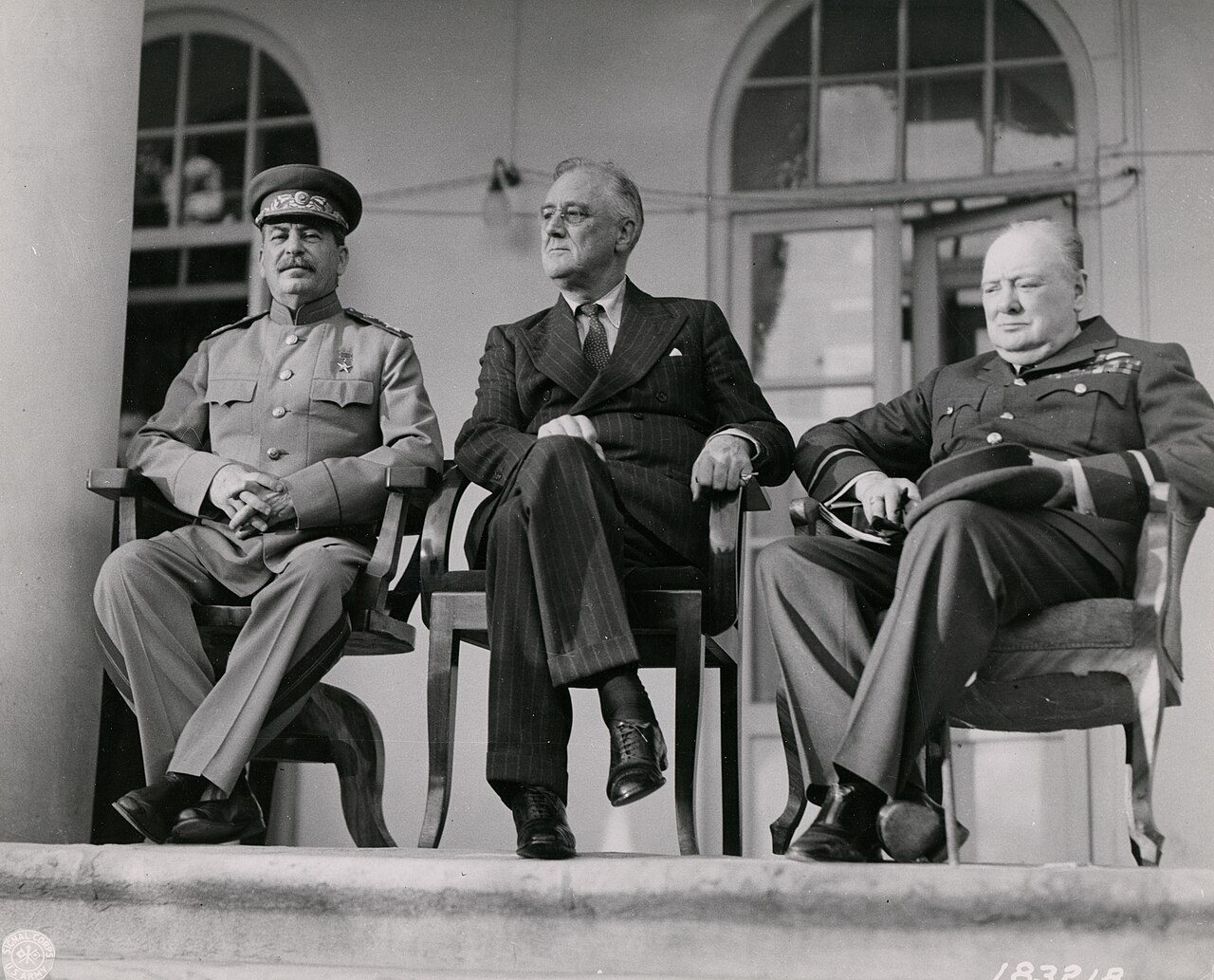
The most famous image from the Tehran Conference shows Joseph Stalin, Franklin D. Roosevelt, and Winston Churchill seated together, composed enough to look almost settled.[4] The paperwork tells a sharper story. Tehran mattered less because the alliance finally found a flattering photograph and more because it turned an unstable coalition into a schedule. In late November and early December 1943, the conference fixed a military rhythm for 1944 and paired that rhythm with a political declaration about Iran, the country that was hosting the summit while Allied power still sat heavily on its territory.[1][2][3]
That is the question worth reading the documents for. What did Tehran actually decide? Not everything later memory loads onto it. The conference did not resolve all postwar disputes, and it did not make later arguments over Poland, Germany, or Soviet power disappear.[1] What it did do was narrower and more consequential in the immediate sense. It locked Operation Overlord to a target month, tied that target to a matching Soviet offensive, and issued a declaration that publicly described Iran not as a disposable corridor of war but as a state whose independence, sovereignty, and territorial integrity the three powers said they wished to maintain.[1][2][3]
Image context: the cover photograph belongs here because it captures the conference's afterlife better than its inner mechanism.[4] Public memory keeps the seated leaders. The documents show the harder part: a summit where military timing, alliance trust, and the language of postwar legitimacy were being forced into the same frame.
Timeline anchors
- November 28, 1943: Roosevelt, Churchill, and Stalin open the conference in Tehran.[1]
- November 30, 1943: a recorded meeting fixes the Anglo-American commitment to launch Overlord in May 1944, with a supporting operation in southern France.[2]
- November 30, 1943: in the same meeting, Stalin states that the Soviets will organize a large-scale offensive in May 1944 to keep German divisions tied down on the Eastern Front.[2]
- December 1, 1943: the three governments sign the Declaration Regarding Iran.[3]
- June 1944: the synchronized military timetable established at Tehran begins to materialize with the Normandy invasion and Soviet summer offensives.[1][2]
The photograph freezes agreement, but the papers preserve bargaining
The broad Milestones overview from the Office of the Historian gives the standard shape of the conference and is useful precisely because it is so compressed.[1] It says Tehran coordinated military strategy against Germany and Japan, carried the British and Americans to a final commitment on Overlord, and drew from the Soviets an agreement to launch another major offensive on the Eastern Front that would divert German troops away from France.[1] That summary is accurate. It is also still too smooth. The meeting minutes and the Iran declaration show that the conference was doing three kinds of work at once: military sequencing, alliance reassurance, and public justification.[1][2][3]
That matters because the alliance had not entered Tehran with all internal disputes solved. For months, the second-front question had been one of the war's most dangerous political irritants. Stalin wanted a decisive western invasion that would force Germany to divide its strength. Churchill had often preferred Mediterranean opportunities and peripheral pressure. Roosevelt wanted to keep the grand coalition functioning while also preserving enough direct trust with Stalin to shape the postwar order.[1] The significance of Tehran lies in the fact that the issue stops sounding abstract once the minutes begin to speak in calendar language.
First document: Overlord stops being a future intention and becomes a month
The clearest line in the conference record comes from the November 30, 1943 meeting printed in Foreign Relations of the United States.[2] There, General Brooke states that the British and American staffs had agreed to inform Stalin that the Anglo-American forces would launch Overlord during the month of May, together with a supporting operation against the South of France, on the largest scale permitted by the available landing craft.[2]
That phrasing is important because it strips away later mythology and reveals the decision in its operational form. The core move was not a rhetorical pledge to open a second front "sometime soon." It was a month, a paired secondary operation, and a resource condition. The documents are full of military language because that was the whole point. Tehran made it harder for the western powers to slide back into looser alternatives once the summit ended.[2]
The same minutes show Roosevelt immediately pushing from commitment to machinery. After Stalin's response, Roosevelt says the next step is the appointment of the Supreme Commander for the Overlord operation, and adds that he and Churchill will make that decision within a few days after returning to Cairo.[2] That is the sort of line that often disappears in summary histories, yet it shows why Tehran mattered. The conference was not only agreeing in principle. It was narrowing the space in which principle could later be evaded. Once a month and command sequence are named, alliance politics become more expensive to reverse.
Second document: Stalin's offensive turns the second front into reciprocity
The most revealing part of the same FRUS record is that the western pledge is not presented as a unilateral gift to the Soviet Union.[2] Stalin answers by saying the Germans might try to shift divisions from the Eastern Front to blunt the invasion, and that the Soviets therefore would organize a large-scale offensive against the Germans in May in order to contain the maximum number of German divisions in the east and remove difficulties for Overlord.[2]
This is the conference's central mechanism. Tehran did not merely produce a western invasion plan. It produced synchronized pressure. Churchill, in the same exchange, says the three great powers must work together as one team, and later says the communiqué should strike the note that future military operations were to be concerted between them.[2] That is more than alliance ceremony. It means the second front is no longer a one-sided accusation or concession. It becomes a reciprocal sequence in which each side's movement is supposed to make the other side's movement survivable.
Seen this way, the conference reads less like a theatrical meeting of personalities and more like a calendar bargain. The western allies promise that May 1944 will not drift. Stalin promises that Germany will not be free to answer May 1944 with a vast east-to-west redeployment. The documents therefore preserve a precise historical shift: suspicion is not abolished, but it is disciplined into timing.[1][2]
Third document: the Iran declaration shows how the alliance wanted its power to look
The Declaration Regarding Iran, signed on December 1, 1943, can look secondary if one reads Tehran only through the lens of Normandy.[3] That is a mistake. The declaration tells you how the conference wanted great-power strategy to present itself in public. The text begins by recognizing Iran's assistance to the war effort, especially its role in facilitating transport of supplies to the Soviet Union.[3] It then promises economic assistance and, most importantly, states that the three governments join Iran in desiring the maintenance of the country's independence, sovereignty and territorial integrity.[3]
That wording matters because Iran was not a neutral backdrop. It was a strategically occupied and heavily pressured state whose geography made Allied supply and summit security possible.[1][3] The declaration does not erase that power imbalance. What it does is show that the Allies understood they needed a legitimacy language alongside their logistics language. If the military record of Tehran is about how to squeeze Germany from east and west, the Iran declaration is about how to avoid presenting smaller allied or occupied states as mere scenery for that squeeze.[1][2][3]
The Milestones essay makes this link explicit by placing the declaration among the conference's major outcomes rather than treating it as ceremonial filler.[1] That placement is correct. Tehran was not only a war-planning room. It was also a rehearsal for the political vocabulary of the postwar settlement: sovereignty, assistance, territorial integrity, and participation in a future peace system.[1][3]
What Tehran fixed, and what it left open
The enduring value of a primary-source reading is that it keeps the conference from turning into a prophecy machine. Tehran did not fully settle the fate of Eastern Europe, and even the Milestones summary notes that several of the conference's territorial and political understandings would be ratified or contested later at Yalta and Potsdam.[1] The documents also do not show a world made suddenly transparent by trust. They show staffs worrying about landing craft, commanders, timing, and the fact that preparations for such an operation could not really be hidden from the enemy.[2]
What they do fix is still substantial. First, Overlord becomes a dated commitment rather than an elastic aspiration.[2] Second, Soviet cooperation becomes a concrete military undertaking rather than a background assumption.[2] Third, the alliance declares that its use of Iranian territory belongs inside a vocabulary of sovereignty and postwar consideration, not raw expediency alone.[3] Those three layers belong together. Military coordination without political language would have looked predatory. Political language without the military timetable would have looked thin. Tehran's force comes from joining them.
That is why the conference deserves to be read through its own papers rather than through the photograph alone. The seated image shows alliance. The minutes show synchronization. The declaration shows the alliance trying to explain itself to a smaller state whose position made the summit possible. Put together, they reveal Tehran as a conference where coalition war stopped being only shared purpose and became shared sequence.[1][2][3][4]
Sources
- Office of the Historian, U.S. Department of State, "The Tehran Conference, 1943" - overview of the conference dates, Overlord commitment, Soviet offensive pledge, postwar questions, and the declaration on Iran.
- Office of the Historian, Foreign Relations of the United States, Diplomatic Papers, The Conferences at Cairo and Tehran, 1943, Document 374 - minutes of the November 30, 1943 meeting on Overlord in May 1944, the supporting operation in southern France, and Stalin's matching offensive.
- Office of the Historian, Foreign Relations of the United States, Diplomatic Papers, 1943, The Near East and Africa, Volume IV, Document 432 - full text of the Declaration Regarding Iran issued from Tehran on December 1, 1943.
- Wikimedia Commons, "File:Tehran Conference 1943.jpg" - public-domain archival photograph page identifying Stalin, Roosevelt, and Churchill and noting the Roosevelt Library provenance.