The Saturday Night Massacre is often remembered as a single lurid scene from Watergate: Richard Nixon wanted Archibald Cox gone, Elliott Richardson and William Ruckelshaus refused, and Robert Bork carried out the dismissal on October 20, 1973.[1][2][3] That outline is accurate, but it still flattens the event. The sharper historical question is why firing one special prosecutor damaged Nixon so badly, so quickly, and so durably.[1][2][5]
The mechanism was not simply outrage at a personnel change. Nixon's move detonated because it collapsed three different commitments into one visible conflict. First, Richardson had created Cox in May 1973 as a credibility device for a Justice Department already stained by Watergate.[3][5] Second, the tape dispute made control over evidence the central constitutional problem by October 1973.[1][2][5] Third, Richardson's refusal to fire Cox told Congress and the public that prosecutor independence had become more than decorative language.[2][4][5] Once that happened, the White House no longer looked like it was containing an investigation. It looked like it was proving why the investigation had to be insulated from the White House in the first place.
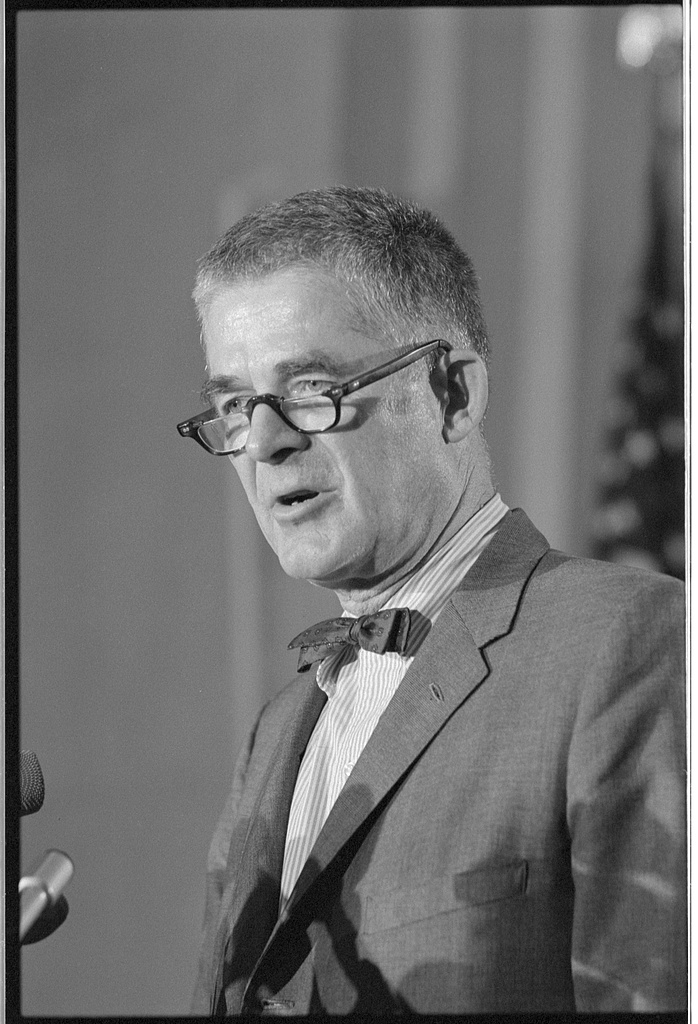
The cover image catches the setup before the break.[6] Cox stands at a June 4, 1973 Justice Department press conference, formal and still institutionally contained. That matters because the Saturday Night Massacre was not born from one night's temper alone. It grew out of a bargain that had already been made in public: the administration would restore legal credibility by appointing a prosecutor whose authority would not dissolve the moment his inquiry became inconvenient.[3][5][6]
Timeline anchors
- May 18, 1973: Richardson announces the appointment of Archibald Cox as Watergate special prosecutor.[5]
- July 16, 1973: Senate testimony reveals the existence of Nixon's secret White House taping system, pushing the investigation toward the tapes themselves.[1][2][5]
- October 19, 1973: Nixon offers the Stennis compromise, under which Senator John Stennis would review tapes and provide summaries instead of direct access.[1]
- October 20, 1973: Cox rejects the compromise; Richardson resigns rather than fire him; Ruckelshaus also resigns; Bork dismisses Cox.[1][2][3]
- October 23, 1973: Nixon agrees to hand over tapes to comply with the subpoena fight he had tried to contain.[1]
- November 1, 1973: Leon Jaworski is named special prosecutor, with stronger political backing and clearer expectations of independence.[1][2]
1. Richardson created Cox to repair legitimacy, not just to delegate work
The crisis begins in May 1973, not in October. According to the Ford Library's Watergate exhibit, Nixon named Richardson attorney general in an effort to limit political damage, and Richardson on May 18 announced that the Justice Department would appoint Archibald Cox to investigate possible administration wrongdoing.[5] The Ford site also preserves the key condition: Cox accepted after being assured he could act independently, with White House cooperation, and could be dismissed only for extraordinary improprieties.[5]
That point is essential because it explains why the later firing landed differently from an ordinary executive dismissal. Cox was not presented as one more subordinate lawyer carrying out a president's routine line. The whole political value of his appointment lay in the opposite claim. Richardson was trying to restore confidence in a department that many Americans suspected could not credibly investigate the president from inside the normal chain of command.[3][5]
The Justice Department's own biographical page on Cox states the arrangement plainly: Richardson, a former student of Cox, appointed him in May 1973, and once the Senate investigation exposed the existence of the tapes, Cox subpoenaed them from the president whose administration he had been asked to investigate.[3] The appointment therefore carried a hidden fuse. If Nixon later moved to stop Cox personally, he would not be correcting an administrative detail. He would be attacking the very instrument that had been created to restore trust.
2. The tapes turned autonomy into the whole issue
Watergate changed shape once the taping system became public in July 1973.[1][2][5] Before that revelation, the scandal could still be narrated as burglary, cover-up, campaign abuse, and witness management. Afterward, it became a fight over whether a president could privately possess the best documentary evidence in a case touching his own conduct.[1][2]
That is why the subpoena struggle mattered so much. The National Archives chronology notes that Nixon on October 19 offered the Stennis compromise: Senator John Stennis would review the tapes and provide summaries to the special prosecutor.[1] The Nixon Library fills in why the offer was structurally weak. The administration wanted controlled transcripts, third-party verification chosen on its terms, and a narrow definition of which tape passages were relevant.[2] Cox rejected the deal because it left the White House too much power to decide what counted as evidence and because it tried to close off future demands.[2][3]
At that point, the crisis had become more than a legal disagreement over production. Cox's refusal was a test of whether the independence promised in May had real operational meaning in October. If the White House could answer a subpoena by offering edited summaries verified through an arrangement it largely designed, then the special prosecutor's independence would have been reduced to a public-relations shell.[1][2][5]
3. Richardson's refusal changed the venue from court fight to constitutional emergency
The decisive turn came when Nixon ordered Richardson to fire Cox and Richardson refused.[1][2][3] The National Archives chronology gives the stripped-down chain: on October 20, Cox rejected the compromise, Richardson refused the order and resigned, and Bork then fired Cox; the sequence became known as the Saturday Night Massacre.[1] The Justice Department biography adds that Ruckelshaus also refused.[3]
Why did those resignations matter so much? Because they translated a dispute that had been moving through subpoenas, appeals, and negotiated compromise into a public declaration by the Justice Department's own senior leadership. Richardson and Ruckelshaus were effectively saying that obeying the president on this point would destroy the independence the administration had already promised.[2][4][5]
The Library of Congress Watergate guide is useful here because it makes the damage legible in political terms, not only legal ones. Its account of the Bork papers says Nixon wanted to stop Cox from obtaining incriminating tapes, that Richardson and Ruckelshaus resigned rather than carry out the order, and that the result significantly damaged Nixon's credibility with the press and public.[4] That is the heart of the mechanism. The resignations were persuasive precisely because they came from inside the executive branch. They told outside observers that the president's demand had crossed a line visible even to his own appointed legal officers.
The Ford Library page preserves Cox's immediate response in a famous short sentence: whether the United States would remain a government "of laws and not of men" was now before Congress and the public.[5] The phrase lasted because the event had already made it feel concrete. This was no longer a hidden struggle over evidence management. It had become a visible question about whether presidential will could cancel an investigation midstream.
4. Bork's compliance did not solve Nixon's problem; it proved the critics' case
Bork's role is often remembered as the final act, but historically it was a bridge, not a solution. The Library of Congress guide notes that as solicitor general he was next in succession, fired Cox and his staff, and later tried to preserve continuity inside the department.[4] The Ford Library similarly records that Bork acted only after Richardson and Ruckelshaus had left and after Nixon assured him that the investigation would continue.[5]
That continuity argument failed politically because the order had already disclosed the underlying intention. Once two senior officials had resigned rather than execute it, Bork's compliance no longer looked like neutral departmental maintenance. It looked like proof that only formal insulation could protect the investigation from presidential pressure.[1][2][4][5]
This is why the White House lost ground almost immediately. The National Archives chronology notes that by October 23, only three days later, Nixon agreed to hand over tapes to comply with the subpoena fight he had tried to blunt.[1] The Nixon Library adds that Cox's firing produced a firestorm of disapproval in Congress and across the country, and that when Leon Jaworski accepted the post in November, he did so with more independence and protection than Cox had enjoyed.[2] The Saturday Night Massacre therefore strengthened the institutional position it was meant to weaken.
The episode also widened the political field. The Ford Library records that by the following Monday, angry members of Congress had introduced twenty-two separate impeachment resolutions.[5] That response matters because it shows how quickly the event changed venue. Nixon had tried to discipline a prosecutor. Instead, he activated Congress.
The bounded conclusion
The Saturday Night Massacre backfired because it exposed the logic of the cover-up more clearly than the White House tapes dispute had yet managed to do.[1][2][5] Richardson had created Cox to prove that the Justice Department could investigate the presidency without folding back into presidential command.[3][5] Nixon then tried to regain control of the evidence through the Stennis compromise and, when that failed, through dismissal.[1][2] Richardson and Ruckelshaus transformed that dismissal into a public constitutional signal by refusing it.[1][3][4]
That is why the event still matters. It shows how institutional credibility can become the decisive terrain in a constitutional crisis. Nixon had legal arguments, political allies, and formal removal power. What he lacked after October 20, 1973 was a believable claim that the investigation remained independent while he was trying to terminate the person conducting it. The Saturday Night Massacre did not end Watergate. It made the rest of Watergate easier for the public to read.
Sources
- National Archives, "Watergate and the Constitution: Chronology" - timeline entries for the Stennis compromise on October 19, the Saturday Night Massacre on October 20, Nixon's October 23 tape concession, and Jaworski's November 1 appointment.
- Richard Nixon Museum and Library, "White House Tapes" - explanation of the Stennis compromise, Cox's rejection, the resignations of Richardson and Ruckelshaus, public backlash, and Jaworski's stronger independence.
- U.S. Department of Justice, Office of the Solicitor General, "Solicitor General: Archibald Cox" - Cox's May 1973 appointment, his subpoena for the tapes, the rejected summaries deal, and the chain of refusals ending with Bork.
- Library of Congress, "Administration Officials - Richard Nixon's Political Scandal" - Watergate manuscript guide sections on Robert Bork, Elliott Richardson, and the political damage caused by the Saturday Night Massacre.
- Gerald R. Ford Presidential Library and Museum, "The Watergate Files" - exhibit text on Richardson's appointment of Cox, the independence assurance, Nixon's October 20 order, Cox's response, and the congressional backlash.
- Library of Congress, "(Watergate special prosecutor Archibald Cox ... at a press conference at the Justice Department on June 4, 1973)" - source page for the archival photograph used as this article's cover image.