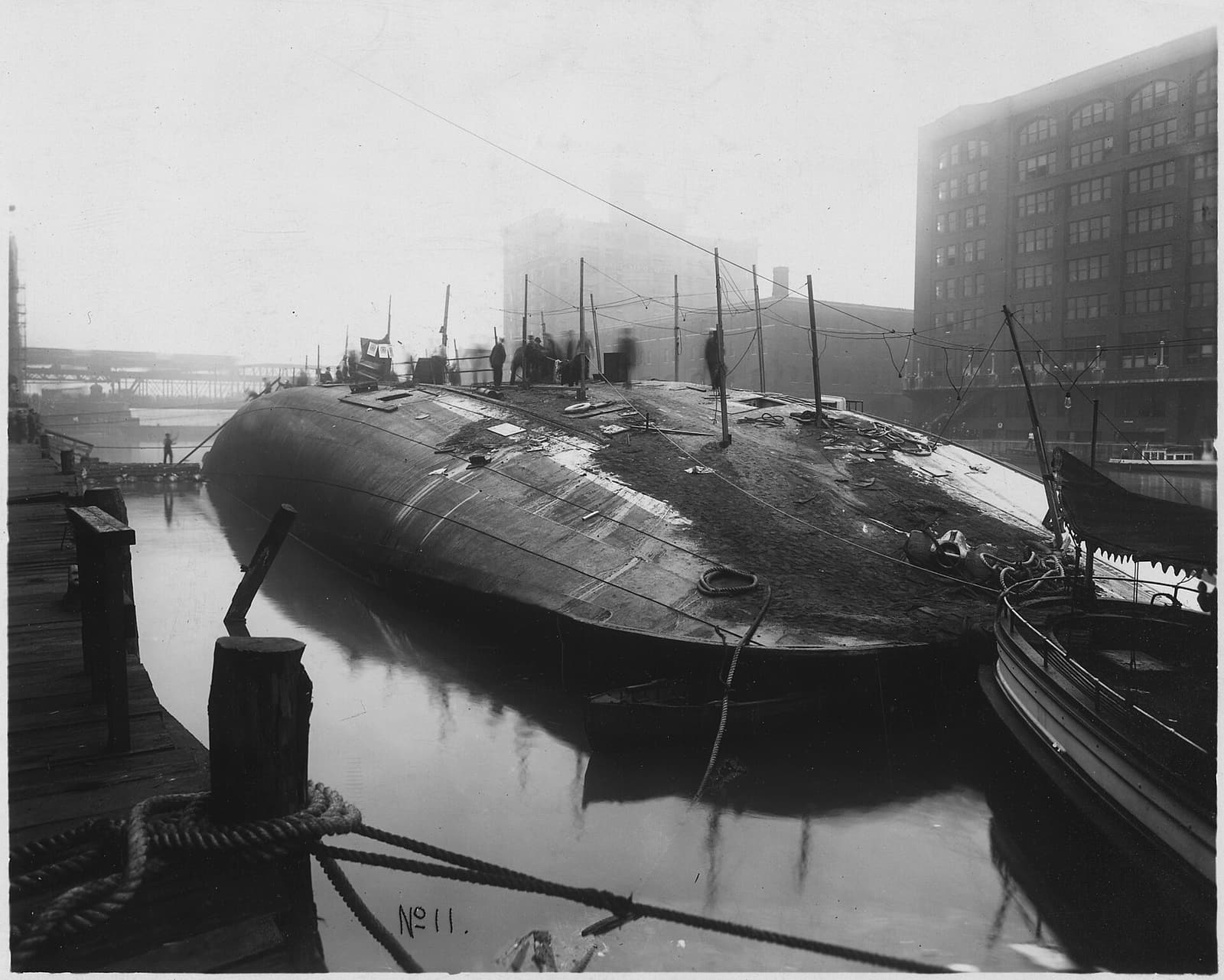
The Eastland disaster is hard to picture correctly because the word "shipwreck" sends the mind away from land. The SS Eastland did not vanish in a storm, burn at sea, or strike a reef beyond rescue. On the morning of July 24, 1915, it rolled over while tied up in the Chicago River, between the ordinary city and a planned excursion to Michigan City, Indiana.[1][2][3]
That setting is the historical shock. The water was shallow enough for the vessel to come to rest in roughly 20 feet of river; the bow was only a short distance from the wharf, and crowds, police, firefighters, divers, nearby boats, and office workers converged almost immediately.[2][3] Yet 844 people died.[1][2][3][4] The event was not a remote failure of access. It was a failure of stability, loading, warning, interior space, and rescue timing inside a ship that had not even begun its lake journey.
Reconstructing the morning therefore requires resisting two simple explanations. It was not only "too many passengers," though the vessel reached its licensed capacity. It was not only "too many lifeboats," though post-Titanic safety equipment added weight high on a vessel with an already troubled stability history.[3][5] The deadliest mechanism was the sequence: a crowded excursion boat listed, was corrected and recorrected, took on water through openings as the angle worsened, and turned compartments, stairways, furniture, and human movement into a trap.[2][3][5]
Timeline anchors
- 1902: the Eastland was built for Great Lakes excursion service, later acquiring a reputation for instability after modifications and earlier listing incidents.[3][5]
- March 1915: President Woodrow Wilson signed the La Follette Seamen's Act, part of the post-Titanic push for greater lifesaving capacity; the Eastland subsequently carried more boats, rafts, and preservers high on the ship.[5]
- July 24, 1915, about 6:30 a.m.: thousands of Western Electric workers and relatives gathered for the company picnic excursion, and passengers began boarding the Eastland.[2][3]
- 7:10 a.m.: boarding reached the 2,500 passenger limit, according to the Eastland Disaster Historical Society timeline.[2]
- 7:16-7:20 a.m.: the list worsened, orders were given to fill starboard ballast tanks, and water did not arrive for several minutes.[2]
- 7:28-7:30 a.m.: the ship rolled into the Chicago River and came to rest on its side; 844 men, women, and children died.[2]
- 1915-1918: legal and relief processes continued, while a federal criminal case created records now highlighted by the National Archives.[1]
The excursion made risk look routine
The Eastland was one of several ships chartered for Western Electric's annual picnic. That detail matters because the morning began in a grammar of normal industrial leisure: factory workers, families, food, clothes chosen for a day out, and a crowded downtown departure.[3][5] Smithsonian's reconstruction notes that more than 7,000 tickets had been sold for the larger outing and that passengers were boarding at roughly 50 per minute in the minutes after 7 a.m.[5]
The crowd was not trespassing onto an outlaw vessel. Federal inspectors were counting passengers, the ship had a legal capacity, and the event had been planned as an orderly company excursion.[3][5] That is why the disaster exposes a more unsettling kind of failure than open illegality. The danger moved through certified procedures. Capacity, inspection, equipment compliance, and dockside routine all existed, yet none of them converted the ship's known instability into an effective stop signal.
The Eastland's previous behavior should have made the loading phase more alarming. Smithsonian summarizes a history of earlier near-capsize or heavy-listing incidents, including trouble in 1904 and 1906, and describes the vessel as top-heavy, shallow-draft, and dependent on ballast tanks for stability.[5] Britannica likewise emphasizes a combination of modifications, inadequate ballast concerns, overcrowding, and added lifesaving gear after Titanic.[3] The point is not that one fact alone explains July 24. The point is that the vessel entered the morning with a known stability problem whose symptoms could look temporary until they became irreversible.
The list became a clock
The event's central drama was not a sudden explosion. It was a list that moved through stages. The Eastland Disaster Historical Society timeline places the first starboard list at 6:41-6:53 a.m., followed by correction, a later port list, and repeated efforts to bring the ship upright.[2] Passengers were still boarding. To many on board, a slight lean may have looked like the ordinary sway of a crowded boat. To observers who understood the vessel's history, it should have looked like a countdown.
At 7:10 a.m., the ship reached its passenger limit, boarding stopped, and preparations began to remove the gangplank.[2] The crew tried to shift passengers toward starboard, but a command to redistribute a crowd is not the same thing as a controlled stability system. People were wet from the morning rain, separated by decks and compartments, holding picnic gear, and reacting to a situation many did not yet understand.[2][5]
The next minutes narrowed the margin. The timeline records that at 7:16-7:20 a.m., the port list worsened to an estimated 10 to 15 degrees, and valves were ordered opened to fill starboard ballast tanks, but water did not come in for seven minutes.[2] That delay matters historically because it turns the event from a static condition into a sequence of failed recovery. The ship was not simply unstable; its corrective response arrived too slowly for the developing list.
By 7:23-7:25 a.m., water was entering through port gangways, and the vessel's stern moved away from the wharf as the bow shifted toward it.[2] At that point, the accident had crossed a boundary. A list at the dock had become a flooding pathway. The open gangways and portholes that made sense in a normal dockside boarding condition became routes by which the river entered the ship.
Safety equipment became part of the stability problem
The lifeboat question is often told as an irony: rules inspired by Titanic helped doom a ship in Chicago. That version is partly true but too neat. Smithsonian explains that post-Titanic lifesaving reform pushed ships toward more passenger capacity in boats and rafts, and that by July 1915 the Eastland carried 11 lifeboats, 37 life rafts, and life jackets for everyone aboard, much of it stowed high.[5] Britannica also identifies added lifeboats and rafts as one of the factors that worsened an already unstable vessel.[3]
But the responsible reconstruction is not "safety regulation killed them." It is narrower and more useful: safety equipment was added to a vessel whose stability problem had not been solved in system terms. A rule aimed at abandonment at sea did not automatically fit a shallow-draft excursion boat with a history of listing while loading. Equipment that would be lifesaving in one scenario could become destabilizing mass in another.[3][5]
That is why the Eastland belongs in the history of regulation as much as in maritime disaster history. The lesson is not that regulation is dangerous. The lesson is that rules fail when they treat equipment counts as a substitute for operational testing, vessel-specific stability, crew training, and credible stop authority. Compliance can be real and still incomplete.
The ship became a lethal interior
The most terrible part of the event was spatial. At 7:28 a.m., according to the timeline, the list reached roughly 45 degrees. Objects moved: dishes, a piano, a refrigerator, loose furniture, food containers, bodies.[2] Passengers on the main deck rushed toward staircases leading upward, and those interior routes became death traps as the ship rolled farther.[2]
This is why the dockside setting did not save hundreds of people. Some passengers and crew jumped onto the wharf or into the river. Some who were already on the exposed side could be reached. But many were below or inside, caught by water, impact, falling debris, and the geometry of a vessel rotating onto its side.[2][5] The river did not need to be deep for the ship to become deadly. It only needed enough depth to flood the compartments into which people had been crowded.
The Eastland Disaster Historical Society's account emphasizes that no lifeboats or life rafts were launched and no life jackets were distributed because the capsize happened so quickly.[4] That detail clarifies the timing problem. Safety gear does not help if the ship rolls before the crew can convert equipment into evacuation. The catastrophe was over in minutes, while rescue, recovery, identification, relief, and legal argument lasted far longer.[1][4]
The archive shows how responsibility moved after the water settled
The National Archives frames the post-disaster record around United States v. George T. Arnold, William H. Hull, Robert Reid, Charles C. Eckliff, Harry Pedersen, and Joseph W. Erickson, a federal case that produced hundreds of pages of transcripts on the ship's history, crew competence, and the events of the day.[1] That archive is important because the Eastland disaster was immediately more than a tragedy. It was an argument over what kind of failure had occurred and who could be made answerable for it.
Britannica notes that investigations followed, but that the crew was ultimately found not guilty and a federal court held the owner not liable because the vessel had passed inspections and been deemed seaworthy.[3] Read beside the National Archives record, that legal outcome leaves a sharp historical discomfort. The system could document instability, count the dead, assemble testimony, and still struggle to translate a chain of design, regulation, inspection, and operational decisions into legal responsibility.
That discomfort is part of the Eastland's afterlife. The disaster killed more people than the Great Chicago Fire's official toll and more passengers than the Titanic or Lusitania, yet it never fixed itself in global memory with the same force.[3][5] One reason is the absence of spectacle at sea. Another is class. Smithsonian stresses that the victims were largely working people and immigrant families on a company outing, not famous transatlantic passengers.[5]
The Eastland should be remembered not because it offers a single villain or a clean moral, but because it shows how catastrophe can hide inside ordinary compliance. A legal passenger count, required lifesaving gear, a familiar dock, inspectors at work, a company picnic, and a ship that had been certified safe all converged on one unstable body. The disaster happened when those pieces stopped functioning as safeguards and started functioning as a sequence.
Why the dock matters
The photograph of the Eastland on its side is almost unbearable because the city is still there.[6] The wreck is not isolated from the built world. It is wedged into the river corridor, surrounded by people and structures close enough to make rescue seem imaginable. That visual fact captures the event's historical lesson better than any abstract phrase about maritime safety.
The Eastland disaster was not only a sinking. It was a docked room turning sideways. The passengers were close to land, close to help, and close to the trip they thought they were about to begin. The failure was that closeness did not translate into survivability. By the time the city understood what was happening, the ship's interior had already become the disaster.
Sources
- National Archives, "Steamship Eastland Disaster" - archival overview of the federal criminal case records, the ship's capsizing, and the court-file evidence chain.
- Eastland Disaster Historical Society, "Timeline" - minute-by-minute reconstruction of loading, listing, ballast attempts, flooding, and capsize on July 24, 1915.
- Encyclopaedia Britannica, "Eastland disaster" - reference account of the capsizing, casualty figures, stability factors, investigations, and later USS Wilmette afterlife.
- Eastland Disaster Historical Society, "Eastland Disaster" - narrative account of passenger experience, interior entrapment, rescue limits, and casualty demographics.
- Susan Q. Stranahan, "The Eastland Disaster Killed More Passengers Than the Titanic and the Lusitania. Why Has It Been Forgotten?" Smithsonian Magazine, October 27, 2014 - historical reconstruction of the picnic, loading, lifeboat-law context, and memory problem.
- Wikimedia Commons, "File:Photograph of The Eastland (upside down) on Chicago River, Chicago. - NARA - 281841.jpg" - National Archives photograph used as the article cover.