The Geneva Protocol is almost all hinge. Signed on June 17, 1925, its operative declaration runs for a single compact paragraph. It does not create an inspectorate, order an inventory, define a destruction schedule, or even use the phrase chemical weapon. Instead, governments “accept this prohibition” on the use in war of poisonous gases and extend it to “bacteriological methods of warfare.”[1]
Those choices made the Protocol both narrower and more durable than its title now sounds. It outlawed an act without outlawing the arsenal behind the act. It treated chemical and biological warfare as methods that states must not employ, while leaving development, production, possession, and verification outside the document. Reservations then allowed many governments to preserve retaliation, turning the Protocol’s flat grammar into a no-first-use bargain in practice.[3][4]
That is not the same as saying the document failed. A close reading shows a treaty trying to convert revulsion into law before states were prepared to disarm. Its achievement was to name a category of conduct as illegitimate. Its limit was that weapons development, production, and stockpiling could continue behind that line.
The battlefield came before the legal category
The Protocol begins with condemnation, not discovery. Poison had already been restricted in earlier laws of war, but industrial gas changed the scale and shape of the problem. The International Committee of the Red Cross dates the emergence of poisonous weapons on the Western Front to 1915 and the first use of mustard gas near Ypres to July 1917. Gas could drift, linger, burn lungs and skin, and force protection into every routine of the trench.[2]
On February 6, 1918, the ICRC appealed publicly for belligerents to renounce poisonous gas. The replies exposed the political problem that would survive into the treaty era. Allied governments accepted the idea conditionally while blaming the Central Powers; Germany invoked its own earlier support for restrictions while blaming its opponents. Both sides could endorse a rule and still insist that compliance depended on the other side.[2]
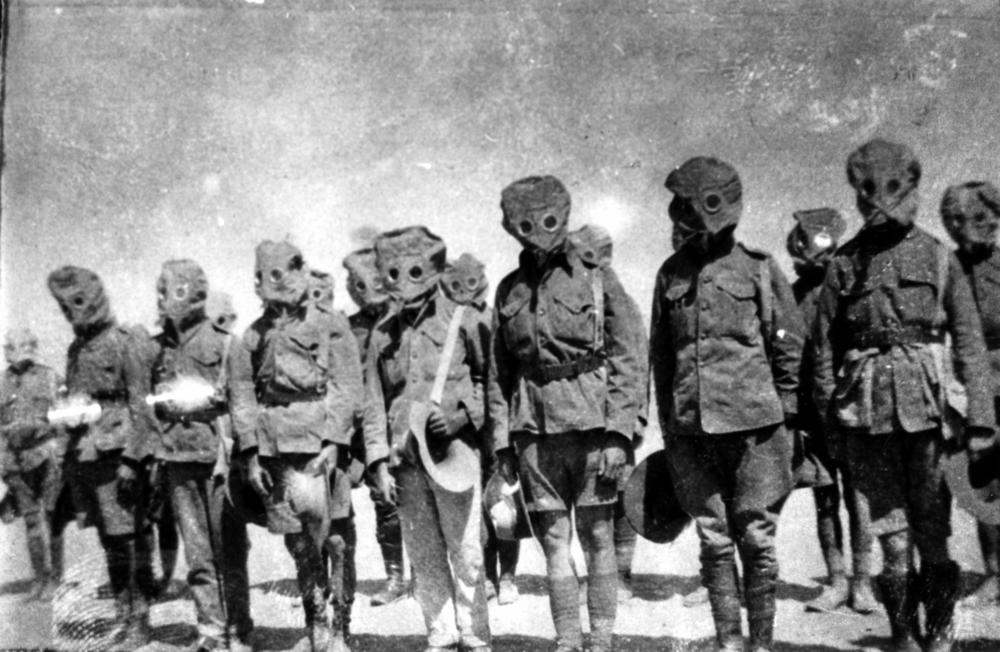
The cover photograph belongs to that world before the Protocol. An unidentified group drills in hood-like gas masks, their eyes reduced to round lenses.[7] It is not a photograph of treaty failure: it predates the treaty. It shows why a ban on use and a capacity for defense could coexist. Once gas had entered military planning, governments could condemn first resort while continuing to prepare for exposure and retaliation.
The League of Nations conference held in Geneva in 1925 inherited that contradiction. Its answer was not to regulate the chemistry from factory to shell. It was to isolate one decision—the decision to use—and place legal weight on it.[1][3]
The controlling word is “use”
The Protocol’s preamble condemns “the use in war” of asphyxiating, poisonous, or other gases and “all analogous liquids, materials or devices.” Its operative paragraph then accepts this prohibition and extends it to bacteriological methods.[1] The repetition matters. Use is not shorthand for an unprinted weapons lifecycle. It is the document’s object.
Several absent verbs make the boundary visible. The text does not say develop, produce, acquire, stockpile, retain, transfer, or destroy. It requires no declaration of holdings and no inspection of a plant or depot. The Organisation for the Prohibition of Chemical Weapons describes this plainly: the Protocol prohibited use, but not the development, production, or possession of chemical weapons.[3]
That narrowness is easy to call a loophole because later disarmament law would target exactly those missing activities. But in 1925 it also supplied a reachable legal threshold. A government did not have to surrender an industrial capability or trust foreign inspectors before accepting the proposition that releasing poison in war was forbidden. The historical record cited here does not prove that every negotiator consciously optimized for a smaller bargain. The document’s structure nevertheless made abstention separable from disarmament.
The phrase “analogous liquids, materials or devices” moves in the opposite direction: it broadens the means covered without attempting a chemical schedule.[1] A rule limited to named gases could have aged with the technology of 1918. “Analogous” asks whether a new material or delivery device belongs to the prohibited method, not whether a chemist in 1925 had listed it. The language gained flexibility by sacrificing precision.
“In war” is a boundary, not decoration
The next hinge is the setting. The Protocol does not say that parties must never possess or use toxic chemicals “under any circumstances,” the formulation later used by the Chemical Weapons Convention. It says use in war.[1][6]
That wording locates the document in the law of armed conflict rather than in a general system for regulating dangerous chemicals. It also helps explain why the text speaks of gases, liquids, materials, devices, and bacteriological methods without building an agency to supervise peaceful industry. The prohibited object is a way of fighting.
The bacteriological clause is especially revealing. It was added before biological warfare had acquired the long operational history of battlefield gas. The parties did not wait for a bacteriological Ypres. They extended an existing condemnation by analogy, treating deliberate disease as another method that should be outside war.[1][5]
The Protocol therefore combines a narrow verb with an expansive category. It does not control the weapons through their entire lifecycle, but it refuses to let future delivery technology or a different biological agent escape merely because the wording began with gas. Its brevity is not simplicity. One boundary concerns conduct; the other concerns technological substitution.
Reciprocity entered through the last six words
The declaration ends by saying the parties agree to be bound “as between themselves.”[1] That phrase is the treaty’s jurisdictional seam. It makes the prohibition a relationship among participating governments rather than a rule binding every state by the Protocol’s own terms.
Formal reservations widened the seam. The OPCW’s historical account notes that many countries reserved a right to use chemical weapons against a state outside the Protocol or to respond in kind after a chemical attack.[3] A 1970 U.S. State Department memorandum counted 39 states with reservations and explained the strategic effect: although the text stated a flat prohibition, most reserving powers had limited it to no first use. The proposed American reservation preserved chemical retaliation while deliberately withholding the same exception for biological weapons.[4]
The strongest critical reading follows directly. A government could ratify, maintain a stockpile, prepare delivery systems, and announce that the prohibition would stop binding if an enemy crossed the line first. There was no standing institution to inspect that posture or punish a breach. Chemical weapons were used by a number of countries in the 1920s and 1930s, while major powers continued investing in them.[3] On this reading, the treaty condemned conduct that its own design could neither make materially impossible nor reliably verify.
The strongest defense starts from the same evidence. No-first-use is weaker than disarmament, but it is not nothing. When the initiator was itself bound by the Protocol, retaliation reservations still identified that state as the violator; they made its first resort require legal and political justification. The treaty also created a common text to which later governments could accede and from which reservations could be withdrawn. It turned reciprocal restraint into a platform, even while deterrence remained inside the bargain.[3]
Both readings are necessary. Treating reservations as harmless would hide the arsenal behind the promise. Treating the promise as empty would miss the work done by defining first use by a bound party as a breach.
“Conscience” had to become “practice”
The most ambitious sentence sits in the preamble. The parties want the prohibition accepted as part of international law, “binding alike the conscience and the practice of nations.”[1] The paired nouns are a miniature theory of norm-making. Moral disgust is not enough if staffs continue to plan, governments preserve exceptions, and soldiers expect the order. Practice is not enough if abstention is merely tactical and can be reversed when conditions change. The Protocol tries to join repugnance to repeated state behavior.
Its language also carries the hierarchy of its era. The claim that gas had been condemned by the opinion of the “civilised world” presents a universal rule through a category long used to rank peoples and states.[1] That phrase should not be quietly modernized. It shows internationalism speaking in an imperial vocabulary even while asking more governments to make the prohibition universal.
The accession clauses reveal how the authors imagined expansion. Parties promised to exert every effort to bring in other states; ratifications and accessions would be deposited with France; and each state became bound in relation to parties that had already deposited.[1] There is no enforcement ladder. The growth mechanism is repetition: another government joins, another reciprocal relationship forms, and the prohibition’s claimed universality becomes less aspirational.
Later conventions changed the lifecycle
The later biological and chemical treaties read like answers to the verbs missing in 1925. The Biological Weapons Convention opened for signature on April 10, 1972, and entered into force on March 26, 1975. It extends the ban to development, production, acquisition, transfer, and stockpiling, adds destruction duties, and is understood effectively to prohibit use, supplementing the Geneva Protocol’s use-only rule for biological weapons.[5]
Chemical disarmament took longer. Negotiations concluded in 1992, and the Chemical Weapons Convention opened for signature in January 1993 before entering into force on April 29, 1997.[3] Its first article undertakes never under any circumstances to develop, produce, acquire, stockpile, retain, transfer, or use chemical weapons. Parties must destroy their chemical-weapons stockpiles and production facilities. Declarations, routine verification, and the possibility of a challenge inspection turn the promise into an administered system.[6]
The difference is more than added length. The Geneva Protocol regulates the moment a weapon becomes a method of warfare. The later conventions move backward through the chain—toward weapons development, production, acquisition, storage, and transfer—and forward toward destruction. They try to remove the option that the earlier agreement asked governments not to exercise.
Yet the later law does not make the 1925 text disposable. Article XIII of the Chemical Weapons Convention says that it neither limits nor detracts from obligations assumed under the 1925 Protocol.[8] The older document established the category of prohibited use; the newer one supplied the lifecycle controls and institutions that category lacked.
A thin document with a long afterlife
The Geneva Protocol should neither be praised as if it abolished chemical and biological weapons nor dismissed because it failed to do so. Its actual achievement is more exact. In 1925, governments placed gas and bacteriological methods on the far side of a legal line. They did so through a reciprocal instrument that tolerated reservations, ignored stockpiles, and relied on states to turn conscience into practice.
That design left soldiers in masks and weapons in depots. It also left later negotiators a sentence to strengthen. The Biological Weapons Convention and Chemical Weapons Convention could prohibit weapons development, production, acquisition, stockpiling, and transfer—and require destruction—because a prior agreement had already made use the wrong to be completed around.[5][6]
Read at the level of its verbs, the Protocol is not a failed comprehensive ban. It was never comprehensive. It is the history of a narrower move: outlaw the act first, let the continued existence of the arsenal expose what international law still had to build.
Sources
- International Committee of the Red Cross, Protocol for the Prohibition of the Use of Asphyxiating, Poisonous or Other Gases, and of Bacteriological Methods of Warfare, June 17, 1925 — authoritative primary text, including the preamble, operative declaration, reciprocity, accession, and deposit clauses.
- International Committee of the Red Cross, “The ICRC in WWI: Efforts to Ban Chemical Warfare” — institutional history of battlefield gas, the February 1918 appeal, belligerent replies, and the path to the 1925 Protocol.
- Organisation for the Prohibition of Chemical Weapons, “History” — institutional account of the Protocol’s use-only scope, retaliation reservations, continued weapons programs and use, and the negotiation of the Chemical Weapons Convention.
- U.S. Department of State, Office of the Historian, Foreign Relations of the United States, 1969–1976, document 203, August 11, 1970 — archival memorandum and proposed ratification package explaining reservations, retaliation, and the American interpretation of the Protocol.
- United Nations Office for Disarmament Affairs, “Biological Weapons Convention” — official account of the BWC’s scope, signature and entry-into-force dates, and its relationship to the Geneva Protocol’s use-only prohibition.
- Organisation for the Prohibition of Chemical Weapons, “Chemical Weapons Convention” — official text guide to lifecycle prohibitions, destruction duties, declarations, implementation, and challenge inspections.
- Wikimedia Commons, “Soldiers drill in their gas masks during World War I” — source page for the archival photograph preserved by the State Library of Queensland, with institutional provenance and original-file metadata.
- Organisation for the Prohibition of Chemical Weapons, “Article XIII — Relation to Other International Agreements” — primary text preserving obligations assumed under the 1925 Geneva Protocol.