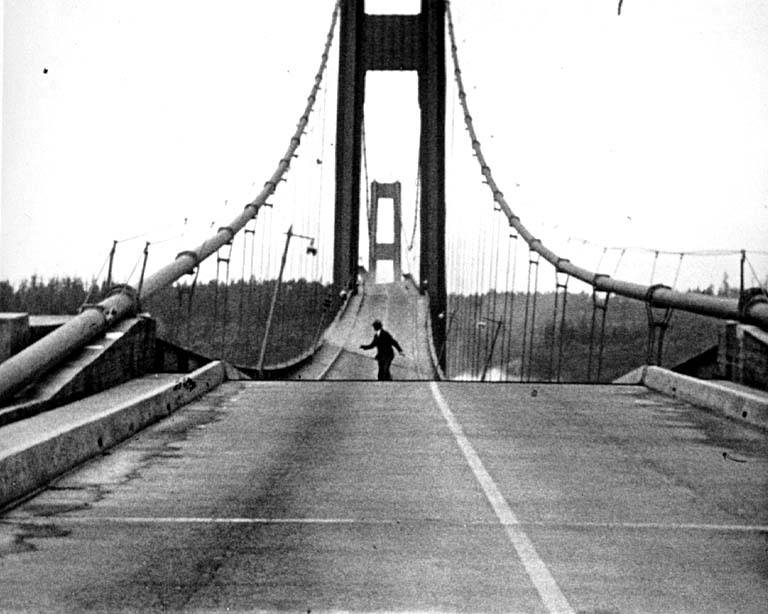
The Tacoma Narrows Bridge is one of the rare engineering failures that almost everyone can picture. A roadway waves, twists, and finally falls into Puget Sound. The usual classroom label is just as familiar: resonance. Wind matched the bridge's natural frequency, the motion grew, and "Galloping Gertie" destroyed itself. That version is memorable, but it is too neat. The evidence points to a more useful history: a very light, narrow, flexible suspension bridge exposed a blind spot in 1930s design practice, then failed through a wind-structure interaction that engineers later framed chiefly as torsional flutter rather than elementary forced resonance.[1][2][3][4]
The correction matters because it changes what the collapse teaches. If Tacoma Narrows is only a resonance parable, the lesson is almost cartoon-simple: avoid matching frequencies. If it is read through the contemporary reports, WSDOT's reconstruction, federal bridge-safety summaries, and Billah and Scanlan's critique of textbook accounts, the lesson is harder. Designers had pursued slenderness and elegance inside an accepted theory that did not yet handle aerodynamic behavior well enough. The bridge was not obviously shoddy by the standards that approved it; that was precisely the danger.[2][3][4]
The cover photograph helps explain why myth took hold.[6] Motion pictures and still images made the collapse look like physics made visible. But a visible pattern is not the same thing as a complete mechanism. Tacoma Narrows remains important because the bridge forced engineers to ask a less theatrical question: what happens when a structure's own motion begins feeding energy back into the wind forces acting on it?[2][4]
Timeline anchors
- Summer 1939: engineers hear reports of smaller waves in the Bronx-Whitestone Bridge, another Leon Moisseiff-associated suspension span.[1]
- May 1940: as the Tacoma Narrows floor system is completed, workers and engineers notice the deck's vertical wave motion.[1]
- July 1, 1940: the bridge opens to traffic across the Narrows.[3][5]
- November 1, 1940: an east tie-down cable breaks during high wind, showing that temporary measures have not solved the center-span problem.[1]
- November 2, 1940: Professor F. B. Farquharson finishes wind-tunnel studies and recommends changes to the solid girders.[1]
- November 7, 1940: at about 10:03 a.m., the deck shifts from vertical motion into destructive torsional twisting; at 11:02 a.m., a major center-span section falls; by 11:10 a.m., the main collapse is over.[1]
- March 1941: the Carmody Board findings identify excessive flexibility, the solid plate-girder deck's aerofoil behavior, and the need for wind-tunnel testing of suspension bridge designs.[2]
Myth 1: the bridge failed because wind simply "hit the right frequency"
The resonance story survives because it is teachable. A regular force drives an oscillator; the frequency matches; amplitude grows. Billah and Scanlan showed why that account became a problem in undergraduate physics texts: many presentations turned Tacoma Narrows into an example of elementary forced resonance, even though the actual bridge behavior involved more complicated aerodynamic self-excitation.[4] The issue is not that frequency and vibration are irrelevant. The issue is that the simple version makes the wind behave like a clean metronome outside the bridge, rather than part of a coupled wind-and-structure system.
WSDOT's technical reconstruction draws the boundary clearly. The bridge did exhibit vertical oscillations before collapse, and engineers tried to correct that "bounce."[1] But the crucial change on November 7 was not merely bigger bouncing. Shortly after 10 a.m., the bridge shifted into torsional motion: one side of the deck rose while the other fell, then the motion reversed.[1][2] That change turned a disturbing ride into a structural emergency.
The most useful evidence is the sequence. At 7:30 a.m., the wind measured about 38 mph; around 9:30 a.m., engineers measured 42 mph near the east end.[1] Those are serious winds but not an unimaginable storm. The collapse was shocking precisely because a modern suspension bridge failed under conditions engineers had not treated as catastrophic.[2][3] A simple resonance tale makes the event sound inevitable once one frequency matched another. The historical record shows a design whose slenderness, plate-girder shape, limited torsional resistance, and changing motion regime combined into something less tidy and more dangerous.[2][3]
Myth 2: nobody saw warning signs
The opposite simplification is that Tacoma Narrows fell without warning. That is also wrong. From the first week of May 1940, as workmen finished the floor system, people noticed vertical wave motions.[1] Farquharson later remembered that the bridge began to "gallop" on the night it opened, and WSDOT's history describes him tracking wind speed and the shape of the oscillations.[1] Workers reportedly experienced enough movement during construction that the bridge's nickname was already becoming earned before the collapse.[5]
What matters historically is not the absence of warning, but the way warning was interpreted. Engineers did not ignore the motion entirely. They installed hydraulic jacks in May 1940. They used temporary tie-down cables in October. Farquharson built a 1:200 scale model of the full bridge and a 1:20 model of a deck section, then used wind-tunnel studies to recommend remedies.[1] Those actions show real concern and real technical work.
The failure lay in timing and conceptual frame. The remedies were aimed first at vertical motion, while the fatal mode proved torsional.[1][2] By November 7, state authorities were preparing contract work for wind deflectors and streamlining changes that engineers hoped would stabilize the center span.[1] WSDOT's account gives the grim counterfactual: some measures might have provided significant stability within days or weeks, but the wind arrived before the retrofit did.[1]
That is a more unsettling story than "nobody noticed." People noticed, measured, modeled, and proposed fixes. The bridge still failed because the system moved faster than the institution could translate concern into completed aerodynamic correction.
Myth 3: one bad bridge ended the problem
Tacoma Narrows was a specific failure, not a universal explanation for every bridge. Yet its afterlife did change long-span design culture. The Federal Highway Administration's resilience framework summarizes the material facts in engineering terms: the bridge opened with a 2,800-foot center span, used 8-foot steel plate girders rather than the deeper open stiffening trusses common in earlier bridges, and had much lower dead load and stiffness than previous suspension spans.[3] The collapse showed that wind was not just a static side load. It could create dynamic behavior that required stiffness, torsional resistance, damping, wind-tunnel testing, and later integrated modeling.[3]
WSDOT's lessons page makes the intellectual shift sharper. The 1940 collapse exposed limits in "deflection theory," the design approach that had encouraged increasingly light, flexible, slender suspension spans.[2] After Tacoma Narrows, aerodynamic stability analysis had to supplement, not simply decorate, the older calculations.[2] That is the institutional importance of the disaster. It did not give engineers one perfect formula; WSDOT explicitly notes that experts still disagree over aspects of the exact failure mechanism.[2] It did force a profession to stop treating wind as a minor afterthought in this class of bridge.
The point is visible in the 1950 replacement. Britannica notes that the failed plate-girder form was replaced by a span stiffened with a web truss.[5] WSDOT's broader lesson is that later suspension bridges became either more aerodynamically streamlined, stiffened against torsional motion, or both.[2] The failure did not end ambition in bridge design. It changed the questions ambitious designers had to answer before steel reached the water.
What the evidence supports
The best evidence-based reading keeps three claims together. First, Tacoma Narrows really did become unstable in wind, and the collapse was not a myth invented by dramatic film.[1][5][6] Second, the popular resonance explanation is too casual. The decisive motion was a torsional, self-excited wind-structure instability in a bridge with unusually low resistance to twisting.[2][3][4] Third, the human and institutional story is not simply incompetence. The bridge had been approved under respected theory, monitored after warning signs appeared, and studied before retrofit work could be completed.[1][2]
That combination is why Tacoma Narrows still deserves its place in history. It was not just a bridge that moved too much. It was a case where a beautiful, modern, economical design revealed that the profession's mental model was missing a dangerous part of the world. The collapse became famous because cameras caught the deck behaving impossibly.[6] It remains important because the evidence shows why the impossible had become thinkable before the first section fell.
Sources
- Washington State Department of Transportation, "Tacoma Narrows Bridge history - Community connections - Collapse" - chronology of warning signs, Farquharson's studies, temporary remedies, November 7 timing, and the collapse sequence.
- Washington State Department of Transportation, "Tacoma Narrows Bridge history - Bridge - Lessons from failure" - Carmody Board findings, excessive flexibility, torsional motion, flutter explanation, deflection-theory limits, and post-1940 bridge-design lessons.
- Federal Highway Administration, Framework for Improving Resilience of Bridge Design - section 5.2.1 on the Tacoma Narrows Bridge's span, plate girders, low stiffness, measured wind, collapse progression, and aerodynamic-design lessons.
- K. Yusuf Billah and Robert H. Scanlan, "Resonance, Tacoma Narrows bridge failure, and undergraduate physics textbooks," American Journal of Physics 59, no. 2 (1991) - metadata page for the critique of oversimplified forced-resonance explanations.
- HistoryLink.org, "Tacoma Narrows Bridge collapses on November 7, 1940" - regional history overview of the opening, oscillation, collapse, and local consequences.
- Wikimedia Commons, "Howard Clifford running off the Tacoma Narrows Bridge during collapse, Tacoma, Washington" - source page for the archival University of Washington Libraries photograph used as this article's image.