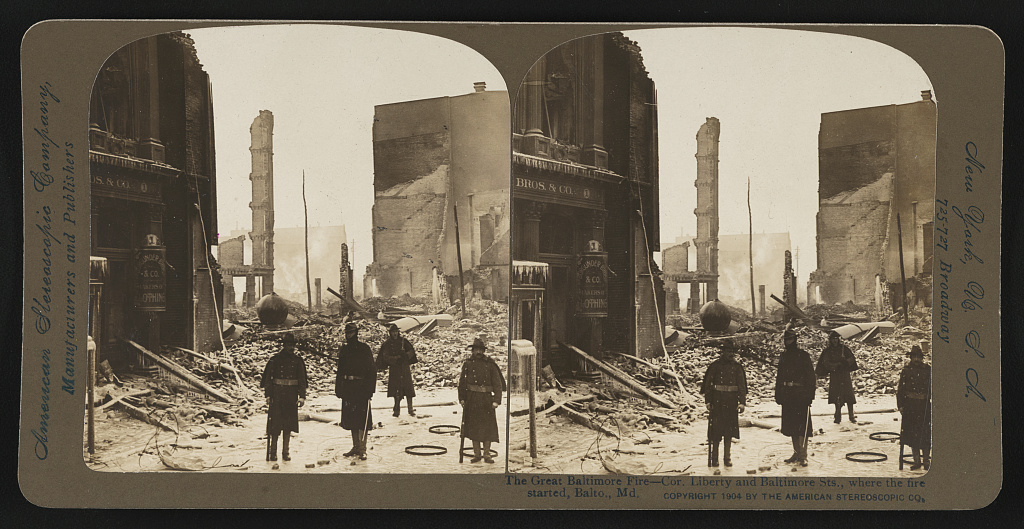
The Great Baltimore Fire of 1904 is easy to remember as a spectacular urban disaster: smoke, ruins, and a downtown business district burned flat over two winter days. The more useful history is narrower and harsher. A basement fire became a test of how a city connected its buildings, streets, water, mutual aid, and rebuilding authority. Baltimore did not burn simply because fire existed in a combustible city. It burned because a fast commercial blaze met wind, dense blocks, delayed containment, incompatible equipment, and an urban form that had not been designed for a regional emergency.[1][2][3]
That is why the fire’s afterlife matters. The event exposed two different kinds of infrastructure at once. One was visible in the ruins: blocks of offices, warehouses, shops, and market buildings reduced to walls and twisted metal. The other was less visible but more portable: standards. Firefighters came from outside Baltimore, including nearby cities, but some crews could not connect their hose couplings to Baltimore hydrants. NIST later treated the episode as a defining example of why national hose and hydrant standards mattered, and the fledgling NFPA adopted a coupling standard in 1905 based on federal survey work.[3][5]
The photograph used here is not just atmospheric wreckage.[6] It fixes the story near the downtown commercial street grid where damage, memory, and rebuilding all converged. The ruined corner reads as a local scene. The historical lesson is that local scenes can fail for national reasons.
Timeline anchors
- 1902: Baltimore’s Municipal Art Society and Park Board commissioned Olmsted Brothers to plan a park and parkway system; that pre-fire planning context shaped post-fire reform ambitions.[4]
- February 7, 1904, about 9:45 a.m.: an automatic alarm indicated fire in the basement of the John E. Hurst & Co. building, and responding firefighters soon faced flames driven out by an explosion and wind.[2]
- February 7, 1904, 10:48 a.m.: the Maryland Center for History and Culture’s collection history identifies the alarm at the Hurst Building area as the beginning point of the Great Baltimore Fire.[1]
- February 7-8, 1904: the fire spread through the commercial core, eventually devastating roughly 140 acres, 86 blocks, about 1,500 buildings, and thousands of businesses.[1][3]
- February 18, 1904: Frederick Law Olmsted Jr. began a five-day post-fire study, ten days after the fire ended, with street-widening and streetscape recommendations.[4]
- March 12, 1904: Baltimore established the Burnt District Commission under Ordinance 66 to direct rebuilding, street work, building lines, sidewalks, public spaces, and harbor extensions.[5]
- 1905: NFPA adopted its first fire-hose coupling and adapter standard after NIST survey work prompted by coupling incompatibility problems highlighted by Baltimore.[3]
The ignition became dangerous because the district was ready to transmit it
The fire’s first stage was local and physical. Maryland Courts’ summary of Baltimore: The Book of the Fire places the early report in the basement of the John E. Hurst & Co. building on Sunday morning, February 7. Firefighters responded quickly, but an explosion pushed flames from the building, and strong winds carried fire into nearby structures.[2] That sequence matters because it removes the comfort of imagining a slow civic failure. The fire department was not absent at the beginning. The problem was that the event outran first response almost immediately.
MCHC’s finding aid gives a slightly different but compatible frame, dating the alarm to 10:48 a.m. at the Hurst Building, Liberty Street and Hopkins Place, on the south side of German Street, now Redwood Street.[1] It also records the uncertainty around cause: a discarded cigarette or cigar butt falling through a small hole in a sidewalk deadlight has been speculated, but the article does not need that speculation to carry more weight than it can bear.[1] The better-supported point is structural. Once fire had escaped the building, winter wind and closely packed commercial blocks let one incident become a district event.[1][2]
This is the first historical lesson. The ignition story is less important than the transmission story. A cigarette, a basement, an alarm, and an explosion explain where the disaster could start. They do not explain why it could move across downtown. That required a built environment in which many buildings, streets, contents, and response systems were coupled together more tightly than the city’s fire-control capacity.
Mutual aid arrived, but connection failed
Baltimore did not face the fire alone. Nearby jurisdictions sent help, and the rail network made outside fire response possible on a scale that would have seemed impressive in isolation. The trouble was that arrival is not the same as interoperability. NIST’s history of fire-safety work states the core failure plainly: engines from surrounding communities reached Baltimore, but their hose couplings had different threads and could not connect to Baltimore hydrants, leaving trucks sidelined while the fire destroyed about one-fourth of the city.[3]
That detail can sound like a technical footnote. It was not. It turns the Great Baltimore Fire into a standards history. Mutual aid depends on shared assumptions: thread sizes, hydrant outlets, adapters, command routines, water access, street clearance, and the authority to improvise when those assumptions break. In Baltimore, the visible problem was burning buildings. The hidden problem was that regional fire capacity had not been made mechanically legible to itself.
NIST’s later publication on national-standard hydrants makes the point even sharper. It describes out-of-city fire equipment as “hampered or rendered useless” by incompatible hose and hydrant connections, and notes that after Baltimore a national fire-hydrant connection standard was adopted by NFPA.[5] A century later, the same abstract reported that only 18 of the 48 most populous U.S. cities surveyed had national-standard fire hydrants installed, a reminder that standards can be born from catastrophe yet still diffuse unevenly.[5]
The fire therefore belongs beside other urban disasters that revealed weak interfaces rather than merely weak parts. Baltimore had firefighters, hydrants, engines, rail connections, and neighboring aid. What failed was the interface between them. That is why the hose-coupling story has lasted: it shows how small differences in hardware can turn regional capacity into stranded capacity.
The Burnt District made rebuilding a political instrument
After the flames came the second event: deciding what the burned city would become. Maryland State Archives’ guide to the Burnt District Commission records the scale of the problem in administrative language. The fire destroyed 140 acres, 1,500 buildings, and four large lumber yards, and left more than 35,000 Baltimoreans jobless. Damages were estimated between $125 million and $150 million.[5] Those numbers made rebuilding too large to be treated as private repair alone.
The Burnt District Commission, established on March 12, 1904, lasted three and a half years and received broad authority to plan, improve, and rebuild with public funds.[5] Its work included reducing street grades, widening streets, setting building lines and sidewalks, creating public squares and market spaces, and planning harbor extensions.[5] That is the second reason the fire matters historically. The disaster converted a city-core emergency into a planning opportunity, but not a frictionless one. Street widening, condemnation, public spending, and commercial urgency all had to be negotiated under pressure.
NPS’s Olmsted page supplies the design context. Olmsted Brothers had been involved with Baltimore planning before the fire, and Frederick Law Olmsted Jr. conducted a five-day post-fire study beginning February 18, 1904.[4] The recommendations included physical improvements, harmonious streetscapes, and especially wider streets, though budget cuts and rapid urban growth limited completion.[4] The fire did not invent reform ambitions. It changed their timing and leverage.
This is important because disaster memory often stops at destruction. Baltimore’s evidence pushes further. Fire created a temporary window in which streets, grades, building lines, and harbor space could be reconsidered at district scale. Yet even a burned landscape did not become blank paper. The rebuild had constraints: money, property, speed, politics, and the need to reopen commercial life.
What changed after Baltimore
The Baltimore Fire’s strongest historical claim is not that it was America’s largest urban fire, or that it alone created modern building codes. Those claims would be too blunt. NIST’s museum history places Baltimore inside a broader pattern: construction types and materials in nineteenth- and early-twentieth-century American cities posed recurring fire threats, and urban fires helped drive ordinances and insurance mitigation guidelines that became part of the basis for early building codes.[3]
The more precise claim is that Baltimore made the chain visible. The fire began in a building, spread through a district, defeated parts of the response system through incompatibility, and then forced rebuilding authorities to treat the burned area as a planning and standards problem.[1][2][3][5] It joined local damage to national consequences. A hose thread in Baltimore could become a federal survey question. A ruined street could become a debate over width, grade, building line, and public space.
That sequence is why this event still deserves reconstruction. The Great Baltimore Fire was not just a city burning. It was a city discovering that emergency response is an ecosystem. Buildings, hydrants, streets, railroads, outside crews, insurance practice, municipal authority, and standards bodies all appeared in the same story because the fire forced them into contact. The disaster’s enduring lesson is therefore practical and institutional: a city can have many strong components and still fail when the connections between them have never been made common.
Sources
- Maryland Center for History and Culture, "Great Baltimore Fire photograph collection" - archive finding aid with the fire’s start point, duration, suspected cause, weather, aid response, damage scale, and collection scope.
- Maryland Courts Law Library, "Special Collections: Baltimore - Book of the Fire" - summary of the early alarm, Hurst & Co. basement fire, explosion, wind-driven spread, and J. E. Henry photographic record.
- National Institute of Standards and Technology, "History" - account of the 1904 Baltimore hose-coupling incompatibility problem and the 1905 NFPA standard based on NIST survey work.
- National Park Service, "Baltimore Fire, 1904" - Olmsted planning context, February 18 post-fire study, street-widening recommendations, and implementation limits.
- Maryland State Archives, "Information on BRG17 - Burnt District Commission" - government-records guide covering the commission’s 1904-1907 authority, damage figures, public works, street widening, and rebuilding scope.
- Library of Congress, "The Great Baltimore Fire - cor. Liberty and Baltimore Sts., where the fire started, Balto., Md." - source page for the 1904 stereograph photograph used as this article’s image.