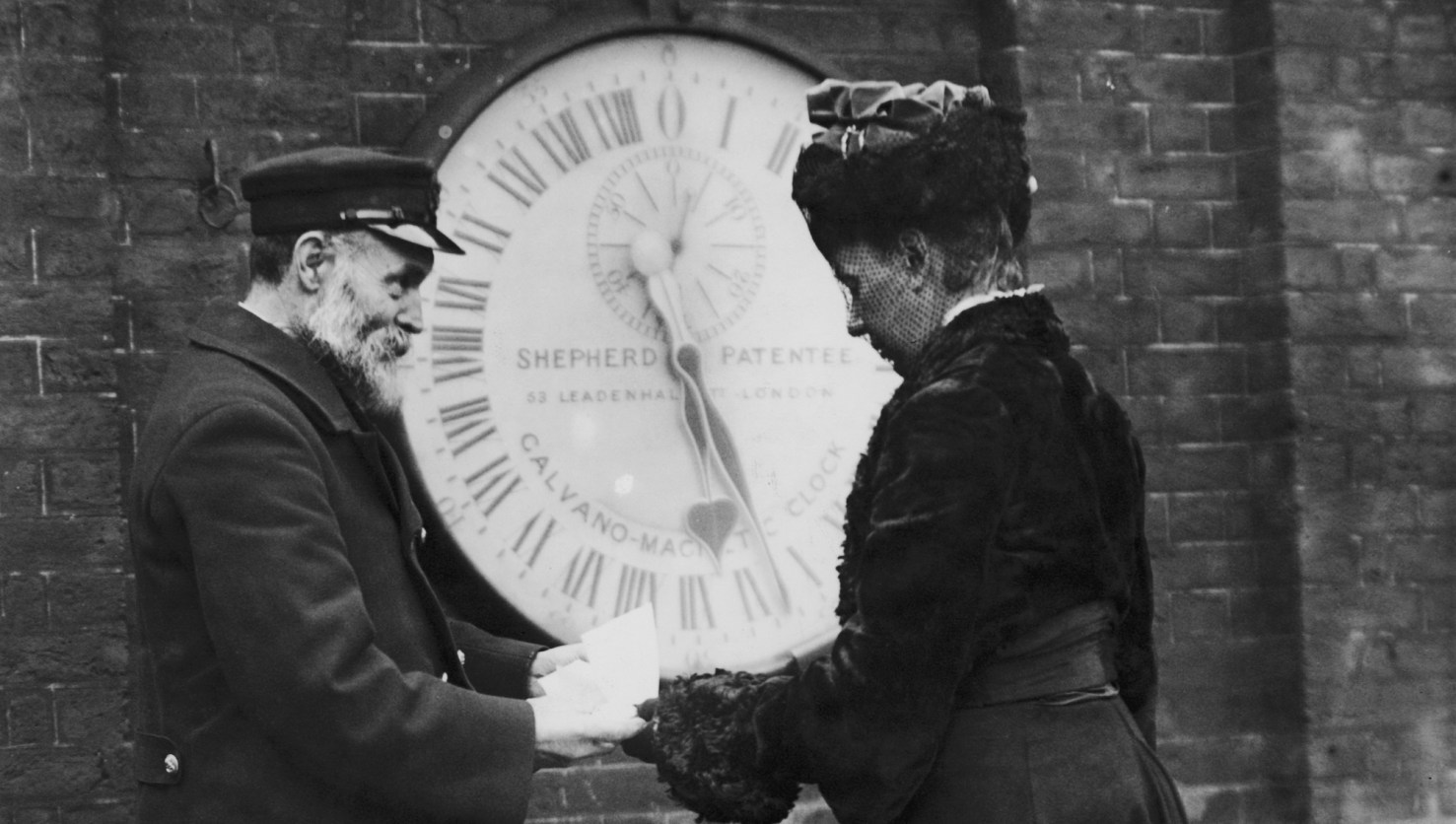
In the most useful photograph of Ruth Belville at work, the famous clock is not the object changing hands. It stays fixed in the brick wall of the Royal Observatory at Greenwich. An attendant holds a small sheet of paper; Belville reaches for it. Her pocket chronometer, a late-eighteenth-century instrument she called Arnold, will leave the gate with her. The Observatory’s standard clock will not.[3][6]
The photograph was arranged for the press in March 1908, but the transaction it shows was real. Belville brought Arnold to Greenwich, learned how far its display differed from the Observatory’s standard, and received a certificate recording the check. She then carried the watch through London so subscribers could compare their own clocks with it. The familiar phrase that she “sold the time” makes the work sound charmingly absurd. More precisely, she sold a chain of comparisons.[1][3][4]
That distinction explains the puzzle of her career. Belville took over the family route in 1892, after electrical time signals were already available, and continued into the age of radio. The BBC began broadcasting its six-pip signal in 1924; Britain’s telephone speaking clock arrived in 1936. Yet customers still paid for a woman carrying an old watch in a handbag until 1939 or 1940. This was not simply London refusing modernity. It was a small, durable service doing something the newer networks did not automatically guarantee at every customer’s premises: making the error of a particular clock visible to a person who knew what to do with it.[1][2][3]
1892: inheriting a route
Ruth Belville inherited neither an observatory post nor a public time monopoly. She inherited permission, an instrument, a customer network, and a routine.
Her father, John Henry Belville, had worked at the Royal Observatory from 1811. London watchmakers traditionally sent employees uphill to compare portable timepieces with Greenwich’s standard. The family service, conventionally dated to 1836, reversed the journey: John Henry carried a John Arnold pocket chronometer from the Observatory to subscribers. After his death in 1856, customers asked his widow, Maria, to continue. She did so for 36 years. When Maria retired in 1892, their daughter Ruth—then 38—took the route.[1][2][3]
Continuity mattered because the service was relational as well as technical. Arnold linked three generations of Belvilles to the same community of clockmakers and firms. Observatory access authenticated the starting point. Repeated visits made performance observable: a subscriber did not have to believe an advertisement for a new distribution system but could compare this week’s reading with last week’s visit. None of those features made the watch universally superior. Together, they made it sufficient for a particular trade.
By Ruth’s period, the route had contracted from the roughly 200 subscribers reported at her father’s death to around 30–40 customers. Accounts describe a regular Monday check at Greenwich and visits across the docks, Clerkenwell, the West End, South Kensington, and Baker Street. A 1908 interview suggests that some forty customers were seen at least once every two weeks, a useful caution against imagining one identical circuit completed every Monday.[1][3][4]
This was a niche, not a citywide grid. Its smallness was part of why it could last.
What traveled in the handbag
Arnold is often treated as a magical container of Greenwich Mean Time. It was better understood as a transfer standard: a stable portable instrument whose error could be measured at one location and used for comparison at another.
The first comparison happened at Greenwich. Belville presented the chronometer; an Observatory assistant checked it against the regulator, noted whether it was fast or slow, and issued a certificate. The watch did not need to be forced to read perfectly at the gate. What mattered was knowing its correction. In a 1939 interview recalled by horologist Donald de Carle, Belville could announce that Arnold was several seconds fast before handing it over for the check. The error was information, not failure.[1][4]
The second stage was transport. A good chronometer had to keep its rate steadily enough that the certified difference remained useful while Belville moved through the city. Walking, trains, and buses introduced time between comparisons, so the service could never reproduce the Observatory’s clock without uncertainty. Royal Museums Greenwich describes the service as accurate to a tenth of a second, but that figure is best read as the precision of the Observatory check, not a promise that every customer’s clock ended the day within one tenth of Greenwich. Delivery added drift, handling, reading, and adjustment.[1]
The third comparison took place at the subscriber’s premises. The customer inspected Arnold, applied the certified correction, and adjusted a working clock or watch. Belville did not broadcast a signal that automatically moved every dial. She supplied a traceable reference and, just as important, arrived beside the instrument that needed attention.[3][4]
“Selling time” therefore compresses four separate goods: access to Greenwich, a portable chronometer with a known rate, documentary evidence of its error, and the labor of delivery. The time itself was not scarce. A trustworthy local comparison was.
Why the wires did not win at once
Greenwich had been distributing time without the Belvilles for decades. A time ball began dropping at the Observatory in 1833, primarily so navigators on the Thames could set marine chronometers by sight. In the early 1850s, electrical apparatus connected the Observatory’s master clock to railway and public clocks and sent signals along telegraph lines. The public Shepherd Gate clock in Belville’s photograph was part of that wired system.[3]
Those methods served different users. A time ball required a sightline and clear attention at the appointed instant. A public dial displayed a reference but did not correct a clock inside a distant workshop. An electrical service required wires, receivers, batteries, relays, synchronized clocks, maintenance, and a commercial relationship with a network operator. Historians David Rooney and James Nye describe Victorian time distribution not as a smooth march from astronomy to universal precision but as a contested system of public authority and private firms. Networks could widen access while creating new points of failure and new arguments over who controlled the standard.[5]
The Belville service had obvious limits: it was slow, geographically narrow, dependent on one person, and incapable of simultaneous delivery. But it demanded little new equipment from a subscriber who already owned clocks. David Rooney reports that telegraphic services drew complaints about line reliability and could be less accurate in practice than the hand-carried chronometer. Customers who already trusted Maria asked Ruth to continue even though the more modern alternative existed.[2]
This is not evidence that a handbag beat electricity in general. It shows why replacement happens task by task. Telegraphic distribution was ideal where a maintained network could correct many connected clocks. Belville was useful where a modest number of specialists wanted a recurring, inspectable comparison without installing that network. The two systems overlapped because their costs, failure modes, and forms of assurance differed.[2][5]
1908: an attack becomes an advertisement
By 1908, inaccurate public clocks had become a London controversy. Nature complained that a newspaper debate over “lying clocks” was turning into advertising by firms selling rival synchronization systems. The dispute treated punctual public time as an economic and even moral problem: mismatched clocks wasted minutes, confused commerce, and seemed to display indifference to scientific accuracy.[7]
Against that background, Standard Time Company director St John Wynne—rendered “Winne” in some records—ridiculed the Belville method in a lecture to the United Wards’ Club. He called it amusingly out of date and made a sexist insinuation that Ruth’s access and custom depended on her femininity. His company sold electrical pulses that could keep connected clocks synchronized, so the contrast between a network and a woman with a watch was commercially convenient.[4]
It also gave Belville a public story no advertisement could have designed better. Newspapers photographed and interviewed her. Reports said the attention brought new customers; she later credited her competitor with valuable publicity. The photograph at the top of this article belongs to that moment. It turns a technical service into a legible ritual: Observatory, clock, official paper, carrier.[3][4][6]
The publicity did not prove her method more accurate than every wired service. It made its trust mechanism visible. A subscriber could see who collected the standard, which instrument carried it, and how the correction was certified. The electrical network promised automatic uniformity; Belville offered a named chain of custody.
1924–1940: obsolescence arrives in layers
Radio changed the comparison again. From 1924, anyone with a suitable receiver could hear the BBC’s Greenwich Time Signal at home. The speaking clock introduced in 1936 made an accurate announcement available on demand by telephone. These services sharply reduced the value of sending a person across London with a reference watch.[1][2]
Yet neither invention made every earlier arrangement irrational on launch day. Equipment ownership was uneven. Habits and contracts persisted. Clockmakers still needed to inspect and adjust physical instruments, not merely hear a signal. And a familiar weekly visit could continue after its original informational monopoly had disappeared. Belville’s late career was less a victory over new technology than a long tail of compatibility, trust, and customer inertia.
Ruth ended the route in 1940, when wartime danger made an elderly woman’s rounds unsafe. The detailed Royal Observatory history project suggests autumn while acknowledging that the precise final delivery is not documented. It is therefore safer to identify the closing year than to invent a last ceremonial handoff.[1][2][3]
Ruth died in 1943. Arnold passed to the Clockmakers’ Company and is now displayed at the Science Museum. The object survived because it was never merely a quirky old watch. For more than a century, it occupied the middle of an evidence chain: Observatory standard, measured correction, portable rate, customer comparison.[1][2]
Belville’s microhistory replaces a simple fable—old-fashioned woman outlasts modern machines—with a more useful one. Infrastructure is not only the fastest signal available. It is the full route by which a standard becomes actionable at the edge. Telegraph, radio, and telephone progressively made that route cheaper and broader. Until they also made the personal comparison unnecessary for her remaining customers, Ruth Belville kept walking it.
Sources
- Royal Museums Greenwich, “The Greenwich Time Lady: Ruth Belville” (2023) — Ruth’s route, the family succession, Arnold’s Observatory check, later broadcast services, and retirement.
- David Rooney, “Ruth Belville: the Greenwich time lady,” Science Museum Group (2015) — curator’s account of Arnold, subscriber trust, telegraph-service reliability, radio time, and the speaking clock.
- Graham Dolan, “Distribution of time by the Belvilles,” The Royal Observatory Greenwich historical site — chronology, 1908 interview evidence, press-image provenance, customer cadence, and the probable 1940 endpoint.
- Bethan Bell, “The woman who sold time—and the man who tried to stop her,” BBC News (2024) — the 1908 commercial attack, press response, and Donald de Carle’s 1939 account of Ruth’s Observatory procedure.
- David Rooney and James Nye, “‘Greenwich Observatory Time for the public benefit’: standard time and Victorian networks of regulation,” The British Journal for the History of Science 42, no. 1 (2009), doi:10.1017/S0007087408001180 — analysis of contested electrical time-distribution networks.
- Popular Science, “Literal time ladies used to sell people a look at their watches” (2025) — publication source for the Fox Photos/Hulton Archive/Getty Images hero photograph.
- “Public Clocks and Time Distribution,” Nature 77 (January 16, 1908), doi:10.1038/077253a0 — contemporary response to London’s “lying clocks” and competing synchronization proposals.