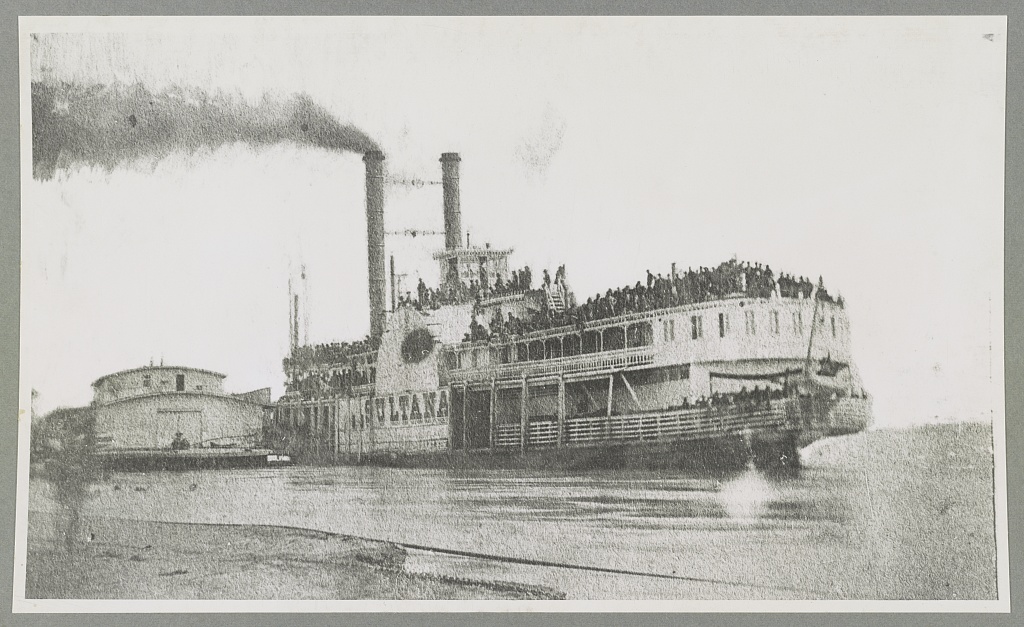
On April 26, 1865, the Sultana stopped at Helena, Arkansas, and made one of the most incriminating portraits in the history of American transport. Men cover the decks of the side-wheel steamboat. They crowd the railings, fill the roofline, and reduce the vessel beneath them to a dark horizontal band. The Library of Congress identifies about 1,880 Union soldiers in the photograph, most of them former prisoners of war finally travelling north.[7]
The image was taken one day too early to be a disaster photograph. Nothing is burning. No wreckage interrupts the Mississippi. Yet it records the condition that an Army investigation would soon call unjustifiable: a vast government transport backlog had been placed on one commercial steamer even though other boats were available at Vicksburg.[1]
Before dawn on April 27, the Sultana's boilers exploded above Memphis. Steam and broken machinery tore through sleeping men; the wooden superstructure caught fire; survivors jumped into a cold, flooded river. The precise death toll remains unsettled, but even the lowest defensible official count makes the loss one of the deadliest maritime disasters in United States history.[1][2][3]
The catastrophe is often introduced as an irony of timing: men who survived Andersonville or Cahaba died within sight of home, just after the Civil War had effectively ended. The final six days reveal something more exact. The Sultana did not leave Vicksburg because there was no alternative. It left because responsibility had been divided among officers, passenger numbers were poorly controlled, a per-person payment system rewarded a full boat, a compromised boiler received a limited repair, and officials treated an appalling load as too difficult to undo once it was already aboard.[1][3]
April 21: a packet boat entered the war's last traffic jam
The Sultana left New Orleans on April 21, 1865, as a regular packet bound upriver toward St. Louis. Built at Cincinnati in 1863, it carried civilian passengers, crew, freight, animals, and sugar. By the time it reached Vicksburg, however, the ordinary commercial voyage had met an extraordinary military movement.[1][3]
Thousands of recently released Union prisoners were waiting near Vicksburg after confinement at Cahaba in Alabama and Andersonville in Georgia. They were physically depleted and administratively awkward: the war was ending faster than the transport system could return them to Ohio, Indiana, Michigan, Kentucky, Tennessee, and West Virginia. The Mississippi offered the route north to Cairo, Illinois, where rail and river connections could take them farther home.[1][3]
The Army paid private operators by the person carried—five dollars for an enlisted man and ten for an officer, according to the Encyclopedia of Arkansas.[3] That tariff does not prove every later allegation of bribery. It does establish the incentive visible at the landing: an empty patch of deck had a price.
Captain James Cass Mason, who was part-owner of the Sultana, wanted the government load. The Army wanted the parole camp cleared. Between them stood several officers whose duties overlapped without producing a reliable passenger count or a binding inspection of the vessel. The danger did not begin with one secret decision. It accumulated in a public transfer that many people supervised and no one stopped.[1]
April 23–24: the boat was repaired and overloaded at the same landing
The Sultana arrived with a leaking boiler. The repairman at Vicksburg patched the affected area, but later testimony preserved two truths at once. The work was described as competent for a limited repair; a thorough and permanent job would have required removing and replacing two adjoining sheets. The first engineer watched the patch after departure and reported no sign that it was giving way. The 1865 investigation therefore refused to say that the patch itself had caused the explosion.[1]
A modern Coast Guard account emphasizes the warning embedded in the repairman's testimony: the boiler needed more work than it received, and Mason did not want to lose the time required for it.[2] That is evidence of haste, but not a solved failure animation. The boiler might have ruptured through low water, damaged iron, excessive pressure, the stresses of a heavily loaded vessel working against a flood current, or an interaction among them. The surviving fragments and testimony did not let investigators isolate the initiating mechanism.[1]
While the repair proceeded, the Army loaded the men.
The report of Brevet Brigadier General William Hoffman, completed on May 19, 1865, counted 1,866 troops aboard, including 33 paroled officers. It found that no responsible officer had inspected the Sultana to determine either its capacity or its fitness for so many passengers. Men arrived from camp in three parties; the officers supervising embarkation did not all know about the middle group of 300 to 400. By the time they understood the scale of the load, they acted as if reversing it would be harder than accepting it.[1]
It was not the absence of boats that forced the decision. Hoffman's report said two other steamers were at the landing during the day and both could have taken some of the soldiers. One, the Pauline Carroll, became entangled in suspicions that someone was trying to profit improperly from dividing the transport contract. Officers who believed they were resisting one possible fraud helped preserve a different and more visible danger: almost everyone remained on the Sultana.[1]
The material warning was impossible to miss. The legal passenger capacity cited by the Coast Guard was 376.[2] The official inquiry described scarcely enough deck area for every soldier to lie down. Movement became difficult by day and nearly impossible at night. Horses, mules, and hogs were already aboard. The upper deck sagged so visibly under the weight that additional stanchions had to be installed beneath it.[1]
This is the chronicle's decisive scene. The disaster was still reversible. Another hull floated at the same landing. The overload could be seen, counted, and physically measured in bending timber. What failed was not perception but authority: warning passed sideways among officers without becoming an order to unload.
April 26: Helena turned the passenger list into a photograph
After leaving Vicksburg, the Sultana fought its way north against a high spring river. At Helena on April 26, photographer Thomas W. Bankes set up his camera. The surviving Library of Congress print is grainy and was made later from a copy negative, but its documentary force is unusually direct.[7]
An official list can omit a name. A retrospective total can vary by hundreds. The photograph cannot supply a perfect count either, yet it preserves the load as a physical fact. People occupy nearly every visible horizontal surface. Their mass changes the apparent proportions of the ship. The men are not anonymous cargo, but the frame shows how the transport system had treated them as volume.
That evening the Sultana reached Memphis. The boat unloaded its sugar; some of the former prisoners helped and earned a little money. It then crossed to take on coal. Around 1:00 a.m. on April 27, it resumed the journey toward Cairo. Many passengers slept wherever they had found space.[1]
April 27, about 2:00 a.m.: fire divided the boat from the river
Roughly an hour after leaving Memphis, near a group of islands known as the Old Hen and Chickens, the boilers exploded. The blast ripped through the center of the steamer and dropped shattered structure onto exposed furnace fires. Dry wooden cabins ignited quickly.[1][3]
The passengers faced two lethal environments at once. Staying aboard meant steam, fire, collapse, or entrapment. Jumping meant darkness, cold water, strong current, and a flood-swollen river that had spread into wooded lowlands beyond its usual banks. Men weakened by prison and the journey clung to planks, ropes, trees, one another, or anything else that floated. Some survived the initial blast and fire only to die from drowning or exposure.[1][2]
Survivor testimony gathered in Chester D. Berry's 1892 volume is indispensable but must be read as memory, not as a synchronized recorder. Witnesses disagreed about distances, times, passenger totals, and the behavior of the boilers. Their accounts converge on the human sequence: sleep, concussion, flame, the decision to jump, then hours in water without a visible shore.[1]
Rescue came from passing boats and people along the river. Memphis hospitals and the Soldiers' Home received the injured. But the disaster site itself moved: bodies and survivors drifted downstream, while the burned hull eventually settled on the Arkansas side. This was not a contained wreck from which one complete manifest could be checked against one recoverable set of remains.[1][3]
April 28–May 19: the numbers changed before the blame settled
The first newspaper reports exposed the accounting problem immediately. On April 29, the Boston Daily Journal printed telegrams from April 28 that contradicted one another within a few lines. One reported 1,100 paroled prisoners and 1,400 dead; another put 2,106 people aboard, about 500 rescued, and 200 or 300 uninjured at the Soldiers' Home. The arithmetic was provisional because the underlying names and categories were provisional.[5]
Hoffman's later official reconstruction was more disciplined. It counted 1,866 troops, of whom 1,101 were lost, plus an estimated 137 deaths among cabin passengers and crew—a total of 1,238.[1] The Library of Congress catalog cautiously says more than 1,100 soldiers died.[7] Modern institutional accounts often use estimates approaching 1,800.[2][3]
Those figures should not be averaged into false precision. They were built from different definitions, incomplete rolls, uncertain civilian and crew counts, and later efforts to reconcile survivors who were omitted, duplicated, misidentified, or died after rescue. The secure conclusion is a range, not a single engraved number: at least about 1,200 people died, and some serious reconstructions place the total several hundred higher.
The inquiry record was firmer about the loading decision than the final count. Hoffman concluded that putting so many troops on one vessel had been unnecessary and named four officers as responsible in different degrees, with Colonel Reuben Hatch and Captain Frederic Speed the most blameworthy. He also left the immediate boiler cause open. Administrative culpability could be established without pretending the wreckage had answered every engineering question.[1]
The National Archives still describes dedicated Sultana records in the files of the Commissary General of Prisoners, including lists of the dead and survivors.[4] Their existence is a useful correction to the idea that the event simply vanished. The government investigated, counted, litigated responsibility, and preserved paper. What it could not do was turn fragmented movement into a complete manifest after the fact.
The catastrophe was covered, then made to feel forgotten
The conventional explanation for the Sultana's weak place in national memory is a crowded news cycle. It has substance. Lee had surrendered at Appomattox on April 9. Lincoln was assassinated on April 14 and died the next morning. John Wilkes Booth was killed on April 26, the day Bankes photographed the steamer. The Boston Daily Journal placed its first Sultana dispatches amid reports on Booth, Lincoln's funeral journey, collapsing Confederate forces, and the war's political aftermath.[5]
But contemporary distraction is not the whole explanation. Elias John Baker's study of Sultana memory argues that Americans were already accustomed to steamboat explosions and often treated them as an accepted cost of steam travel. Survivors did not remain silent: they organized reunions, compiled testimony, sought pensions, and made being forgotten part of the disaster's public meaning. Safety advocates also invoked the catastrophe in the campaign that produced the 1871 Steamboat Act and a more centralized inspection service.[2][6]
The last photograph therefore does two kinds of historical work. It restores faces to an administrative count, and it refuses the comfort of invisibility. The overload was not hidden inside a boiler or detectable only by a specialist. It stood across three decks in daylight.
The uncertain boiler mechanism matters because it limits what can honestly be claimed. The disputed death toll matters because weak records were themselves part of the system that failed. Yet the central sequence is not uncertain. On April 24, officers had another steamer, a visibly sagging deck, and time to divide the load. On April 26, a camera recorded the choice they had made. On April 27, the river turned that choice into a casualty list the government could never fully reconstruct.
Sources
- Chester D. Berry, Loss of the Sultana and Reminiscences of Survivors (1892) — survivor accounts and reprinted 1865 inquiry records covering the voyage, loading, boiler evidence, explosion, rescue, official count, and responsibility findings.
- United States Coast Guard, "Sultana Fire — A maritime disaster that helped shape the Coast Guard's Marine Safety mission" (April 25, 2025) — vessel capacity, repair testimony, survivor evidence, and the 1871 inspection regime.
- Encyclopedia of Arkansas, "Sultana" (updated February 10, 2026) — voyage context, prisoner transport payments, disaster chronology, casualty range, wreck location, and memorial history.
- United States National Archives, "Records of the Commissary General of Prisoners," Record Group 249 — archival description of the 1865 Sultana files, including lists of dead and survivors.
- Library of Congress, Boston Daily Journal, April 29, 1865 — contemporary telegraphic reports showing the first conflicting passenger, rescue, and casualty estimates alongside the war's other breaking news.
- Elias John Baker, "'No Place in American History': Remembering and Forgetting the Sultana Disaster," University of Mississippi PhD dissertation (2021) — study of contemporary interpretation, safety advocacy, survivor commemoration, and the construction of the disaster's "forgotten" status.
- Library of Congress, "Helena, Arkansas. April 26, 1865. Ill-fated Sultana" — catalog record and high-resolution scan for Thomas W. Bankes's archival photograph used as the article image.