The first article of the Svalbard Treaty contains a small interruption with enormous consequences. Before recognizing Norway's “full and absolute sovereignty,” the signatories insert “subject to the stipulations of the present Treaty.” The qualification comes inside the promise. Anyone reading only the grand words about sovereignty has stopped too soon.[1]
Signed in Paris on 9 February 1920, the agreement settled who would govern the Arctic archipelago then called Spitsbergen. But it also protected the ability of people from other treaty countries to fish, trade and mine there. How could authority belong to one country while commercial opportunity remained open to others? The answer is in the verbs: Norway would govern, protect, regulate and recognize rights, under obligations written into the same document.[1]
The authority at the signing table
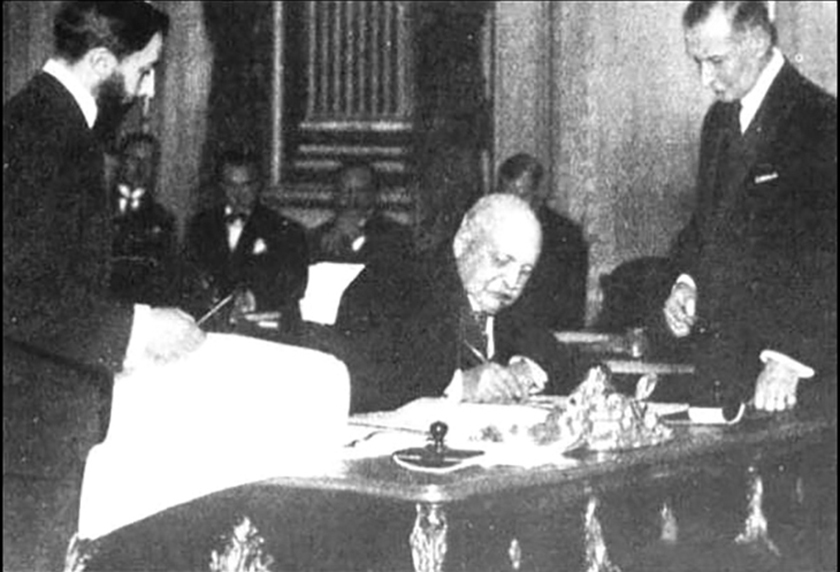
The surviving photograph places Fritz Wedel Jarlsberg at a table, bent over the document, with other delegates gathered around him. The Norwegian Parliament identifies him as the head of Norway's negotiating team. The photograph records a diplomatic act; the treaty's later clauses reveal the less ceremonial work that act required.[2]
Coal mining had sharpened the need to settle the islands' status. Norway hosted conferences between 1910 and 1914, but agreement proved elusive before the First World War interrupted negotiations. At the postwar peace conference, a proposal for Norway to administer the islands on behalf of the international community was discarded. The settlement recognized Norwegian sovereignty with conditions attached.[2]
That distinction makes Article 1 easier to read. The document does not divide the archipelago into national sectors or give each foreign mine a government of its own. Instead, subsequent articles specify how Norwegian authority must treat particular activities and rights. The promises of access make sense because there is now an identified state responsible for observing them.[1]
Equal access still had rules
Article 3 joins two commitments that are easy to separate when quoting selectively. Nationals of the treaty parties receive equal access to the waters, fjords and ports. Their maritime, industrial, mining and commercial operations remain subject to local laws and regulations. The article also prohibits monopolies and explicitly prevents preferential treatment for Norwegian nationals, ships and goods in the trade provisions it sets out.[1]
Read together, those sentences protect participation within a governed economy. A foreign operator could claim equal treatment; the text gave that operator no general exemption from regulation. Equally, Norway could not use its position as sovereign to reserve the listed commercial opportunities for Norwegians.[1]
Article 2 makes the arrangement unusually concrete. After promising equal fishing and hunting rights, it authorizes Norway to preserve—and, where necessary, restore—the islands' fauna and flora. Those measures must apply equally, without direct or indirect national favoritism.[1]
This is an important limit on what “access” means in the document. A rule protecting wildlife can restrict extraction while preserving equal treatment. The relevant question becomes how the restriction operates across nationalities. Conservation and commercial access already occupy the same article in a treaty often remembered chiefly for coal.
A sign on the ground was only the beginning
The Northern Exploration Company's claims show what awaited the new administration. Founded in 1910, the British company pursued coal and other minerals across the archipelago. The Norwegian Polar Institute's account describes signs carrying claims in three languages, erected to make possession unmistakable. Buildings and equipment often remained after ventures failed because removing them cost too much.[3]
The company eventually asserted a claim to roughly 10,000 square kilometres. The account records ownership of 650 square kilometres being granted in 1925. It does not, by itself, reconstruct the adjudication of every parcel, but the difference is enough to warn against treating an ambitious claim as an established title.[3]
Article 6 directs claims arising from occupation before the treaty's signature into an annex. There, the prose becomes procedural: governments must submit claims to a Danish commissioner, accompanied by mapped boundaries; disputed or otherwise unrecognized claims can proceed to arbitration. The tribunal is to consider occupation, notification and development, including whether wartime conditions prevented exploitation. Norway must issue valid titles for recognized claims. Claims that miss the prescribed process are extinguished.[1]
The sequence matters. The settlement provided a route from taking possession to obtaining recognized property. It required evidence, a decision and a title. Article 7 then added equal treatment in property and mineral rights, with expropriation permitted only for public purposes and proper compensation.[1]
These provisions give the opening promise of sovereignty a practical shape. Administration would have to distinguish a company's board nailed to the landscape from a right that others were required to respect.
The mine owner was not the only person in the mine
Article 8 tells Norway to create mining regulations excluding national privileges in taxation and working conditions. In the same sentence, it requires remuneration and protection for paid staff of every category sufficient for their physical, moral and intellectual welfare. The language widens the treaty's attention from the freedom to operate a mine to the people working in it.[1]
That promise is evidence of an obligation, not evidence that every miner subsequently enjoyed good conditions. Establishing fulfillment would require another archive: inspections, wage records, testimony and enforcement decisions. The treaty tells us what its parties undertook to secure.[1]
Its fiscal language is similarly specific. Taxes, dues and duties are to serve the territories exclusively and stay within what the stated purpose requires. Reading this as a promise of no taxation would erase the administrative work the document itself demands. My reading is that the bargain permits the costs of governing while limiting the use of Svalbard as a source of revenue for other purposes.[1]
Rights could precede a government's signature
One final clause complicates the group portrait. Revolutionary Russia was absent from the Paris negotiations because its government was not recognized by the Western powers. Article 10 nevertheless extended the same rights to Russian nationals and companies pending Russian accession, and provided for their land claims to pass through Denmark. As Geir Ulfstein and Sven G. Holtsmark explain, the Soviet Union formally joined the treaty in 1935.[1][4]
The agreement entered into force on 14 August 1925.[4] Its opening sentence had supplied the governing authority; the remaining provisions had supplied much of the bargain that made recognition possible. Equal commercial treatment, wildlife protection, examined land claims and duties toward workers all sat within that settlement.
The pen in the photograph could record agreement in a moment. Making the agreement operative required the slower work described on the pages that followed: checking a boundary, applying a rule equally, issuing a title and paying attention to the people below ground.
Sources
- Treaty concerning Spitsbergen, signed in Paris, 9 February 1920, English text, Articles 1–3 and 6–10 and the Annex; primary document reproduced by Arctic Portal (PDF).
- Norwegian Parliament, “The Svalbard Treaty,” updated 25 July 2025; negotiations and the signing photograph from the Governor of Svalbard's archive.
- Kristin Prestvold, “The Northern Exploration Company,” Norwegian Polar Institute, Cruise Handbook for Svalbard, updated May 2015; company claims, equipment and recognized property.
- Geir Ulfstein and Sven G. Holtsmark, “Svalbardtraktaten,” Store norske leksikon (Norwegian); entry into force, Russia's exclusion from the negotiations and subsequent Soviet accession.