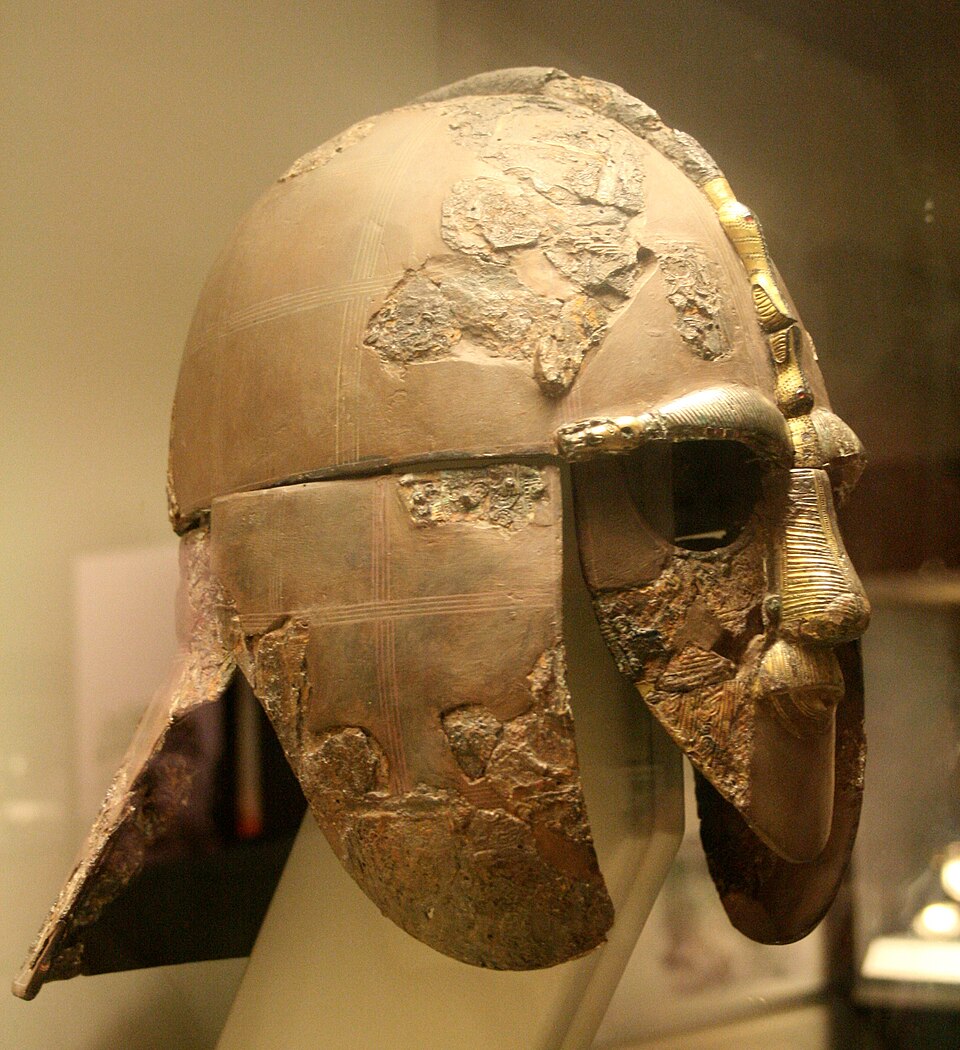
The Sutton Hoo helmet is often treated as the face of an age. That is understandable: it has eyes, brows, a nose, a moustache, cheek pieces, a neck guard, and enough frontal force to look almost personal. But as a historical source, the helmet is more interesting if we resist turning it into a portrait. It is not the face of a named man. It is a reconstructed object from a ship burial whose body has vanished, whose owner cannot be identified with certainty, and whose surviving power depends on the careful joining of archaeology, conservation, and interpretation.[1][2][4]
That uncertainty is the point. A close reading of the helmet does not tell us exactly what one seventh-century ruler thought. It shows how elite power at Sutton Hoo was made visible through materials, animal forms, warrior scenes, imported goods, burial labor, and later museum reconstruction. The helmet made the grave look back at the living. In 1939, when Basil Brown and the excavation team uncovered the richest intact early medieval grave then known in Europe, they did not simply find treasure. They found a method of memory.[2][3]
The face is a reconstruction, not a simple survival
The British Museum object record is blunt about the helmet's condition. The original helmet was iron with copper-alloy fittings, but what visitors now see is a modern reconstruction built from many individual fragments, supported with jute textile and plaster.[1] The present form dates to Nigel Williams's 1971 reconstruction, after Herbert Maryon's earlier 1946 reconstruction was judged inaccurate.[1] That means the helmet's famous face is both ancient and modern: a seventh-century object made legible through twentieth-century conservation judgment.
This does not weaken the helmet's authority. It clarifies it. The object teaches the reader to separate evidence from completion. The iron, copper alloy, tinning, gilding, garnets, silver wire, stamped panels, and traces of leather lining belong to the early medieval artifact.[1] The completed head-shape belongs to conservation work that had to decide where fragments sat in relation to one another.[1] The helmet is therefore a primary source with a visible interpretive layer. It shows what survived, but also how much skilled mediation is required before survival becomes intelligible.
That matters because Sutton Hoo as a whole is a lesson in traces. The ship itself had decayed in acidic soil, leaving what the National Trust calls its "ghost" imprinted in the sand.[4] The helmet works similarly, though at a smaller scale. It is not a pristine object lifted whole from the grave. It is a damaged object whose reconstruction lets us see a lost social performance.
The mask turns protection into theater
Read frontally, the helmet turns military equipment into a public image. It has a domed cap, cheek pieces, mask, and neck guard; the surface is covered with tinned copper-alloy panels stamped with animal interlace and figural scenes.[1] The eyebrows are gilt copper alloy, inlaid with silver wire and edged with cloisonne garnets; the nose and mouth piece make the lower face into a stylized moustache and lip.[1]
This is not only armor. The British Museum's burial essay notes that the helmet's face mask forms a dragon: the eyebrows become wings and the moustache becomes the tail.[2] That reading changes the object. What looks first like a human face is also an animal body laid over a warrior's head. The wearer did not merely hide behind metal. He entered a compound image in which human authority, animal force, craft display, and mythic suggestion met at eye level.
The eyebrows are especially revealing. The British Museum object record notes rows of small garnet cells along the lower edge of each brow, 23 on one side and 25 on the other.[1] The burial essay adds that only one garnet is backed with gold foil reflectors and suggests this may point toward Woden, the one-eyed god.[2] The article's safest claim is narrower than certainty about belief: the asymmetry was meaningful enough to notice, and the museum's interpretation shows how the helmet invites religious and heroic readings without yielding a final translation.
The panels make violence repeatable
The helmet's surface is not blank prestige metal. It is patterned. The British Museum identifies stamped designs including animal interlace and two warrior scenes often called "The Dancing Warriors" and "The Fallen Warrior."[1] Three different dies were used for the figural scenes and two for the interlace.[1] That detail is important because stamped imagery is repeatable. The helmet does not carry one improvised drawing; it carries motifs pressed from tools.
Repeatability makes the object more social. The designs may have circulated across an elite visual world, and the British Museum's 2025 curatorial note on a similar Danish die explicitly warns against leaping to a simple Danish origin for the Sutton Hoo helmet.[1] A better reading is that motifs, techniques, and elite signs moved across early medieval networks. Sutton Hoo was not isolated local splendor. Its imagery belonged to a wider language of rulership, war, and animal ornament.
That wider language fits the grave. The burial chamber contained weapons, fine vessels, silverware from distant Byzantium, textiles, gold dress accessories, garnets, and the helmet itself.[2] The point is not that the buried person owned expensive things. It is that the burial arranged those things into a claim: this was someone whose memory deserved ship labor, mound labor, imported objects, weapon display, and visual magnificence.
The grave makes the helmet political
The helmet cannot be read apart from Mound One. The British Museum describes the burial as a 27-metre ship with a central chamber filled with treasures.[2] The National Trust similarly frames the King's Mound burial as a 90-foot ship in which a king or great warrior of East Anglia was laid to rest with extraordinary possessions about 1,400 years ago.[4] The exact identity remains uncertain. Raedwald of East Anglia is a plausible candidate, but the sources are careful: likely, not proven.[2][4]
That caution matters. The helmet's historical force does not require us to name the dead person. In fact, anonymity makes the evidence sharper. Because the body did not survive and the name cannot be pinned down, the objects must do more interpretive work. The helmet becomes less a biographical relic than a statement about what a community could stage around elite death.
The staging was enormous. The British Museum notes that placing and burying the ship would have required dragging it uphill from the River Deben, digging a large trench, cutting trees for the burial chamber, arranging finery, and raising the mound.[2] The National Trust's landscape interpretation adds that the Royal Burial Ground included around 18 mounds, most robbed over time, while the Great Ship Burial escaped that fate.[4] The helmet is therefore part of a landscape of selective survival. It survived because one mound stayed intact long enough for modern archaeology to meet it.
Why the helmet changed the period
Sutton Hoo became famous because it changed the scale of early Anglo-Saxon history. Sue Brunning's British Museum anniversary essay states that the discovery helped explode the older idea of post-Roman Britain as a simple "Dark Ages" decline, revealing artistic achievement, complex belief, international connections, and concentrated wealth.[3] That is the larger argument the helmet still carries.
The helmet's face is the reason many people remember Sutton Hoo, but the deeper source is relational. The mask points to performance. The stamped panels point to shared elite imagery. The garnets, gold, silver, tinning, and copper alloy point to material skill. The burial chamber points to funeral choreography. The Byzantine silver, Sri Lankan garnets, and broader assemblage point to long-distance connections.[2][3] No one feature has to bear the whole interpretation. The object is strong because the evidence layers reinforce one another.
The close reading should therefore end where the helmet begins: with a face that is not quite a face. It is armor, regalia, animal image, conservation problem, burial witness, and museum icon at once. It made a vanished ship burial visible by giving the absent dead a durable front. The helmet looks back because archaeologists, conservators, and curators made its fragments speak again; but what it says is still early medieval. Power wanted to be seen, remembered, feared, and carried into the next world under a mask dense enough to survive as evidence.
Sources
- British Museum, "The Sutton Hoo Helmet" collection object record - materials, dimensions, findspot, reconstruction history, stamped designs, garnets, and display location.
- British Museum, "The Anglo-Saxon ship burial at Sutton Hoo" - discovery context, 27-metre ship burial, grave goods, helmet imagery, Raedwald caution, and long-distance connections.
- Sue Brunning, British Museum, "Eighty years (and more) of Sutton Hoo" - 1939 excavation, Edith Pretty's donation, and the burial's effect on interpretations of early Anglo-Saxon society.
- National Trust, "The Royal Burial Ground at Sutton Hoo" - mound landscape, King's Mound, decayed ship imprint, East Anglian royal context, and on-site interpretation.
- Wikimedia Commons, "File:Original Sutton Hoo Helmet.jpg" - source page for the real British Museum helmet photograph used as the article image.