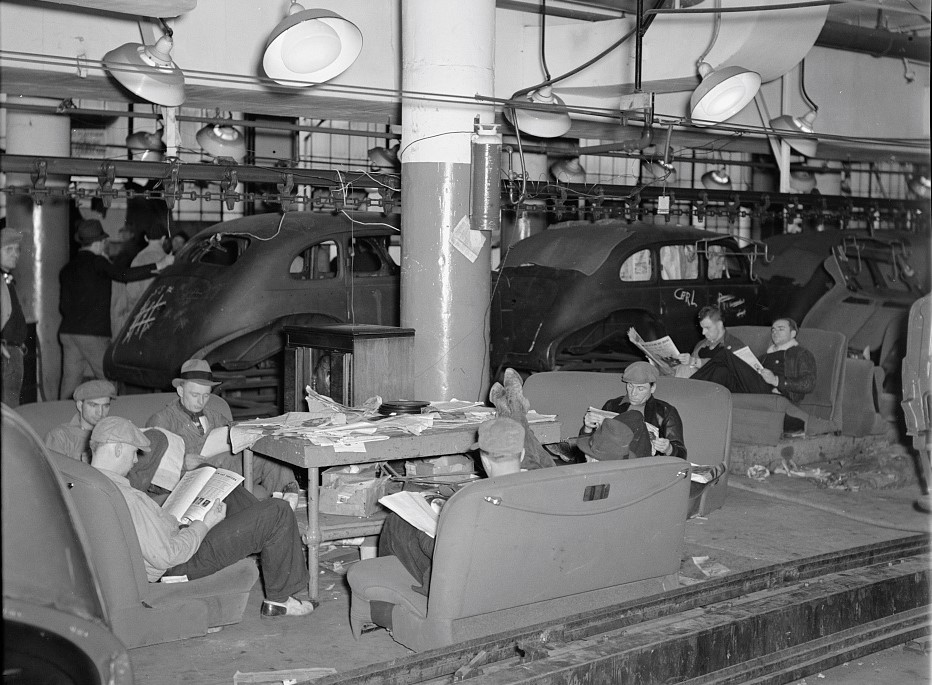
The Fisher Body sit-down strike is often remembered as a labor victory in a single clean phrase: workers occupied General Motors plants, held out for 44 days, and forced GM to recognize the United Automobile Workers. That is true, but it is too neat. The strike mattered because it converted the factory from a workplace into the actual bargaining table. Instead of standing outside the gate while replacements crossed the line, workers stayed where the company was most vulnerable: inside the body plants that fed GM's wider car-making system.[2][3]
That change in geography altered the whole contest. A conventional strike asked whether enough workers would remain outside long enough to hurt production. A sit-down strike asked whether management, police, courts, and state officials were willing to remove workers bodily from the machinery and buildings whose very occupation made the strike powerful. In Flint, that question was never purely legal or moral. It was operational. The UAW's breakthrough came from making every attempted answer costly: shut off heat and electricity, and the company looked punitive; block food, and families mobilized; send police, and violence could widen; wait too long, and production loss mounted.[2][3][4]
December 30 made Fisher One the pressure point
The strike began on December 30, 1936, when workers at GM's Fisher Body Plant No. 1 in Flint stopped work and stayed inside. VCU's Social Welfare History Project describes the action as a 44-day sit-in involving Fisher One, Fisher Two, and Chevrolet No. 4, while MotorCities places the workers at Fisher Body Plants 1 and 2 and eventually Chevy Plant 4, the largest plant GM owned at the time.[3][5] The exact plant sequence matters because the strike was not simply symbolic occupation. It targeted a production chain.
Fisher Body was not a random building. Auto assembly depended on bodies moving through the system. If body production was interrupted at the right points, GM's wider operation lost rhythm. That is why the occupation was more than a refusal to work. It was a refusal to let the company regain the physical nodes it needed to restart work on its own terms.
The UAW had another reason to stay inside. In earlier industrial disputes, companies could try to keep production going with strikebreakers. The sit-down form complicated that response. Workers were not outside a gate asking others not to enter. They were already inside, guarding the line between production equipment and managerial control.[4] The plant became leverage because the workers' bodies were now part of the shutdown mechanism.
Occupation had to become order
The most revealing part of the strike is not that workers sat down. It is that they organized the sit-down well enough to make it last. VCU's account notes that leaders Bob Travis and Roy Reuther helped establish committees for cleaning, exercise, security, entertainment, and defense.[3] Yale University Press's Julius Getman makes the same point in interpretive form: the Flint workers did not merely wait for national leaders to save them; they built an orderly system of self-government, reached out to the broader community, and held the line under pressure.[6]
That internal order was not sentimental detail. It was a strategic requirement. A disorderly occupation would have made removal easier to justify and harder for the wider public to defend. A disciplined occupation created a different problem for GM and state officials. The workers were defying property control, but they were also preserving a livable routine inside the plants. They slept, ate, guarded entrances, entertained themselves, and marked time. The famous photographs of men inside the plant are powerful because they show industrial space repurposed without being reduced to chaos.[1][4]
The strike's calendar also matters. A few hours of occupation can look like a dramatic protest. Six weeks of occupation becomes a parallel administration. Each day the workers stayed, the issue shifted from whether a sit-down was shocking to whether GM could regain production without recognizing the organization that had shown it could hold production still.
GM's counterpressure widened the strike's social body
GM tried to make the occupation harder to sustain. The Reuther Library recounts that Governor Frank Murphy refused to order the strikers out, after which GM attempted to force an exit by shutting off heat and electricity and preventing food deliveries.[2] VCU's summary carries the same sequence: plant conditions were made intolerable, yet the strikers maintained discipline.[3]
Those moves did not simply squeeze the men inside. They widened the strike's social body outside the plants. The Reuther Library notes that female relatives formed the Women's Emergency Brigade to organize protests and bring food and supplies, with children also walking the picket line.[2] VCU likewise emphasizes women coordinating deliveries and protests.[3] That support network was not auxiliary in the weak sense. It was a logistical extension of the sit-down. If occupation made the plant the bargaining table, family and community support kept that table supplied.
This is where the strike's power becomes easier to see. The workers inside held production space. Supporters outside contested access to food, sympathy, public order, and political meaning. GM could argue property rights and managerial authority. The union could point to unsafe conditions, low pay, and the workers' demand for a recognized voice. The Digital History Reader's source set is useful here because it preserves the public argument as it unfolded: GM letters, UAW demands, Alfred P. Sloan's memo, union replies, strike songs, photographs, editorials, and the final settlement all show that the conflict was fought through documents as well as doors.[4]
The state did not act as a simple company arm
The hinge figure was Michigan Governor Frank Murphy. Reuther's account says Murphy refused to order the strikers out and later called in the National Guard to keep peace outside the plant after violent clashes.[2] That distinction is crucial. The Guard's presence could have become a removal force. Instead, in the Flint sequence, state restraint helped prevent the company from converting the occupation into a quick eviction.
This does not mean the state became neutral in some abstract sense. It means the strike survived because public authority did not immediately collapse into corporate repossession. Once police clashes and private pressure had raised the stakes, Murphy's posture gave the dispute time to remain political rather than merely coercive.[2][3]
Time favored the workers only if they could keep discipline. GM's production losses mounted, but the UAW also risked exhaustion, hunger, legal attack, and public backlash. The strike's achievement was to keep those dangers from breaking the occupation before GM had to negotiate. By early February, the company was facing a shutdown that could not be solved merely by waiting for morale to rot.
February 11 converted occupation into recognition
On February 11, 1937, GM reached a temporary agreement with the UAW and the strike ended.[2][3] MotorCities states the outcome plainly: after 44 days, the action caused GM to recognize the union and agree to the first UAW-GM contract.[5] The Digital History Reader includes the settlement among its core documents, placing it beside the letters and public statements that had defined the conflict.[4]
That ending was narrower than later memory sometimes suggests. It did not instantly make all future labor relations peaceful. It did not make sit-down strikes legally secure forever. It did not solve every grievance in the auto industry. But it did prove that the UAW could force GM to treat it as a bargaining counterpart rather than a nuisance to be isolated plant by plant.[2][5][6]
The difference was structural. Before Flint, the UAW could look like a fragile federation trying to organize inside one of the country's largest corporations. After Flint, it had demonstrated the ability to identify a production bottleneck, hold it, supply it, defend its legitimacy, and exit with recognition. That is why VCU calls the strike a turning point that changed the UAW from isolated individuals into a major union and helped lead toward unionization of the automobile industry.[3]
Why the sit-down worked
The strike worked because five things lined up. First, the workers chose leverage-rich space: Fisher Body was connected to GM's wider production rhythm.[3][5] Second, they used a tactic that made strikebreaking harder, because the plants were occupied from within.[4] Third, they built internal order, so occupation could last and could be defended publicly.[3][6] Fourth, women, relatives, and supporters extended the strike's supply and legitimacy beyond the plant walls.[2][3] Fifth, Governor Murphy's restraint kept the central question open long enough for economic pressure to accumulate.[2]
Remove any one of those elements and the story changes. A poorly chosen plant might have produced drama without leverage. An undisciplined occupation might have invited faster removal. A strike without outside support might have collapsed under isolation. A state government committed to immediate eviction might have ended the experiment before GM felt enough pressure to bargain.
That is why the Fisher Body sit-down strike should be read less as a spontaneous eruption than as a working sequence. The workers occupied the production space. They made it livable. Families and supporters kept it connected to the city outside. GM escalated pressure but could not cheaply repossess the plants. The state held back from direct eviction. The company finally negotiated. In that chain, the factory stopped being only GM's property and became the place where industrial citizenship was argued into existence.
Sources
- Wikimedia Commons, "Sitdown strikers in the Fisher body plant factory number three. Flint, Michigan.jpg" - Sheldon Dick / Farm Security Administration archival photograph used for the article image.
- Walter P. Reuther Library, "Remembering the Flint Sit-Down" - archive blog on GM counterpressure, Governor Frank Murphy, the National Guard, the Women's Emergency Brigade, and the February 11 agreement.
- Catherine A. Paul, "Flint Sit-Down Strike (1936-1937)," Social Welfare History Project, Virginia Commonwealth University - overview of the 44-day sit-in, plant sequence, committees, support networks, and outcome.
- Virginia Tech Digital History Reader, "Module 06: The Sit-Down Strike of 1936-37 - Evidence" - primary-source set including GM/UAW statements, strike songs, photographs, national coverage, and the settlement.
- MotorCities National Heritage Area, "1936-37 Flint Sit-Down Strike and first UAW-GM contract" - anniversary summary identifying the plants, 44-day duration, UAW-GM contract, and production significance.
- Julius Getman, "Remembering the Flint Sit-Down Strike," Yale University Press - interpretive essay on worker self-government, solidarity, and the strike's wider labor-movement significance.