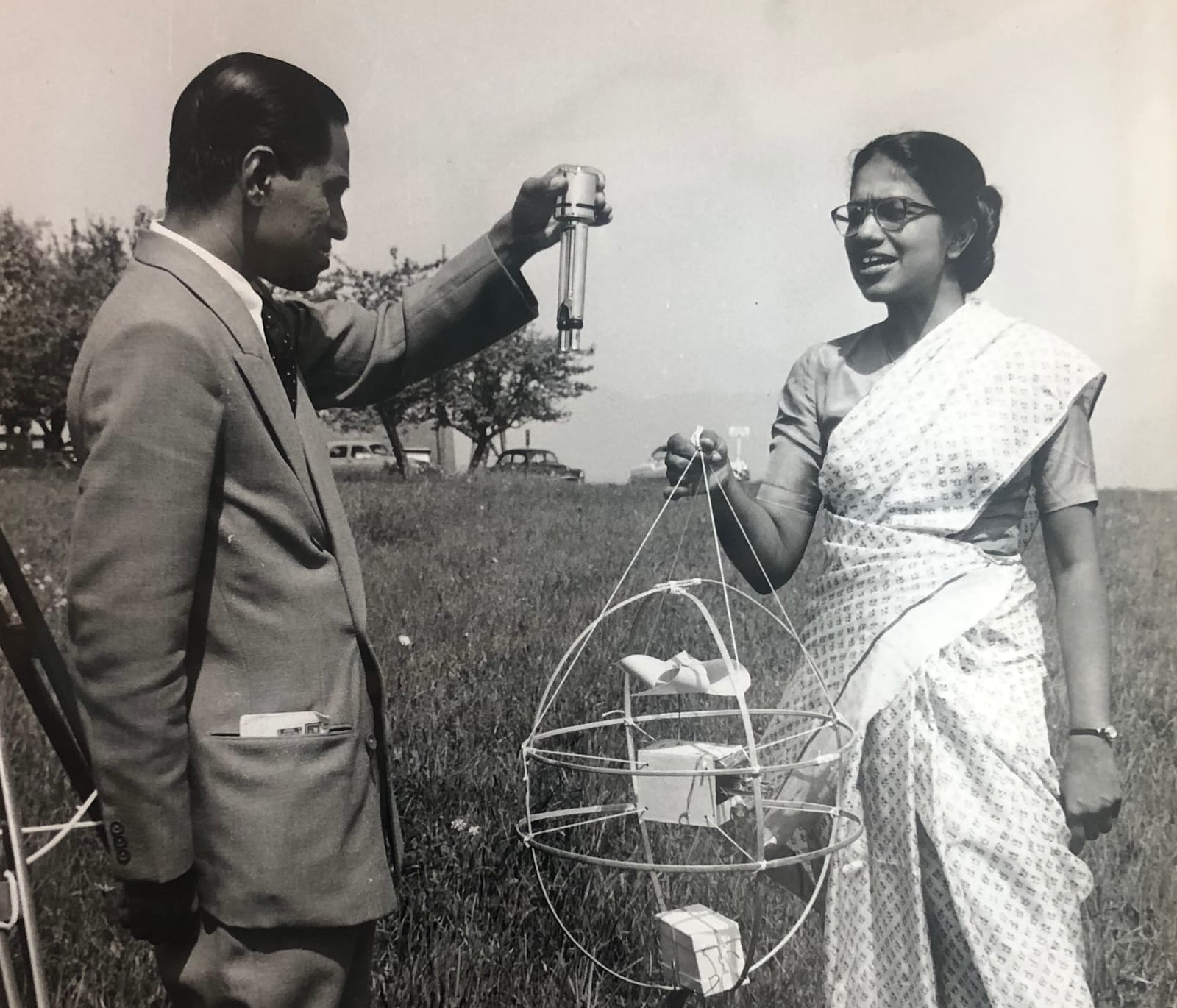
In a 1956 photograph from Payerne, Switzerland, Anna Mani stands in a field beside another participant who is holding a small instrument. A spindly launch frame fills the foreground. The scene is practical rather than ceremonial: two meteorologists, exposed equipment, open sky. They were there for an international radiosonde comparison, one of the exercises by which weather services learned whether instruments built and operated in different countries were actually reporting the same atmosphere.[1]
That photograph gives Mani's career a better frame than the familiar portrait of a solitary woman defeating a male profession. She did break barriers. She also did something more institutional and more difficult to summarize. At the India Meteorological Department, she helped turn the political ambition of scientific self-reliance into specifications, workshops, primary standards, calibration routines, field networks, instruction manuals, and international comparisons. India did not become independent in weather measurement merely by making instruments inside India. The instruments had to agree with one another—and with the wider scientific world.
In a memorial biography published in 2004, her former colleague C. R. Sreedharan recalled that Mani often insisted a single test outweighed thousands of opinions.[2] It was not just a laboratory rule. It described her answer to a postcolonial problem. A nation could stop importing a rain gauge. It could not declare the gauge accurate by patriotic confidence.
The assignment arrived before the institution was ready
Mani was born in 1918 in Peerumade, in the princely state of Travancore. She studied physics and chemistry in Madras and joined C. V. Raman's laboratory at the Indian Institute of Science in 1940, where she investigated fluorescence and absorption in rubies and diamonds. This work trained her to treat measurement as an encounter between a physical object, an instrument, and a standard of proof.[2]
In 1945, the Government of India awarded her a scholarship to study meteorological instrumentation in Britain. She trained with the British Meteorological Office, visited stations and manufacturers, and spent time at the National Physical Laboratory learning standards and standardization. When she returned in 1948, India was newly independent and the India Meteorological Department's instrument division in Pune had an unusually literal nation-building assignment: manufacture at home the equipment on which a national observing service depended.[2]
The division's head, S. P. Venkiteshwaran, had already begun assembling an integrated workshop. Foundry, milling, turning, sheet metal, plating, carpentry, painting, and packing were gathered under one roof because a mature network of small component suppliers did not yet exist. Raw material had to enter one end and a finished instrument ready for calibration leave the other. Mani joined that collective project; she did not invent it alone.[2]
Her first assignment was a recording rain gauge. Hygrographs, thermographs, barographs, and anemographs followed. The colleague who later wrote her Indian National Science Academy memoir, C. R. Sreedharan, credited B. B. Huddar and others alongside her. That matters. The historical achievement was not a shelf of devices bearing one inventor's name. It was a working division capable of repeatedly translating meteorological needs into buildable instruments.[2]
A drawing was only the beginning
Self-reliance is easy to picture as a factory floor. Mani's contribution becomes clearer in the less photogenic work that followed manufacture. She prepared engineering specifications, detailed drawings, technical manuals, testing procedures, and calibration requirements for nearly one hundred types of surface instrument. According to Sreedharan, imports of surface instruments had stopped within five years.[2]
That is a striking milestone, but it can be misunderstood. Ending imports was not the same as ending dependence on shared science. Pressure, temperature, wind, rainfall, and humidity remain comparable only when instruments are traced to stable references and checked under controlled procedures. Mani therefore traveled across India to establish regional standard barometers and compare them with primary standards in Pune and Kolkata. The point of the national network was not that every instrument was uniquely Indian. It was that a reading made in one part of India could enter a common system without losing its meaning.[2]
This is why calibration belongs in the political history of independence. A state needs observations to issue forecasts, support aviation, study climate, and plan infrastructure. If each station's numbers drift, the national map becomes a mosaic of local errors. If the service relies entirely on foreign instruments, spare parts, designs, or expertise can become bottlenecks. Mani's program joined the two risks: build locally, then test relentlessly.
It also replaced one kind of inheritance without pretending the inheritance had never existed. She learned instrument practice in Britain, worked inside a department formed under colonial rule, and used machinery imported for the Pune workshop. Her team then revised designs, trained operators, converted equipment and manuals when India adopted metric units, and made the system maintainable on Indian terms.[2] This was neither pure technological rupture nor simple continuation. It was selective transfer followed by institutional ownership.
The International Geophysical Year widened the test
The 1957–1958 International Geophysical Year forced that national program into a global schedule. K. R. Ramanathan urged Mani to establish a network of solar-radiation stations across India. Because Indian-made radiometers were not yet ready, the first four stations used instruments obtained from Europe. At the same time, Mani and Ommen Chacko began developing pyrheliometers, pyranometers, and pyrgeometers at Pune.[2]
The sequence is revealing. Imported instruments allowed observations to begin on time; domestic development built future capacity. Self-reliance did not require refusing a useful foreign device while a workshop caught up. It required making temporary dependence lead toward reproducible competence.
Radiation measurement also exposed a problem larger than manufacture. Instruments with different designs could produce different values under the same sun. Maintenance varied. Units and terminology were not always uniform. A station could accumulate years of precise-looking numbers that remained difficult to compare with another station's record. Mani's answer was procedural: field calibration, common guidance, trained observers, data scrutiny in Pune, and repeated intercomparison.[2]
By 1962, the World Meteorological Organization had selected her to chair a working group on radiation instruments and observations. She helped organize long comparisons of sunshine recorders, pyranometers, and net pyrradiometers across multiple countries and climatic regimes. She also pushed for comparison to travel rather than requiring cash-strapped weather services to send every standard instrument to one distant center. In 1970, a Pune standard was carried through Tokyo, Seoul, Hong Kong, Saigon, Bangkok, and Colombo so national instruments could be compared and calibrated with less expense.[2]
This was scientific diplomacy conducted through hardware. It did not erase unequal resources among weather services. It created a practical route by which more of them could participate in a common measurement system.
Ozone made the comparison vertical
Mani applied the same logic to atmospheric ozone. In 1962, Ramanathan encouraged her to develop an Indian chemical ozonesonde: a balloon-borne instrument that sampled air as it climbed and transmitted a signal from which a vertical ozone profile could be calculated. A. W. Brewer had already developed a successful electrochemical sonde at Oxford in 1957. Mani's historical role was not to originate the entire instrument category. It was to build, test, and improve an Indian version until it could support systematic tropical observations.[2]
The early launches failed. The Pune team persisted. In September 1964, it obtained its first successful sounding, and in January 1965, Mani and Sreedharan published a three-page technical report on measuring ozone's vertical distribution with a chemical ozonesonde.[2][3] The modest form of that paper is instructive. National capability did not arrive as a grand declaration; it appeared as an apparatus description, a calibration account, and results that other specialists could inspect.
By 1970, the Indian sonde had been tested in an international comparison in Hohenpeissenberg, West Germany. Systematic soundings expanded from Pune, New Delhi, and Thiruvananthapuram. Here again, the successful object was only one layer of the achievement. Balloons had to be launched, signals received, profiles calculated, instruments recalibrated, and repeated observations kept comparable over time.[2]
The later importance of those routines should not be read backward as prophecy. Mani did not build an ozone program because she already knew the political history that would follow the discovery of the Antarctic ozone hole in 1985. She built it because tropical ozone was worth measuring accurately. That is precisely why long-lived observing systems matter: they preserve evidence before a crisis tells society which evidence it wishes it had.
Weather data became energy infrastructure
Mani retired from the India Meteorological Department as a deputy director general in 1976, but measurement kept moving into new public uses. Her Handbook of Solar Radiation Data for India, prepared with data from 18 stations, assembled observed radiation into a form that designers and researchers could use.[2][4][6] A companion volume with S. Rangarajan extended the analysis through computed values. The India Meteorological Department's 2009 successor volume explicitly described those works as a widely used database and updated the record with later observations.[6]
Wind followed the same path from observation to infrastructure. Wind Energy Data for India, published in 1983 with D. A. Mooley, organized measurements, instrumentation, climatology, and station records for assessing energy potential.[5] Beginning in 1984, Mani led a wider wind-energy survey that selected instruments, installed masts, gathered and analyzed data, and eventually produced a multivolume resource survey. By the time ill health ended her leadership in 1996, Sreedharan reported that the project had collected data from about 150 stations.[2]
There is a tempting straight line from those books to every later solar array or wind farm. The sources do not justify so simple a claim. Energy projects depend on policy, finance, transmission, engineering, land, and many later generations of measurement. Mani's contribution was more foundational and more bounded: she helped make atmospheric resources legible enough to enter design and planning. A windy ridge or bright plateau becomes an energy proposition only after observation acquires duration, calibration, location, and a usable form.
The system is the biography
Biography often turns institutions into scenery. Mani's career asks for the reverse. Venkiteshwaran built the manufacturing program she entered. Huddar helped make the early instrument work possible. Chacko shared the radiation program. Sreedharan and other colleagues carried the ozonesonde forward. Rangarajan worked on the solar and wind volumes. Mechanics, observers, balloon crews, data scrutineers, and station staff kept the network alive.[2][4][5]
Naming that network does not reduce Mani. It identifies the level at which she was most consequential. She could move between workshop drawings and international committees, between a failed sonde and a national observation schedule, between a primary standard and a field worker's routine. Her authority came from making measurement reproducible across people and places.
The 1956 photograph in Payerne catches that history before its larger consequences were visible. Mani is not posed beside a finished monument. She is handling equipment in the middle of a comparison. That is the right image. For her, self-reliance was never the freedom to measure alone. It was the capacity to build locally, compare openly, correct error, and produce numbers that others could trust.
Sources
- World Meteorological Organization, “Celebrating pioneer Indian meteorologist Anna Mani” (August 23, 2018) — career overview and source page for the 1956 Payerne radiosonde-comparison photograph used as the article image.
- C. R. Sreedharan, “Anna Modayil Mani (1918–2001),” Biographical Memoirs of Fellows of the Indian National Science Academy 25 (2004), pp. 77–91 — colleague's memoir covering training, instrument manufacture, calibration, radiation comparisons, ozone work, teams, and energy surveys.
- C. R. Sreedharan and Anna Mani, “Measurement of the Vertical Distribution of Ozone by a Chemical Ozonesonde,” Current Science 34, no. 2 (January 20, 1965), pp. 39–41 — primary technical report on the Pune ozonesonde.
- Anna Mani, Handbook of Solar Radiation Data for India, 1980 (Allied Publishers, 1981) — bibliographic record, contents, and scope of the observed-radiation reference work.
- Anna Mani and D. A. Mooley, Wind Energy Data for India (Allied Publishers, 1983) — Met Office bibliographic record.
- India Meteorological Department, Solar Radiant Energy over India (2009) — institutional follow-on documenting the later radiation network and the continuing use and update of Mani's solar-radiation data work.