The Suez Crisis is often compressed into a single sentence—Nasser nationalized the canal, Britain and France attacked, and the old empires were humbled. That summary is directionally right, but historically thin. The event makes more sense as two clocks running at once: a military clock that advanced quickly in Sinai and Port Said, and a diplomatic-financial clock that moved even faster in New York and Washington.
Once those two clocks are read together, the outcome stops looking paradoxical.
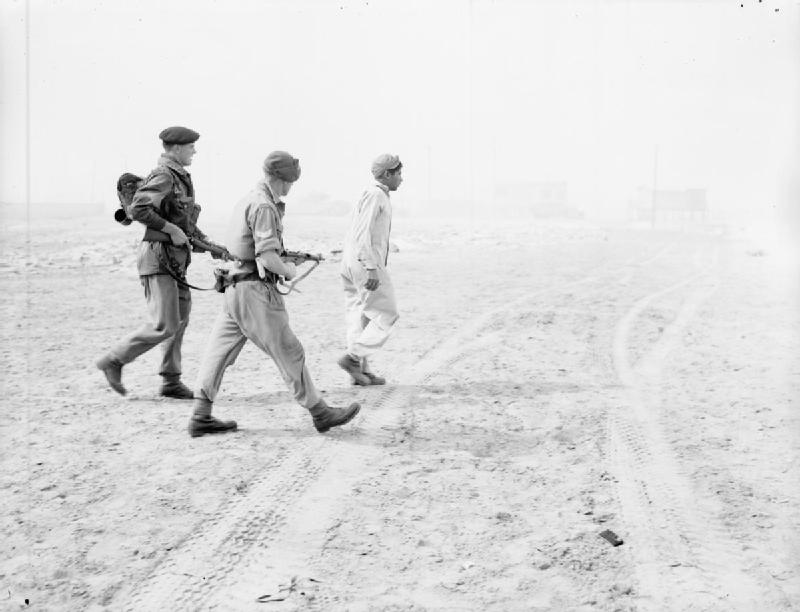
Image context matters here: the Port Said paratrooper scene often gets read as evidence of a straightforward military win, but the article treats it as only one layer of the crisis—what happened on the beach and what happened in diplomatic-financial channels were diverging in real time.
Timeline: the decisive 160 days
- 26 July 1956: Gamal Abdel Nasser announces nationalization of the Suez Canal Company in Alexandria; Egyptian authorities move to take operational control.[1]
- 22–24 October 1956: British, French, and Israeli representatives meet at Sèvres and draft the secret protocol that structures a staged war-and-intervention sequence.[2]
- 29 October 1956: Israel launches operations into Sinai (Operation Kadesh), opening the military phase.[3][4]
- 30 October 1956: Britain and France issue an ultimatum to both Egypt and Israel; Cairo rejects terms framed around canal-zone military separation.[3][4]
- 31 October 1956: Anglo-French air operations begin against Egyptian targets.[3][4]
- 5 November 1956: Airborne and amphibious assaults move on Port Said and the canal approaches.[3][4][8]
- 6 November 1956: Ceasefire is accepted under intense U.N. and U.S. pressure while fighting positions are still tactically favorable to the invaders.[3][5]
- 7 November–December 1956: U.N. Emergency Force (UNEF I) framework and deployment process begin; Anglo-French withdrawal follows by late December.[5][6]
- March 1957: Israeli withdrawal from Sinai and Gaza is completed under sustained international pressure and U.N. process constraints.[3][6]
The chronology is important because it shows that the campaign did not end when battlefield momentum failed; it ended when political and financial constraints overtook battlefield momentum.
Clock one: operational momentum
The military design embedded in the Sèvres protocol was straightforward in logic: Israel would move first, Britain and France would intervene under a canal-security pretext, then seize control points before a durable outside veto could lock the conflict down.[2]
For several days, this looked executable. Israeli movement in Sinai created the trigger condition; Anglo-French strikes degraded Egyptian positions; Port Said operations established visible control along the canal gateway.[3][4][8]
If the story ended at the tactical level, this would read like a successful coercive operation.
Clock two: legitimacy, currency, and coalition politics
The second clock moved through institutions and balance sheets rather than beaches. U.N. emergency-session politics shifted quickly toward ceasefire and separation, while Washington publicly distanced itself from the invasion path and pushed for rapid de-escalation.[3][5][6]
At the same time, Britain confronted acute reserve stress and sterling vulnerability. FRUS editorial documentation records Harold Macmillan’s later account that U.S. agreement on IMF-related technical support was linked to ceasefire acceptance timing; regardless of archival limits on every procedural detail, the episode captures the hard coupling between military choices and external financial tolerance.[7]
That linkage is the key mechanism: once external financial support credibility weakened, operational gains became expensive to hold and politically harder to justify.
The compression window: 31 October to 6 November
One reason Suez is often misread is that the decisive strategic reversal happened inside less than a week. Between 31 October (air operations begin) and 6 November (ceasefire acceptance), the campaign moved through a sequence that looked tactically cumulative but strategically subtractive.
- Air and amphibious operations produced visible military momentum.
- U.N. emergency politics moved quickly toward ceasefire legitimacy.
- U.S. signaling reduced confidence that the operation could be politically or financially carried for long.
In practical terms, each additional day of military action increased the next day’s diplomatic and balance-of-payments exposure. That is the opposite of classic coercive logic, where battlefield control is supposed to improve bargaining leverage over time. In Suez, time worked against the invaders because the legitimacy-cost curve and the funding-confidence curve were both steep.
This is why “they were winning on the ground” can be true and still analytically incomplete. Tactical maps measured positional control. The settlement path was being priced in a different arena: coalition acceptability, reserve confidence, and the terms under which external support could continue.
Mechanism check: what exactly made holding gains difficult?
Three constraints reinforced one another.
- Institutional constraint: Once the U.N. pathway to emergency separation and force deployment gained momentum, the room for open-ended occupation narrowed quickly.
- Alliance constraint: Washington’s distancing posture did not need to include direct military opposition to be decisive; it only needed to make clear that political and financial shelter would be conditional.
- Monetary constraint: For Britain in particular, reserve stress and sterling vulnerability transformed battlefield time into macroeconomic risk time.
The point is not that any one channel alone would have forced immediate retreat. The point is that all three moved in the same direction within the same week. That alignment created a settlement gravity stronger than tactical initiative.
Why the outcome looked abrupt but was structurally predictable
The crisis felt sudden in public memory because the military phase was short and dramatic. In structural terms, however, the ending was baked in by a mismatch:
- High tactical capability on the invading side,
- Low coalition legitimacy in the post-1945 U.N. setting, and
- High macro-financial dependence on U.S.-anchored monetary confidence.
When those three conditions coexist, occupation leverage decays quickly even before forces are physically expelled.
What this chronicle changes in how we read Suez
Suez is not only a story of “declining empire” in symbolic terms. It is also a practical historical template for modern crisis analysis: when military sequencing and financial-diplomatic sequencing point in opposite directions, the second sequence usually decides the settlement.
That is why Suez matters beyond 1956. It is a case where battlefield initiative could not outrun legitimacy arithmetic and balance-of-payments reality.
Sources
- U.S. Office of the Historian (FRUS, Vol. XVI, Doc. 1) — editorial note on Nasser’s 26 July 1956 nationalization announcement and decree context
- Selwyn Ilan Troen (reproduced protocol text PDF) — The Protocol of Sèvres (1956 collusion document text)
- U.S. Office of the Historian — The Suez Crisis, 1956 (Milestones overview and chronology)
- Encyclopaedia Britannica — Suez Crisis (timeline and campaign sequence)
- United Nations Peacekeeping — UNEF I mission profile (establishment purpose and withdrawal supervision)
- U.S. Office of the Historian — FRUS Volume XVI collection index (documented sequence: hostilities, ceasefire, and withdrawal diplomacy)
- U.S. Office of the Historian (FRUS, Vol. XVI, Doc. 516) — editorial note on sterling-reserve pressure and ceasefire-linked U.S. financial leverage context
- Wikimedia Commons image source — Port Said battlefield photo (Suez, 1956)