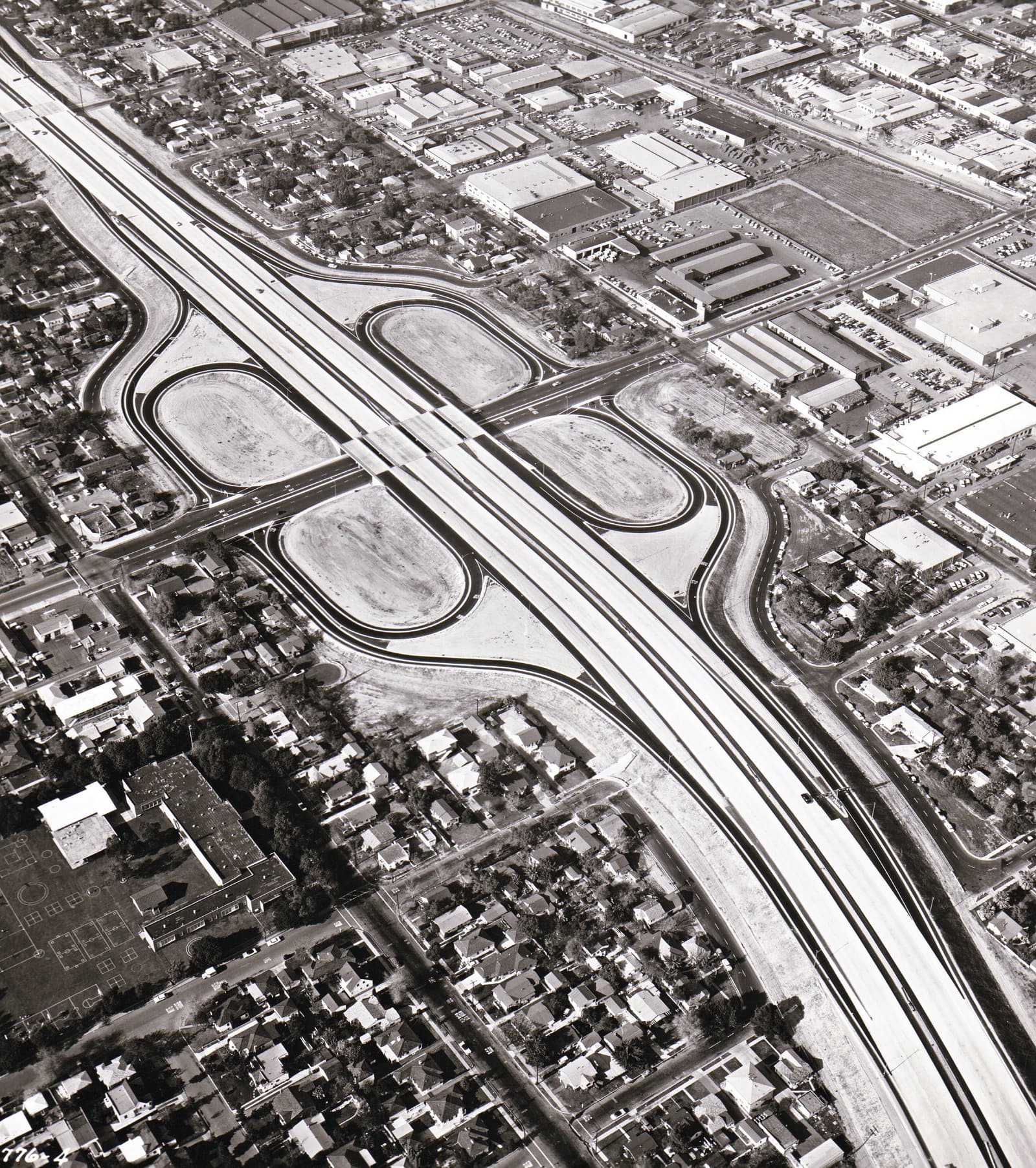
A long-distance highway network in the United States was not a surprise idea in 1956. The surprise is that it stayed mostly unbuilt for over a decade after authorization, then moved quickly once one specific institutional package locked in.
The sharp historical question is this: what changed between "we should build it" and "we can actually deliver it"?
The answer is a mechanism with four parts: a legible national problem definition, a financing lockbox, a federal-state cost split that solved local bargaining failures, and a standardized delivery template that could be copied state by state.
Timeline anchors: when the lock clicked
- 1944: the Federal-Aid Road Act directed designation of a 40,000-mile interstate system, but construction lagged because funding architecture was unresolved.[1][2]
- August 1947: 37,681 miles were designated, with additional urban mileage planned; the map existed before the money-and-governance engine did.[2]
- June 26–29, 1956: Congress approved conference language and President Eisenhower signed the Federal-Aid Highway Act and companion revenue structure.[3][4]
- August 2, 1956: Missouri awarded what is widely documented as the first Interstate contract under the new program (13.3 miles, about $1.1 million), signaling immediate execution rather than symbolic legislation.[2]
Step 1: the policy problem became nationally legible
The interregional-highway idea had been in circulation since prewar planning. What mattered by the mid-1950s was that three constituencies could all recognize themselves inside one problem statement:
- defense mobility,
- civilian traffic growth,
- interstate commercial integration.
The earlier planning language captured this blended frame. In the 1939/1944 planning lineage later summarized by FHWA history, the target network was conceived as interregional routes meeting both wartime and peacetime long-range traffic needs.[2]
That framing reduced ideological friction: the same network could be sold as security infrastructure, economic infrastructure, and modernization infrastructure.
Step 2: Congress replaced abstract support with a cashflow machine
This is the pivot point. Earlier attempts repeatedly ran into the same wall: everyone liked roads, but no one trusted the financing burden allocation.
The 1956 settlement solved that through a dedicated Highway Trust Fund logic and explicit user-tax revenue channels. House and Senate historical summaries align on the core numbers: 41,000 miles, $25 billion authorization, and roughly a 90% federal / 10% state construction split.[3][4][5]
Mechanically, this changed expectations in two ways:
- states could plan multi-year buildouts without waiting for annual ad hoc fiscal bargaining,
- contractors and agencies could treat the program as durable rather than politically reversible.
In implementation terms, the law converted a one-time political victory into repeatable budget authority.
Step 3: the federal-state contract was designed for scale, not just approval
A key reason the program moved fast after passage is that the institutional division of labor was simple enough to replicate:
- the federal side provided standards, funding share, and network coherence,
- state highway departments executed route selection detail, right-of-way acquisition, and construction sequencing.
This architecture mattered as much as money. A purely centralized delivery model would have choked on local right-of-way and engineering variation. A purely local model would have fragmented standards and continuity. The 1956 structure sat in the middle and scaled.
Step 4: standardization compressed execution uncertainty
Post-signature momentum was not only political. It was operational. Agencies moved with standardized design and procurement practices, reducing negotiation overhead at each project boundary. The early Missouri award right after signature is a good indicator that project pipelines were already being staged against expected federal commitment.[2]
In other words, the program did not accelerate because Congress suddenly discovered roads; it accelerated because financing certainty and execution templates arrived together.
The live historical dispute: defense imperative or fiscal-engineering breakthrough?
Two strong interpretations coexist, and both have evidence.
Interpretation A: defense urgency was the decisive trigger
Evidence: Eisenhower’s 1919 convoy experience, wartime autobahn observations, and explicit Cold War-era defense framing in presidential messaging and legislative narrative.[3][6]
Interpretation B: congressional fiscal design was the decisive trigger
Evidence: repeated pre-1956 delay despite broad support, then immediate progress once trust-fund revenue, tax instruments, and the 90/10 split were codified by Congress.[2][3][4][5]
What would change the assessment
If equivalent build speed could be shown in pre-1956 years without dedicated trust-fund architecture, Interpretation A would gain relative weight. If archival budgeting and committee records keep showing finance-structure deadlock as the core blocker until 1956, Interpretation B remains stronger for the "why then" question.
What this mechanism explains beyond highways
The Interstate case is a reusable state-capacity lesson: large infrastructure programs succeed when problem framing, payment mechanism, and delivery topology are aligned at the same time.
When only one piece exists—vision without money, or money without execution design—history tends to stall.
Bottom line
The 1956 Interstate breakthrough was not a single "great man" moment and not a simple engineering story. It was an institutional bundle: a coalition-friendly national narrative, earmarked revenue, a scalable federal-state contract, and immediate project execution.
That is why a plan that existed for years became a system that could actually be built.
Sources
- U.S. House History, Art & Archives — Federal Highway Act of 1956
- FHWA Highway History — The Greatest Decade 1956–1966 (Part 1)
- U.S. Senate Historical Office — Congress Approves the Federal-Aid Highway Act
- Eno Center — 1956 Federal-Aid Highway Act and Highway Revenue Act (Public Law 627 text summary)
- U.S. Government Publishing Office — Public Law 84-627 (Statutes at Large PDF)
- U.S. National Archives (Prologue) — Ike’s Interstates at 50
- Eisenhower Presidential Library — Interstate Highway System document collection
- EconPapers abstract entry — Baum-Snow (2007), "Did Highways Cause Suburbanization?"