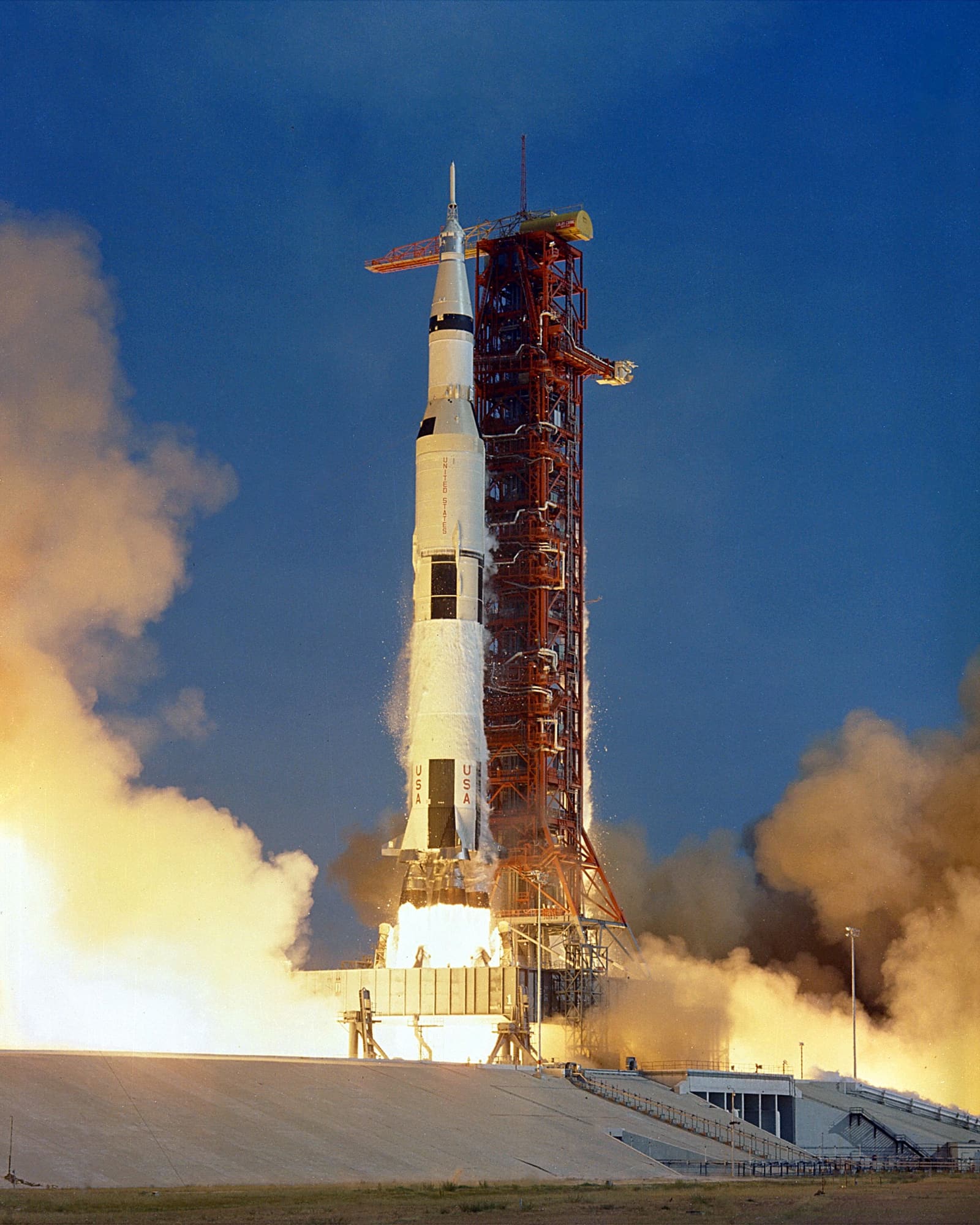
The Moon landing is often told as a single heroic arc, but the real historical argument is sharper: what actually did the causal heavy lifting between 1961 and 1969?
Historians broadly cluster into two explanations. One school treats Apollo mainly as a political mobilization outcome under Cold War pressure. The other argues that mobilization was necessary but insufficient, and that the decisive variable was NASA’s management and systems-integration discipline, especially after the Apollo 1 fire.
Both interpretations can cite evidence. The useful question is where each one explains more, and where it starts to lose predictive power.
Timeline anchors (the events both schools must explain)
- 25 May 1961: Kennedy asks Congress to commit to landing a man on the Moon and returning him safely before decade-end.[1]
- 27 January 1967: Apollo 1 cabin fire kills Grissom, White, and Chaffee during a launch rehearsal; program architecture and management processes are reworked.[2][3]
- December 1968: Apollo 8 successfully orbits the Moon, showing end-to-end mission integration at operational scale.[3]
- 16–24 July 1969: Apollo 11 executes launch, translunar flight, landing, ascent, rendezvous, and Earth return.[4]
Any strong explanation of Apollo has to account for all four points, not just the final footprint image.
Interpretation A: geopolitical mobilization was the main cause
This interpretation emphasizes presidential commitment, congressional appropriations, and strategic competition with the Soviet Union. In this reading, once the United States treated the Moon target as a state-priority project, it could absorb high uncertainty and high cost long enough to brute-force capability.
Evidence used by this school
- The 1961 national commitment framed lunar landing as a deadline-bound state objective, not a normal research program.[1]
- Federal-budget history shows a sharp NASA rise in the 1960s, peaking around the mid-decade share often cited near 4.4% of federal outlays.[5][6]
- Soviet early-space lead (Sputnik, Gagarin) created the political urgency that made exceptional spending durable.[7]
What this interpretation explains well
- Why Apollo received exceptional political protection despite technical setbacks.
- Why schedule pressure stayed credible across administrations.
- Why industrial scale-up happened quickly enough to make a 1969 landing plausible.
Where it weakens
Money and urgency alone do not explain mission reliability after 1967. Large programs can still fail catastrophically if integration and risk controls lag complexity.
Interpretation B: systems management converted resources into a winnable program
This interpretation accepts the geopolitical backdrop, but argues the key inflection was organizational: NASA and its contractors improved interface control, test discipline, and configuration management enough to turn a fragile program into a repeatable operational system.
Evidence used by this school
- Post-Apollo-1 investigations and redesign work changed materials, procedures, and review rigor rather than just adding budget.[2][3]
- The progression Apollo 7 -> Apollo 8 -> Apollo 9 -> Apollo 10 -> Apollo 11 is read as a staged risk-retirement architecture, not a single leap.[3][4]
- Program histories and Soviet-comparison research highlight that governance coherence and systems integration quality strongly separated outcomes in late-1960s lunar competition.[3][7]
What this interpretation explains well
- Why the program recovered from 1967 instead of stalling into repeated failures.
- Why complex multi-segment operations (LM descent/ascent, docking, re-entry) became executable within a tight window.
- Why similar geopolitical ambition in rival programs did not automatically produce the same result.
Where it weakens
It can understate political economy. Without early-1960s appropriation scale, the management turn would have had less to manage.
What would change the balance between these interpretations
Two kinds of evidence would materially shift the debate:
- Counterfactual budget evidence: if archival budget scenarios showed that a much lower NASA spending path still preserved 1969 landing probability, the mobilization thesis would weaken.
- Failure-chain archival evidence: if internal technical records showed Apollo 8–11 reliability gains were mostly luck rather than process changes, the systems-management thesis would weaken.
At current evidence quality, the strongest synthesis is: geopolitical mobilization created the opportunity set, while post-1967 management discipline determined whether that opportunity became a successful landing before the deadline.
Why this debate still matters
Apollo is often used as shorthand for “just fund it and set a deadline.” Historiography suggests a harder lesson: large mission success depends on both political commitment and operational architecture, and the second cannot be purchased automatically by the first.
That is the part modern moonshot language usually skips.
Sources
- The American Presidency Project — John F. Kennedy, Special Message to the Congress on Urgent National Needs (25 May 1961)
- Apollo Flight Journal (NASA-associated archive) — Apollo mission documents and Apollo 1 context
- NASA History (Roger E. Bilstein) — Stages to Saturn (SP-4206)
- NASA — Apollo 11 mission overview and timeline
- White House OMB — U.S. Budget Historical Tables
- The Planetary Society — NASA budget historical analysis (including 1960s federal-share context)
- NASA History (Asif A. Siddiqi) — Challenge to Apollo: The Soviet Union and the Space Race, 1945–1974 (SP-2000-4408)
- Wikimedia Commons image source — Apollo 11 launch photo (GPN-2000-000630)