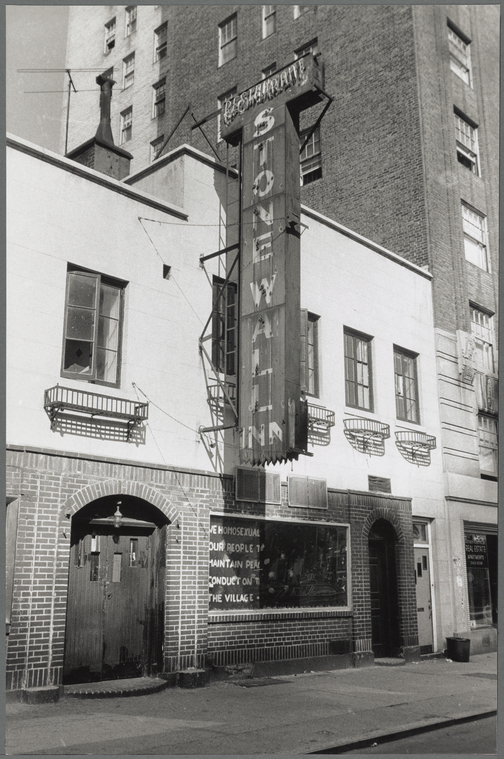
Stonewall is often remembered as one explosive night in June 1969. That memory is incomplete. The sharper historical question is not only why the uprising mattered, but how one block in Greenwich Village kept mattering after the first crowds went home. Many confrontations with police enter activist memory and then diffuse into broader movement history. Stonewall became something more durable: a site people returned to, argued over, legally protected, renamed, photographed, marched past, mourned at, and eventually placed inside the federal commemorative map.[1][2][3][4][5]
That durability was not automatic. Stonewall became a memory site because three different systems kept reinforcing one another over nearly half a century: repeated public ritual, especially the annual march tradition; preservation and landmark law at the city, state, and federal levels; and a physical geography that let Christopher Park, the bar frontage, and the surrounding streets keep functioning as a stage for assembly.[1][2][3][4][5]
The cover image makes that point in miniature. It is a 1969 archival photograph of the Stonewall Inn facade, before the site had accumulated the later layers of plaques, flags, and monument language.[2] The building mattered historically in June 1969 because it was the target of a raid. It mattered afterward because the street outside it kept being reused as public memory infrastructure.
Timeline anchors: the site stayed alive because memory kept getting restaged
- June 28, 1969: a police raid at the Stonewall Inn turns into an uprising; protests and confrontations continue for several nights into July 3.[1][2][3][4][5]
- June 28, 1970: the first anniversary is marked by the Christopher Street Liberation Day March, with related marches in other cities.[3][4][5]
- 1989: the section of Christopher Street in front of the bar is renamed Stonewall Place.[3][4]
- 1992: George Segal's Gay Liberation sculpture is installed in Christopher Park, giving the site a permanent commemorative object.[2][3][4]
- 1999–2000: Stonewall becomes the first LGBT site in the United States listed on the National Register of Historic Places and then designated a National Historic Landmark.[1][3][4]
- June 23, 2015: New York City designates Stonewall a landmark.[4][5]
- June 24, 2016: President Barack Obama establishes Stonewall National Monument, centered on Christopher Park and tied interpretively to the surrounding landscape.[1][2][3]
This sequence matters because it shows that Stonewall did not survive in public memory by simple repetition of the story. It survived because the story kept being attached to calendar dates, legal statuses, and recognizable urban objects.
First layer: the uprising turned one intersection into a reusable political stage
The events of June 28, 1969 did not create queer resistance from nothing. Several earlier confrontations between LGBT people and police had already occurred in other cities, and even New York had a pre-Stonewall organizing history.[1][4] What Stonewall did was different in scale and afterlife. Official accounts from the White House archive, the National Park Service, New York State Parks, and the NYC LGBTQ Historic Sites Project all describe the uprising as beginning with the early-morning raid and then unfolding across multiple nights, with Christopher Park serving as a gathering place, refuge, and platform because it sat directly across from the bar.[1][2][3][4]
That geography mattered. Christopher Park was not merely nearby open space. It gave the neighborhood a fixed point from which people could regroup, watch the street, and turn a raid on a bar into a wider conflict over public presence. The surrounding Greenwich Village street pattern also mattered. The National Park Service's landscape interpretation notes that the area’s narrow and irregular streets helped demonstrators who knew the neighborhood move, retreat, and reassemble in ways riot-control police did not control cleanly.[1][2]
This is the first memory mechanism. A movement site lasts longer when the event can be re-encountered spatially. People do not need a museum label to understand why Stonewall became a place of return. The bar frontage, the park, and the street corner already formed a legible scene.
Second layer: the march turned one episode into an annual civic clock
Ritual is what kept Stonewall from becoming only a famous anecdote. One year later, on June 28, 1970, activists marked the first anniversary with the Christopher Street Liberation Day March.[3][4][5] New York State Parks and the NYC LGBTQ Historic Sites Project both place that first march at the center of the site's afterlife, with sister marches in San Francisco and Los Angeles helping create the lineage of what later became annual Pride parades.[3][4]
This is a crucial shift. The uprising itself was reactive, improvised, and compressed into several nights. The march was scheduled, repeatable, and public by design. Once commemoration moved onto a yearly calendar, Stonewall stopped being only a remembered confrontation and became a recurring appointment. Every return to Christopher Street restated the claim that queer life belonged not only in hidden interiors but in open civic space.[3][4]
The difference between those two forms matters historically. An uprising creates memory through shock. A march creates memory through recurrence. Stonewall entered long-range public history because the second form followed the first.
Third layer: preservation law converted symbolic importance into administrative durability
Even annual ritual does not guarantee permanence. Urban memory can still be erased by redevelopment, neglect, or simple civic indifference. Stonewall's next transition came when commemoration entered preservation law.
The official designation chain is unusually clear. New York State Parks summarizes it in one sentence: the site was listed on the National Register in 1999, named a National Historic Landmark in 2000, designated a New York City Landmark in 2015, made a New York State Historic Site in 2016, and folded into Stonewall National Monument that same year.[3] The NYC LGBTQ Historic Sites Project states the same sequence and emphasizes the importance of the site being the first LGBT place in the United States to receive those federal recognitions.[4] The New York City Landmarks Preservation Commission designation report fixes the local moment even more precisely, with the hearing and designation process culminating on June 23, 2015.[5]
That chain did more than honor the past. It changed the site's operating conditions. Once Stonewall existed inside preservation and landmark systems, memory no longer depended only on marchers showing up. The site acquired review processes, interpretive responsibilities, legal boundaries, and a harder-to-ignore civic status. Symbolic significance became bureaucratically legible.[3][4][5]
Several smaller commemorative additions fit inside that process. In 1989, the city renamed the adjacent stretch of street Stonewall Place. In 1992, George Segal's Gay Liberation sculpture was installed in Christopher Park.[2][3][4] These gestures were modest compared with federal designation, but they mattered because they thickened the site. A memory site becomes durable when it accumulates multiple entry points: a march route, a street name, a sculpture, a plaque, a park fence, a preserved facade.
Fourth layer: national monument status widened the audience without freezing the site
The June 24, 2016 proclamation establishing Stonewall National Monument is the clearest statement of how the federal government reframed the site.[1] The proclamation does two things at once. It treats Stonewall as a turning point in the modern LGBT civil rights movement, and it defines the protected federal footprint narrowly, centered on Christopher Park, while interpretively linking the park to the Stonewall Inn and the surrounding streets.[1][2]
That combination is historically revealing. The federal government did not create a sealed memorial complex detached from city life. It recognized an already active landscape. The proclamation explicitly describes Christopher Park as a place for marches, parades, grief, anger, celebration, and political assembly, and it notes how quickly people returned there in later moments of triumph and mourning, from marriage-equality celebrations in 2015 to vigils after the Pulse massacre in 2016.[1][2][4]
This is why Stonewall reads differently from a static monument built decades after the fact. The site was still being used before the proclamation, and federal status amplified that use rather than replacing it. Monument designation enlarged the audience and institutional backing, but the site's real force remained urban and participatory.
Two ways to read what Stonewall now is
Reading 1: Stonewall is primarily an origin shrine
Under this reading, the site matters because it marks the place where a decisive break happened in 1969 and where the modern LGBT rights movement can be narratively located.[1][2][3]
Reading 2: Stonewall is primarily a recurring civic platform
Under this reading, the site matters because later people kept reactivating it through annual marches, preservation campaigns, legal designation, and public assembly, turning one episode into a long-running civic script.[1][2][3][4][5]
The second reading fits the evidence better. Stonewall did not remain central because history chose it once and for all in June 1969. It remained central because activists, preservationists, city officials, and later the federal government kept making the place usable for memory.
What would change the assessment?
This interpretation would weaken if stronger evidence showed that the annual Christopher Street commemorations quickly migrated elsewhere and that the Stonewall block itself had little continuing role after the early 1970s. It would also weaken if the preservation and designation chain had been largely decorative, with no real effect on access, interpretation, or public visibility. The surviving official record points in the opposite direction. It shows a site repeatedly reactivated in protest, celebration, mourning, naming, sculpture, and law.[1][2][3][4][5]
The larger historical lesson is practical. Memory sites endure when people can return to them on more than one register at once. Stonewall became durable because it was never only a past event. It remained a route, a corner, a march, a park, a landmark file, and eventually a monument.
Sources
- Barack Obama, "Presidential Proclamation -- Establishment of the Stonewall National Monument" (June 24, 2016).
- National Park Service, "Stonewall National Monument Cultural Landscape" - site geography, Christopher Park, 1992 Gay Liberation installation, and landscape significance.
- New York State Parks, Recreation and Historic Preservation, "Stonewall Inn State Historic Site" - six-night uprising chronology, designation chain, and Christopher Street Liberation Day legacy.
- NYC LGBTQ Historic Sites Project, "Stonewall Inn/Christopher Park" - building history, 1969 uprising context, landmark timeline, and later commemorative layering.
- New York City Landmarks Preservation Commission, "Stonewall Inn Designation Report" (June 23, 2015).