Selma is usually remembered as one terrible afternoon on the Edmund Pettus Bridge. That memory is accurate, but it is too narrow to explain why the events of March 1965 mattered so quickly. The sharper historical unit is a compressed nineteen-day sequence: a local protest campaign rooted in Dallas County disfranchisement, the murder of Jimmie Lee Jackson, the attack on roughly 600 marchers on March 7, the tactical pause of March 9, Lyndon Johnson's March 15 speech to Congress, a federal court order on March 17, and the protected march that left Selma on March 21 and entered Montgomery on March 25.[1][2][3][4][5]
Read in that sequence, Selma stops being only a martyrdom story. It becomes a chronicle of political acceleration. Local activists had been forcing the voting-rights issue for months before the bridge attack. What Bloody Sunday did was collapse distance between local repression and federal obligation. Television made the violence visible, Johnson translated the crisis into national legislative language, and Judge Frank Johnson's order turned a blocked march into a protected constitutional act.[1][2][3][4][5]
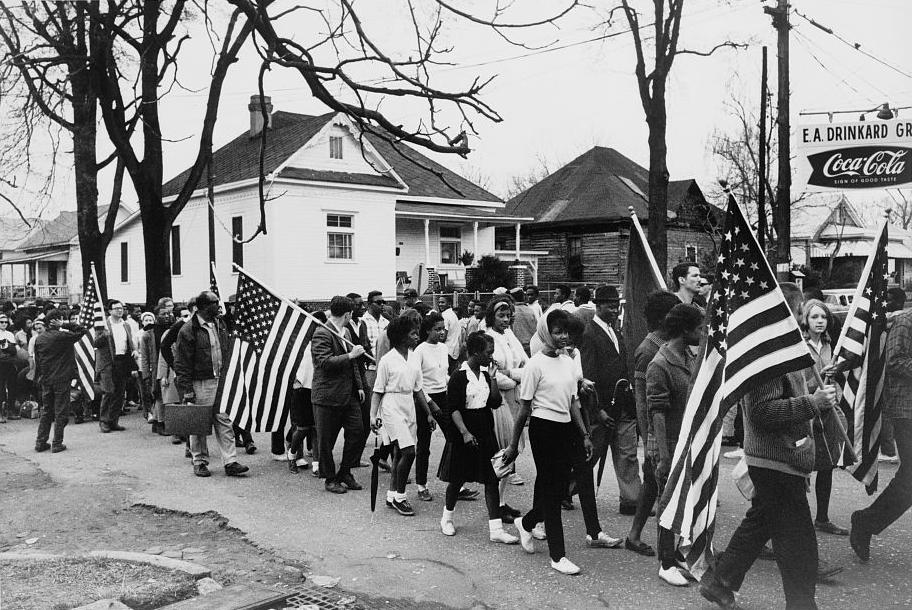
The hero image belongs to that larger frame. It is not from the moment of beating on the bridge. It shows participants on the later Selma-to-Montgomery march walking east along Highway 80 with flags and signs, a public image of how the campaign changed within days from a local confrontation into a national procession under court protection.[4][6]
Timeline: from local pressure to federal clock
- February 18, 1965: During a night protest in nearby Marion, Alabama, state troopers attack demonstrators; Jimmie Lee Jackson is shot while trying to protect family members.[1][3]
- February 26, 1965: Jackson dies, sharpening pressure for a march from Selma to Montgomery.[1]
- March 7, 1965: About 600 marchers led by John Lewis and Hosea Williams leave Selma, cross the Edmund Pettus Bridge, and are attacked by troopers and possemen on what becomes known as Bloody Sunday.[1][2][3][4]
- March 9, 1965: A second march reaches the bridge, prays, and turns back while legal protection is still unresolved.[2]
- March 15, 1965: Johnson addresses Congress in the speech later known as The American Promise, explicitly tying Selma to federal voting-rights legislation.[5]
- March 17, 1965: Federal District Judge Frank M. Johnson Jr. rules that the right to petition government for redress can be exercised in large groups, clearing the way for a protected march.[4]
- March 21, 1965: Roughly 3,200 marchers set out from Selma under federal protection.[2][4]
- March 25, 1965: The march reaches Montgomery with about 25,000 participants.[2][4]
- August 6, 1965: Johnson signs the Voting Rights Act into law.[2]
This sequence matters because it shows that Selma was not a single moral spectacle followed by an inevitable legislative response. Every stage changed the next stage's operating conditions.
Before the bridge: Selma was already a local voting-rights siege
The bridge attack landed so hard because Selma was already the site of a prolonged struggle over voter registration. SNCC had been working in the county well before the national television crews arrived, and SCLC joined a local campaign that was pushing against the sheriff's office, registrars, and a white local political order built on Black exclusion from the ballot.[1] In that setting, the shooting of Jimmie Lee Jackson in Marion was not a detached tragedy. It turned a registration campaign into a march campaign, because the movement needed a route that could force Alabama's voting system into public view.[1][3]
That point is easy to lose if the story begins on March 7. Bloody Sunday was shocking because it condensed a local routine of intimidation into one nationally legible scene. The bridge did not create the issue. It made the issue impossible to keep provincial.
March 7: the bridge turned local repression into national evidence
On March 7, around 600 people lined up behind John Lewis of SNCC and Hosea Williams of SCLC and headed east out of Selma.[1][3][4] The route itself mattered. A march to Montgomery made a local suffrage campaign visible as a direct petition to state power. The movement was not merely demonstrating inside Selma; it was attempting to traverse public space all the way to the governor's capital.[1]
Once the marchers crossed the crest of the Edmund Pettus Bridge, they met Alabama state troopers and a mounted posse. The resulting assault with clubs and tear gas sent marchers fleeing back toward Selma and left the bridge fixed in national memory as the hinge between orderly petition and openly coercive state force.[1][3] The SNCC Digital Gateway stresses that the attack was televised across the country.[1] That matters more than vividness alone. Television did not simply document violence; it synchronized local witness and national audience. After March 7, the argument that voting obstruction in Alabama was a local administrative matter became far harder to sustain.
This is the first reason Selma should be read as a chronicle rather than a monument. The beating on the bridge was historically decisive because it changed the audience and tempo of the conflict in real time.
March 9 to March 15: the movement paused tactically while Washington's clock sped up
Public memory often flattens the second march into a hesitation. It is better read as a legal and tactical hinge. On March 9, Martin Luther King Jr. led a second march to the bridge and turned the marchers back while court protection remained unsettled.[2] That decision frustrated some activists at the time, but within the longer sequence it preserved the campaign's central claim: the march was a lawful petition demanding federal recognition, not a sacrificial gesture repeated for its own sake.
The crucial change came in Washington. In his March 15 address to Congress, Johnson treated Selma as proof that existing law was inadequate where local officials were determined to deny the vote.[5] He told Congress that the issue was not sectional and not only Black; "their cause must be our cause too," and he adopted the movement's own refrain, "we shall overcome."[5] The speech mattered because it converted bridge violence into executive legislative priority. It did not pass the law, but it reset the argument's level. After March 15, the federal government was publicly committed on the record to a voting-rights bill tied directly to Selma.[2][5]
March 17 to March 25: court protection changed the meaning of the road itself
The next pivot was judicial, not rhetorical. On March 17, Judge Frank Johnson held that the right to petition government for redress "may be exercised in large groups."[4] That sentence did practical work. It reclassified the proposed march from a public-order problem into a protected constitutional action. It also changed the road's political meaning. Highway 80 stopped being merely the line to Montgomery and became the route on which federal protection would be visibly tested.
That is why the third march on March 21 should not be treated as a simple replay of the first. It began with around 3,200 people rather than the earlier 600, and it moved under federal protection rather than into an unbuffered line of state violence.[2][4] The movement's claim had widened. By the time the march reached Montgomery on March 25, about 25,000 people were present.[2][4] Scale itself had become part of the argument. Selma was no longer a county campaign asking to be seen; it was a national coalition walking into the state capital under legal protection that Alabama had tried to deny.
The hero image captures that second condition. Marchers on the highway with flags and placards look orderly, even almost ceremonial.[6] That apparent calm is the historical point. Within less than three weeks, a march route once broken by troopers had become an instrument through which federal power, constitutional language, and mass participation appeared together in public space.
Why the nineteen-day sequence matters more than the bridge alone
If the story is told only as Bloody Sunday, Selma becomes an atrocity that shamed the nation. That is true but incomplete. The fuller sequence shows four mechanisms interacting:
- local organizing supplied the issue and the bodies that made the confrontation possible;[1]
- televised violence made the conflict nationally undeniable;[1][3]
- presidential speech converted outrage into legislative commitment;[5]
- federal court protection transformed the march from blocked protest into state-recognized petition, which in turn enlarged participation and tightened the path to statute.[2][4]
That mechanism explains why the Voting Rights Act followed in the same year.[2] Selma mattered not because one day alone changed everything, but because each stage rewrote the next stage's political boundary.
What would change the assessment?
This reading would weaken if stronger evidence showed that the bridge attack had little effect on federal timing, that Johnson's speech had been fully prepared without regard to Selma, or that the protected third march did not materially widen participation or legislative urgency. The surviving public record points in the opposite direction. The National Archives, the Park Service, SNCC's own historical record, and Johnson's speech all place Selma inside one accelerating chain from local violence to federal voting-rights action.[1][2][3][4][5]
The larger historical lesson is procedural. Democracies often change when local actors force a conflict into a form that the national state can no longer postpone. Selma did that through road, camera, court, and crowd. The bridge was the shock. The nineteen days after it were the conversion mechanism.
Sources
- SNCC Digital Gateway, "Bloody Sunday" - local campaign context, Jimmie Lee Jackson, march leadership, and the nationally televised attack on March 7, 1965.
- National Archives, "Selma Marches" - chronology of the three marches, March 21 and March 25 participation levels, and the August 6, 1965 Voting Rights Act signing.
- National Park Service, "Bloody Sunday" - National Park Service account of the first Selma-to-Montgomery march, the attack on the bridge, and the role of Jimmie Lee Jackson's death in the march call.
- National Park Service, "Edmund Pettus Bridge" - Judge Frank Johnson's March 17 ruling, the March 21 protected march, and the March 25 arrival in Montgomery.
- Lyndon B. Johnson, "Special Message to the Congress: The American Promise" (March 15, 1965), The American Presidency Project.
- Wikimedia Commons, "File:Selma to Montgomery Marches.jpg" - Peter Pettus photograph from the United States Library of Congress used as the article image.