The Montgomery Bus Boycott is often retold as a morality play with one electrifying trigger: Rosa Parks refuses to surrender her seat on December 1, 1955, the Black community stays off the buses, and segregation eventually falls. That sequence is true, but it is not yet an explanation. Plenty of righteous protests burn hot and then collapse under routine pressure. The sharper historical question is why this one could hold for 381 days.[1][4][5]
The strongest answer is organizational rather than purely symbolic. Montgomery’s Black community turned refusal into a parallel system. The boycott held because it combined four moving parts: a near-total first-day show of collective discipline, a replacement transportation network that made daily life possible, church-centered fundraising and communication that spread the burden, and a federal court case whose timetable ran beside the street protest instead of replacing it.[1][2][3][4][5][7]
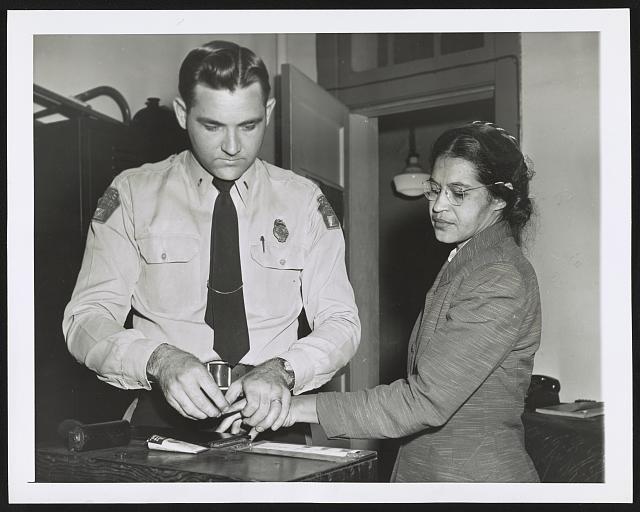
The cover photo helps place the struggle on its real terrain. It shows Rosa Parks being fingerprinted in Montgomery on February 22, 1956, after authorities moved from defending bus segregation to criminalizing boycott participation itself.[6] By that point, the conflict was no longer about one seat on one evening ride. It had become a contest over whether a city could wait out a disciplined mass withdrawal.
Timeline anchors: the boycott survived because several clocks moved together
- December 1, 1955: Rosa Parks is arrested after refusing to give up her seat on a Montgomery bus.[1][5][7]
- December 5, 1955: the one-day boycott succeeds at overwhelming scale, and the Montgomery Improvement Association, or MIA, is formed to extend it.[1][2][5]
- February 1, 1956: attorneys file the federal case that became Browder v. Gayle.[4]
- June 5, 1956: a three-judge federal district court rules bus segregation unconstitutional.[4][5]
- November 13, 1956: the U.S. Supreme Court affirms the district-court ruling.[1][4][5]
- December 20, 1956: the desegregation order reaches Montgomery, and King calls off the boycott; integrated bus service begins the next morning.[1][4]
This sequence matters because it shows that the boycott was never one continuous emotional surge. It had to survive multiple transitions: from outrage to routine, from routine to repression, and from legal victory in principle to legal implementation in the city itself.
First mechanism: a one-day protest became a legitimate governing structure on day one
The boycott’s first achievement was not yet legal. It was social. The Women’s Political Council had already been pressing bus grievances for years, and after Parks’s arrest Jo Ann Robinson and her allies rapidly distributed flyers calling for a Monday boycott.[1][5][7] When December 5 arrived, the response was overwhelming. Stanford’s King Institute describes the turnout as 90 percent participation among Montgomery’s Black residents, while the National Park Service says the one-day boycott was 90 percent effective among a ridership base that was more than 70 percent African American.[1][5]
That scale changed the problem immediately. A one-day protest can be dismissed as a temporary disturbance. A one-day protest with near-total compliance creates a mandate for new leadership. On the afternoon of December 5, ministers and community leaders formed the MIA, elected Martin Luther King Jr. as president, and converted spontaneous solidarity into an institution with officers, committees, demands, and a negotiating posture.[1][2][7]
This is the first causal hinge. The boycott did not last because people merely agreed that segregation was wrong. It lasted because the first day generated enough visible unity to authorize an organization that could make decisions for the next day, the next week, and the next month.
Second mechanism: the movement replaced the bus before the city could wait it out
Moral discipline alone would not have carried domestic workers, students, and laborers through a year of lost rides. The boycott became durable when it built a substitute transit system.
The Library of Congress material is especially useful here because it preserves the movement at the level of operation rather than legend. Its exhibition page on the MIA notes that Rosa Parks briefly served as a dispatcher for the MIA Transportation Committee, connecting riders who needed transportation with drivers of private cars and church station wagons.[2] The companion Library of Congress page for Parks’s carpool notebook gives the scale in concrete terms: at one point the system used 325 private cars, 22 church station wagons, 43 dispatch stations, and 42 pick-up stations, with scheduled service from 5:30 a.m. to 12:30 a.m. transporting about 30,000 people daily.[3]
Other institutional summaries compress those numbers differently. The National Park Service describes over 200 volunteers offering cars and roughly 100 pickup stations, while the Bricklayers Hall listing describes a network with over 300 privately owned cars, 43 dispatch stations, and 42 pickup locations.[5][7] The variation likely reflects different moments and different ways of counting donated vehicles, fixed dispatch points, and church-run shuttles. The larger historical point does not change: Montgomery’s Black community did not treat walking as the whole strategy. It built a replacement mobility system big enough to keep working people moving.
That distinction is the boycott’s real operational genius. A protest that only raises costs for participants can be broken by fatigue. A protest that redistributes those costs through carpools, dispatchers, churches, and donated vehicles becomes much harder to break. The city could threaten the official bus line, but it also had to defeat an improvised civic transit network spread across homes, churches, union spaces, and volunteer labor.
Third mechanism: church infrastructure turned sacrifice into a shared burden
The boycott also needed a way to keep morale, information, and money circulating. Here again the evidence points to institutions rather than charisma alone.
National Park Service summaries describe mass meetings at Black churches as the places where money was raised, news was shared, and commitment was renewed.[5][7] Bricklayers Hall later served as MIA headquarters because it was owned by a Black union and therefore less vulnerable to white pressure than a more dependent office arrangement would have been.[7] From there, the organization managed finances, correspondence, transportation, reports, and later the MIA newsletter.[7]
This matters because repression arrived early. King Institute’s overview records that city officials penalized Black taxi drivers who were helping boycotters, organized injunctions, and in February 1956 indicted more than eighty leaders under an anti-boycott law; King himself was convicted and fined.[1] The same overview notes bombings at the homes of King and E. D. Nixon.[1] A movement built only around one speech or one leader might have fractured under that pressure. Montgomery’s boycott did not, because its supporting capacity had already been distributed across ministers, women organizers, volunteer drivers, union-controlled rooms, church fleets, and neighborhood dispatch points.[1][2][3][7]
In other words, the boycott survived coercion because the city faced not one leader but an ecosystem.
Fourth mechanism: the legal clock ran beside the street clock, not in place of it
The court case is often remembered as the ending. Historically, it matters more as a parallel track that kept hope from evaporating when city repression intensified.
The King Institute’s Browder v. Gayle entry makes the sequence clear. Fred Gray and Charles Langford filed the federal suit on February 1, 1956, on behalf of women mistreated on the buses; Rosa Parks was deliberately not included so the constitutional challenge would not be tangled with her own prosecution.[4] On June 5, the district court ruled bus segregation unconstitutional. On November 13, the Supreme Court affirmed that ruling. On December 17, it rejected rehearing efforts, and on December 20 the order for integrated buses reached Montgomery.[4]
The decisive point is that the MIA did not treat the June ruling or the November affirmation as permission to dissolve the boycott early. King Institute’s boycott overview states that the Supreme Court’s November decision arrived on the very day King and the MIA were in court fighting an injunction against the carpools. The MIA still chose to continue the boycott until the desegregation order physically arrived in Montgomery, operating without the carpool system for about a month after the legal breakthrough.[1]
That is a crucial mechanism, because it shows disciplined sequencing. The boycott leadership separated three different moments that are often blurred together in memory:
- a favorable court ruling in principle,
- the administrative arrival of an enforceable order in the city,
- and the public decision to reenter the buses under new terms.[1][4]
Without that sequencing, momentum could have broken in late 1956. People might have gone back too soon, before enforcement was secure, or lost hope if the carpool injunction landed before the Supreme Court process finished. The movement held because the legal case supplied a horizon of victory while the boycott organization kept daily pressure in place until that victory became executable.
Why Montgomery became a movement template
The National Park Service’s Bricklayers Hall history argues that the way the MIA organized and sustained the boycott became a blueprint for later civil-rights campaigns.[7] That assessment is persuasive because Montgomery solved a problem many later movements also faced: how to convert moral outrage into repeatable collective action under economic pressure.
The template was not mysterious. It joined symbolic clarity to practical substitution. Parks’s arrest gave the movement a clean moral focus. The MIA gave it command structure. Churches and union-controlled space gave it communications and fundraising capacity. Carpools and station wagons gave it daily survivability. Browder v. Gayle gave it a legal endgame that could be awaited without surrendering initiative.[1][2][3][4][5][7]
This is why the boycott reads less like a spontaneous awakening than like a rare case in which a community built just enough alternative infrastructure to keep dignity from being a one-week luxury.
Two common readings, and the stronger one
Reading 1: the boycott lasted because Rosa Parks inspired a city and King inspired the nation
This reading captures something real. Without Parks’s stature, the Women’s Political Council’s speed, and King’s emergence as a public voice, the boycott would not have taken the shape it did.[1][5][7]
Reading 2: the boycott lasted because the movement solved the logistics problem of long-term refusal
This reading fits the evidence better. Inspiration launched the protest, but dispatchers, drivers, station wagons, church meetings, donations, and legal sequencing kept it alive.[2][3][4][5][7]
The stronger interpretation is the second one. The boycott did not become historic because sacrifice alone was pure. It became historic because sacrifice was organized.
What would change the assessment?
This interpretation would weaken if stronger archival evidence showed that the replacement transportation system was mostly symbolic, served only a small elite, or collapsed for long stretches while most riders quietly returned to the buses before December 1956. It would also weaken if the federal lawsuit had little influence on morale and the boycott’s continuation had been driven almost entirely by local habit rather than by the expectation of enforceable legal change. The surviving institutional record points the other way. It shows a mass movement that kept daily life functioning long enough for a court victory to matter.[1][2][3][4][5][7]
Sources
- The Martin Luther King, Jr. Research and Education Institute, "Montgomery Bus Boycott" - boycott chronology, MIA formation, anti-boycott repression, the 300-car system, and the decision to continue until the desegregation order arrived.
- Library of Congress, "The Montgomery Improvement Association" - Rosa Parks's role as an MIA dispatcher and the use of private cars and church station wagons.
- Library of Congress, "Carpool Notebook" - scale details for the replacement transit system, including 325 private cars, 22 station wagons, 43 dispatch stations, 42 pick-up stations, and about 30,000 riders per day.
- The Martin Luther King, Jr. Research and Education Institute, "Browder v. Gayle, 352 U.S. 903" - federal case filing, district-court ruling, Supreme Court affirmance, and the December 20 order.
- National Park Service, "The Montgomery Bus Boycott" - first-day turnout, volunteer carpool scale, Brown v. Board precedent, and the boycott's relationship to the broader civil-rights movement.
- Library of Congress Prints & Photographs Division, "Woman fingerprinted. Mrs. Rosa Parks..." - archival photograph of Rosa Parks being fingerprinted in Montgomery on February 22, 1956.
- National Park Service, "Bricklayers Hall" - MIA headquarters, church and union infrastructure, over 300 cars, 43 dispatch stations, 42 pickup points, and the boycott as a movement blueprint.
Editor’s Pick Review
This piece wins today’s editor pick on mechanism quality under the 24-hour window: it does not stop at symbolic narrative, and it converts a famous event into a verifiable operating model. The four-part causal chain—first-day legitimacy, replacement transport capacity, church-centered coordination, and parallel federal-court timing—is argued with concrete institutional evidence and clear sequencing.
It also passes the stricter visual policy cleanly. The lead image is a topic-grounded archival photograph tied directly to the article’s thesis (state pressure and movement durability), with no analytical diagram substitution. Combined with strong source discipline and high Chinese translation fidelity, this is the strongest publication-ready article in the current candidate pool.