The Social Security Act of 1935 is usually remembered as the moment the United States finally created Social Security.[1] That memory is true, but it is also too narrow. Read as a document rather than as a retrospective label, the Act does not build one simple federal pension state. It divides economic insecurity into different problems, assigns those problems to different time horizons, and then gives different layers of government different jobs.[1][2][3] The historical force of the law lies in that architecture.
That is the sharp question worth following in the text. Why did the statute become so durable when the Depression had already produced many emergency measures? The answer is that the Act did not try to solve every risk with one mechanism. It gave immediate assistance to aged poor people through state plans supported by federal money.[1] It created contributory old-age insurance for workers whose benefits would be financed through payroll contributions over time rather than through ordinary general revenues.[1][2] And in unemployment compensation it used a federal tax lever to push states into creating systems of their own under federal standards.[2] The law lasted because it split security into different clocks.
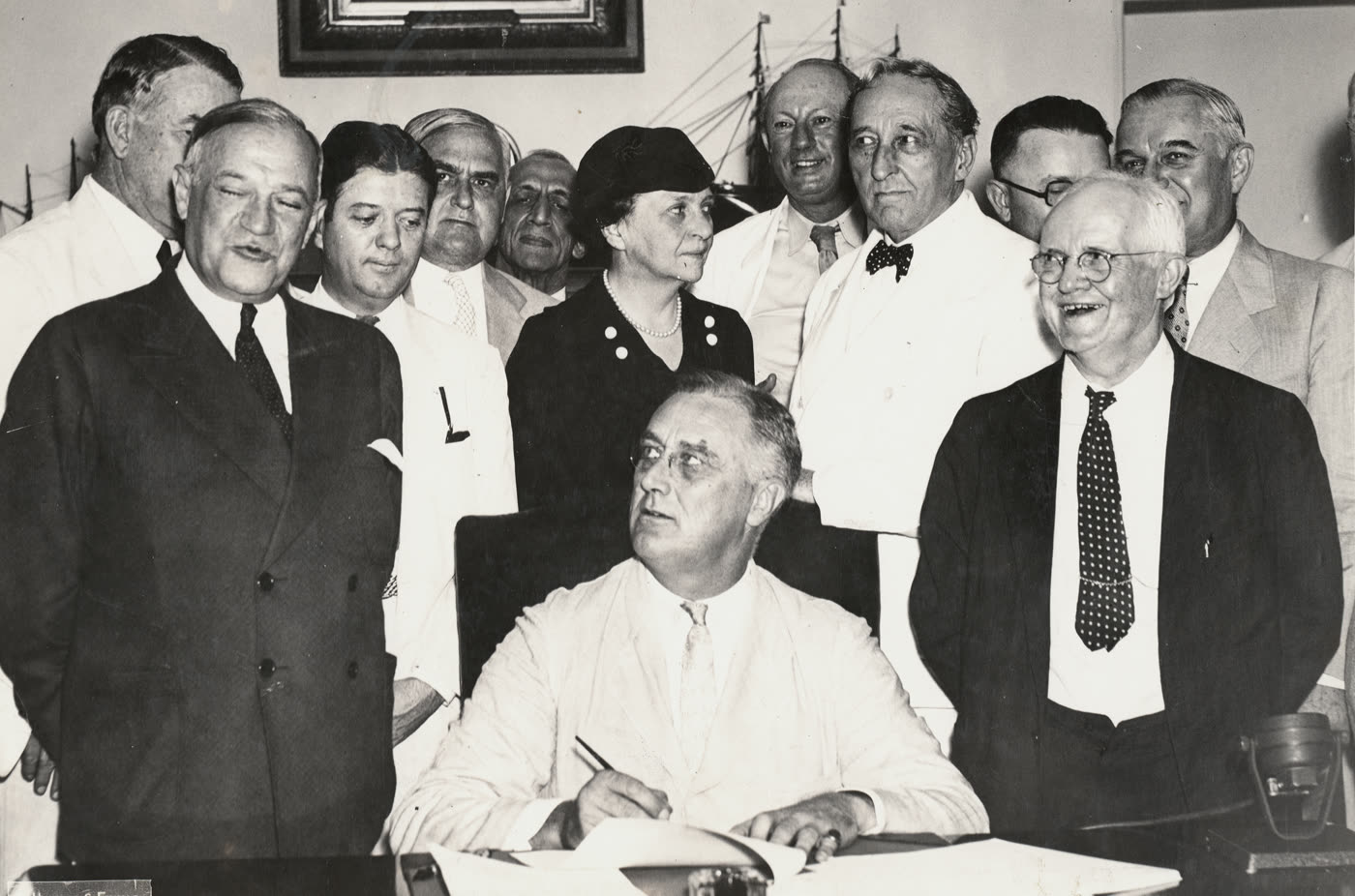
The cover image fits that reading. The widely circulated signing photograph shows Franklin D. Roosevelt at the desk with Frances Perkins and key legislators gathered behind him on August 14, 1935.[5] That is the right visual because the law's main achievement was not one presidential flourish of the pen. It was a negotiated operating system. The Act's structure bound federal taxation, state administration, and long-run insurance logic into one room and then into one statute.[1][2][4][5]
Timeline anchors
- June 8, 1934: Roosevelt tells Congress he wants security against the major hazards of life, especially unemployment and old age, and soon appoints the Committee on Economic Security to design a program.[2][3]
- January 17, 1935: Roosevelt sends Congress his message on social security and transmits the committee's report as the basis for legislation.[2][3]
- April 5, 1935: the House passes H.R. 7260 by a vote of 372 to 33.[4]
- Early August 1935: the bill is reconciled through conference reports approved by both houses.[4]
- August 14, 1935: Roosevelt signs the Social Security Act into law.[1][4][5]
These dates matter because they show that the Act emerged in stages: first a design problem, then a legislative compromise, and only then a national program.[2][3][4]
Title I shows that the Act began with people who could not wait
One of the easiest ways to misremember the Social Security Act is to begin reading it at retirement insurance. The text itself does not do that. The National Archives transcript shows that the statute opens with Title I, grants to states for old-age assistance.[1] That placement matters historically. Congress and the Roosevelt administration knew that millions of older people were already poor during the Depression and could not wait for a contributory system to mature.[1][2]
Roosevelt's January 17 message makes the same distinction explicitly.[2] In the field of old-age security, he says, one principle had to be non-contributory old-age pensions for those who are now too old to build up their own insurance; another had to be compulsory contributory annuities for younger workers and future generations.[2] That is the law's first clock. Some need was immediate and relief-like. Some need belonged to a future insurance system that could only become self-supporting over time.[1][2]
The structure of Title I confirms the point. The federal government would not simply mail one identical national benefit from Washington. States had to submit plans, participate financially, designate a single state agency or a supervising agency, and provide a fair-hearing process for denied claims.[1] The Act therefore addressed old age first through a federal-state assistance model, not through one uniform national pension. That choice tells you what the drafters thought the crisis actually was in 1935: present destitution needed aid now, while durable insurance had to be built on a different schedule.[1][2]
Title II built old-age insurance around payroll time, not around general relief
If Title I addressed the present emergency, Title II handled the second clock: the slower construction of contributory old-age insurance.[1] Roosevelt's message to Congress is the clearest guide to the design principle. He said the system, aside from startup money, should be self-sustaining and that benefit funds should not come from the proceeds of general taxation.[2] The National Archives summary calls this a uniquely American solution: unlike many European pension models, U.S. social security insurance would be supported through contributions drawn from wages and employers' payrolls.[1]
That design choice explains why the Act feels both ambitious and restrained. It is ambitious because it creates a national promise that workers can enter through payroll contributions.[1][2] It is restrained because it refuses to make that promise look like open-ended federal poor relief. The benefits system is built through time, through work histories, and through a revenue stream marked off from general spending.[1][2]
The Committee on Economic Security page helps make the same point from the drafting side.[3] SSA's historical introduction says the committee built the basic blueprint in barely six months and that not everything in the original proposal survived into final law.[3] The blueprint still matters because it clarifies the governing mentality behind the enacted statute: the administration was trying to create a comprehensive security program without collapsing all risks into one administrative form.[2][3] Old-age insurance therefore entered the Act as one component of a larger settlement, not as the whole settlement.
Unemployment compensation used federal taxation to move the states
The third clock in the Act concerns unemployment, and here the document is especially revealing. Roosevelt told Congress that the most practical proposal was a uniform federal payroll tax, with 90 percent allowed as an offset to employers contributing under a compulsory state unemployment compensation law.[2] That is an extraordinary design move. It means Washington would not simply run unemployment insurance alone, but it would use federal taxation to make state participation hard to refuse.[2]
This is where the phrase federal insurance, state assistance, and payroll time becomes useful rather than decorative. In unemployment compensation, the Act used a federal tax mechanism to manufacture state systems under a national framework.[2] Roosevelt was direct about the reason. Federal action had to come first so that states meeting in legislative session could move quickly, and the federal requirement would encourage them to pass their own laws.[2] The states would largely administer unemployment compensation, but they would do so inside a structure whose timing and incentives had already been set by Washington.[2]
That structure helps explain why the Act was politically survivable. The House history page notes that the bill endured bitter attacks from fiscal conservatives even before passage.[4] A fully centralized unemployment system would have produced even greater resistance. The adopted solution left visible roles for the states while ensuring that inaction carried a cost. The law did not abolish American federalism; it used federalism as part of the delivery mechanism.[2][4]
The Social Security Board made the hybrid machine legible
The final clue sits in administration. The long title of the Act itself includes the creation of a Social Security Board, and the National Archives summary says the board was authorized to register citizens for benefits, administer contributions received by the federal government, and send payments to recipients.[1] Section 702 of the transcript adds that the board was also supposed to study and recommend the most effective methods of providing economic security through social insurance.[1] In other words, the Act created not only benefits and taxes, but also a federal body whose task was to keep translating the hybrid system into something governable.
That administrative layer matters because the statute had to hold together very different kinds of policy. One part funded state old-age assistance right away.[1] Another part built contributory insurance for the future.[1][2] Another nudged states into unemployment systems by way of federal payroll taxation.[2] The board was the institution that made these unlike pieces legible as one national program rather than a pile of disconnected titles.[1]
This is also why the signing image still works as a historical object rather than a commemorative cliche.[5] You can see Roosevelt at the center, but the photograph does not show a solitary founder inventing a benefit check. It shows a legislative-administrative coalition. Frances Perkins, committee leaders, and congressional allies are physically present because the law itself is a coalition document.[4][5] Its durability came from that mixed design.
The bounded conclusion
The Social Security Act became foundational not because it offered one federal answer to economic insecurity, but because it refused to pretend that every form of insecurity worked on the same timetable.[1][2][3] It gave immediate old-age assistance to people already in need through state plans supported by federal money.[1] It built contributory old-age insurance for workers through payroll-financed time rather than ordinary general revenue.[1][2] And it used a federal tax offset to move states into unemployment compensation under national standards.[2]
That is the close-reading payoff. The Act's achievement was structural. It split security into different clocks and then linked those clocks together under one statute. The law worked because it recognized that the Depression had created at least three separate political problems at once: present poverty, future old-age risk, and unemployment instability. The document did not solve them with one instrument. It solved them with a machine.[1][2][4]
Sources
- National Archives, "Social Security Act (1935)" - milestone document page with the act transcript, title structure, old-age assistance opening, Social Security Board provisions, and summary of the law's hybrid design.
- Social Security Administration History, "President Roosevelt's Message to Congress, Transmitting the Report of the Committee on Economic Security," January 17, 1935 - the key design statement on self-sustaining insurance, state administration, old-age assistance for those already old, and the 90 percent unemployment-tax offset.
- Social Security Administration History, "The Report to the President of the Committee on Economic Security" - historical introduction explaining the June 1934 origins of the committee, the six-month blueprint process, and the fact that the CES report became the basic basis for the Social Security Act.
- U.S. House of Representatives, History, Art & Archives, "The Social Security Act of 1935" - House passage date, conference timing, the 372-33 vote, and the bill's placement within the Second New Deal.
- Wikimedia Commons, "File:FDR-SSA-August-14-1935.jpg" - source page for the archival signing photograph used as this article's cover image.