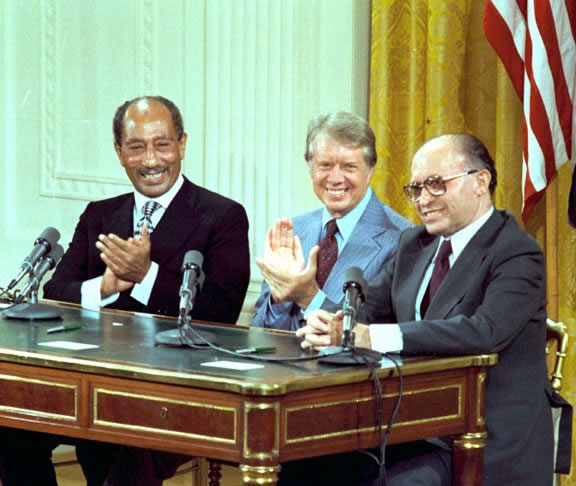
The Camp David Accords are easy to remember as one triumphant tableau: Jimmy Carter, Anwar Sadat, and Menachem Begin smiling at the White House on September 17, 1978.[1][5] That memory is real, but it can also be misleading. The summit did not work because three leaders found sudden harmony in a single room. It worked only after the summit stopped functioning as a three-way performance and became a controlled shuttle. Carter and his team moved between two delegations whose positions were still badly misaligned, narrowed the area of immediate agreement, and converted one part of the Arab-Israeli dispute into signable language while leaving another part unresolved.[1][2][4]
That is why the accords were both historic and bounded.[1][4] They created the framework that led to the March 26, 1979 Egyptian-Israeli peace treaty, the first peace treaty between Israel and an Arab state.[1] But they did not settle the core political future of the West Bank and Gaza. The summit succeeded by separating what could be made concrete right away from what could only be deferred under a more ambiguous formula.[1][2]
The lead photograph helps make that point. It captures the signing ceremony, not the strain that preceded it.[5] By the time the cameras were in the East Room, the real work had already happened elsewhere: in cabins, draft texts, side meetings, and Carter's repeated movement between incompatible positions.
Timeline anchors
- November 1977: Sadat shocks the region by going to Jerusalem, opening a direct Egyptian-Israeli track but not resolving the core territorial and Palestinian disputes.[1][4]
- Spring-summer 1978: U.S. diplomacy tries to find common ground on Israeli withdrawal from the Sinai, West Bank, and Gaza, but stalls.[1]
- August 8, 1978: the White House formally announces that Carter has invited Sadat and Begin to a summit at Camp David.[1]
- September 5-17, 1978: the Camp David Summit takes place at the presidential retreat in Maryland; the process increasingly shifts from joint sessions to Carter-led shuttle diplomacy.[1][2]
- September 17, 1978: the parties sign two framework documents in Washington.[1][5]
- October 1978-March 1979: follow-on talks struggle over settlements, withdrawal timing, and wider Arab politics before Carter reenters personally to close the treaty text.[1][2]
- March 26, 1979: Egypt and Israel sign the formal peace treaty in Washington.[1]
Those dates matter because Camp David was not one meeting with one outcome. It was a sequence: a diplomatic deadlock, a secluded summit, a framework breakthrough, then a second period of difficult treaty translation.[1][2]
1. By August 1978, direct contact had changed the atmosphere, but not the dispute
Camp David becomes easier to read once the prior year is restored. The Office of the Historian traces the summit back to the Carter administration's early hope of reviving the Geneva Conference format after 1973, a strategy that ran into trouble from several directions at once: Arab rivalry, Israeli domestic change, and deep disagreement over territory.[1] Britannica adds the essential political turn in May 1977, when Begin and the Likud Party came to power in Israel, hardening the negotiation environment around land-for-peace questions.[4]
Sadat's November 1977 trip to Jerusalem changed the mood of the conflict but did not close the gap.[1][4] It proved that direct Egyptian-Israeli contact was possible, yet the fundamental disputes stayed in place. Egypt wanted withdrawal from territories captured in 1967, especially the Sinai, while Israel resisted sweeping commitments on the West Bank and Gaza and preferred a more limited autonomy formula there.[1] By the summer of 1978, Carter had reason to believe the process would simply harden into another deadlock unless he changed its format.
That is the real beginning of Camp David. The summit was less a celebratory reward for progress than a procedural intervention designed to prevent diplomacy from freezing.[1]
2. The summit's first model failed: the leaders could not sustain a stable trilateral room
One of the most important details in the State Department account is structural rather than dramatic. It says the talks proved "extremely challenging," and that the trilateral format itself became impossible to sustain.[1] That is the hinge of the event. If Sadat, Begin, and Carter had been able to sit together continuously and bargain their way toward the same text, Camp David would mean one thing. Instead, the summit began revealing that the personal chemistry and public symbolism of the meeting were not enough to carry the substance.
At that point Carter's role changed. He stopped acting mainly as host and became the mechanism that kept the summit alive. The FRUS volume on the dispute is useful here because its official documentary structure makes the chronology explicit: the Camp David summit itself forms one discrete block of documents, followed by two separate phases of treaty negotiation before the March 1979 signing.[2] That shape is the record of a summit that produced frameworks, not closure.
In practical terms, the summit moved toward a shuttle process because that was the only way to keep the conversation from collapsing under the weight of maximal positions.[1] Carter and Cyrus Vance could carry proposals, revise formulations, and test limited wording changes without forcing each side to concede in public, face-to-face, at every turn. Camp David worked when the room got smaller and the circulation of paper got faster.
3. Sinai could be made concrete in a way the West Bank and Gaza could not
The next step in the reconstruction is to separate the summit's two main problem sets. The Sinai Peninsula was hard, but it was hard in a comparatively negotiable way. The discussion involved withdrawal, settlements, airfields, security arrangements, normalization, and timing.[1][4] These were consequential issues, but they were still issues that could be drafted into staged obligations between two states.
The West Bank and Gaza posed a different order of problem.[1] According to the Office of the Historian, they remained the most difficult part of the talks. The delegations clashed over the meaning of UN Security Council Resolution 242, the status of Israeli settlements, and the shape of any future Palestinian self-government.[1] This was not only a territorial disagreement. It was a disagreement about sovereignty, legal interpretation, political identity, and who had standing to decide the future of Palestinians not present as an independent party at the table.
That difference explains the accords' final architecture. Camp David succeeded not because it solved both baskets equally well, but because it did not insist on doing so. The summit found more precise language where precision was still possible and more elastic language where precision would have killed the deal.[1][4]
4. The September 17 breakthrough was two frameworks, not a full peace
The signed result reflected that unevenness. The summit produced two framework documents, not one final all-in settlement.[1] One laid down principles for an Egyptian-Israeli peace agreement. The other offered a formula for Palestinian self-government in the West Bank and Gaza.[1][4] That distinction matters because it is the clearest way to see what Camp David actually achieved.
The Egyptian-Israeli side of the accords was concrete enough to become the basis for a treaty within six months.[1] The Palestinian side was not. It created a pathway for later autonomy talks, but it did not bridge the underlying disagreement over sovereignty, settlements, and representation.[1][4] Camp David's breakthrough was therefore real without being total. It made one Arab-Israeli peace possible and left the broader Arab-Israeli question only partially structured.
This is also why the signing photograph should not be read as a picture of complete resolution.[5] It is a picture of successful narrowing. Carter had found a way to extract a durable bilateral breakthrough from a wider conflict he could not resolve whole.
5. Even after the summit, the treaty still had to be fought into text
The afterlife of the summit confirms the same point. If Camp David had already settled everything, the peace treaty would have followed automatically. It did not. The Office of the Historian stresses that once the frameworks were signed, the work of translating them into a formal treaty proved "daunting."[1] Talks in October 1978 broke down over settlement-freeze language, the timing of withdrawal, Egypt's wider Arab obligations, and Israeli security concerns.[1]
The FRUS volume underscores this by dividing the post-summit period into two long negotiation phases before the treaty signing on March 26, 1979.[2] That documentary shape matters because it shows that the summit's success was conditional rather than self-executing. Carter had to reenter personally in March 1979, secure new compromises, and help close the final text.[1]
This is the best boundary to keep in view. Camp David was not a miracle weekend that instantly solved the Middle East. It was a summit that restructured the diplomatic terrain enough for one treaty to become finishable. That is a major achievement. It is also a narrower one than the signing ceremony can make it appear.
The bounded legacy
Camp David worked only after the summit stopped behaving like a shared stage and started functioning like a mediated sequence of drafts, side meetings, and constrained bargains.[1][2] Carter's shuttle diplomacy did not create agreement from nothing. It created a process in which the immediate Egyptian-Israeli bargain could be made precise enough to sign, while the harder Palestinian question was left in a framework deliberately looser than a treaty.[1][4]
That is why the accords remain such a revealing historical case. They show how high-level diplomacy sometimes succeeds not by solving the whole dispute at once, but by cutting the negotiable piece free from the still-intractable one. Camp David changed the Middle East because that cut was large enough to produce peace between Egypt and Israel. It also showed the limit of the method: what could be deferred at the summit did not disappear afterward.[1][2][4]
Sources
- Office of the Historian, U.S. Department of State, "Camp David Accords and the Arab-Israeli Peace Process" - on the deadlock before the summit, the September 5-17, 1978 process, the shift away from sustained trilateral talks, the two frameworks, and the March 26, 1979 treaty.
- Office of the Historian, Foreign Relations of the United States, 1977-1980, Volume IX, Arab-Israeli Dispute, August 1978-December 1980, Second, Revised Edition - official documentary structure showing the Camp David summit phase and the two separate treaty-negotiation phases that followed.
- National Archives, "Camp David" - overview of the presidential retreat noting the September 1978 Mideast Peace Summit that produced the Camp David Accords.
- Encyclopaedia Britannica, "Camp David Accords" - background on Begin's 1977 election, Sadat's Jerusalem visit, the summit's two-part result, and the later Egypt-Israel treaty.
- White House Historical Association, "Carter, Sadat, and Begin sign the Camp David Accords in the White House East Room" - source page for the September 17, 1978 signing photograph used as this article's cover image.