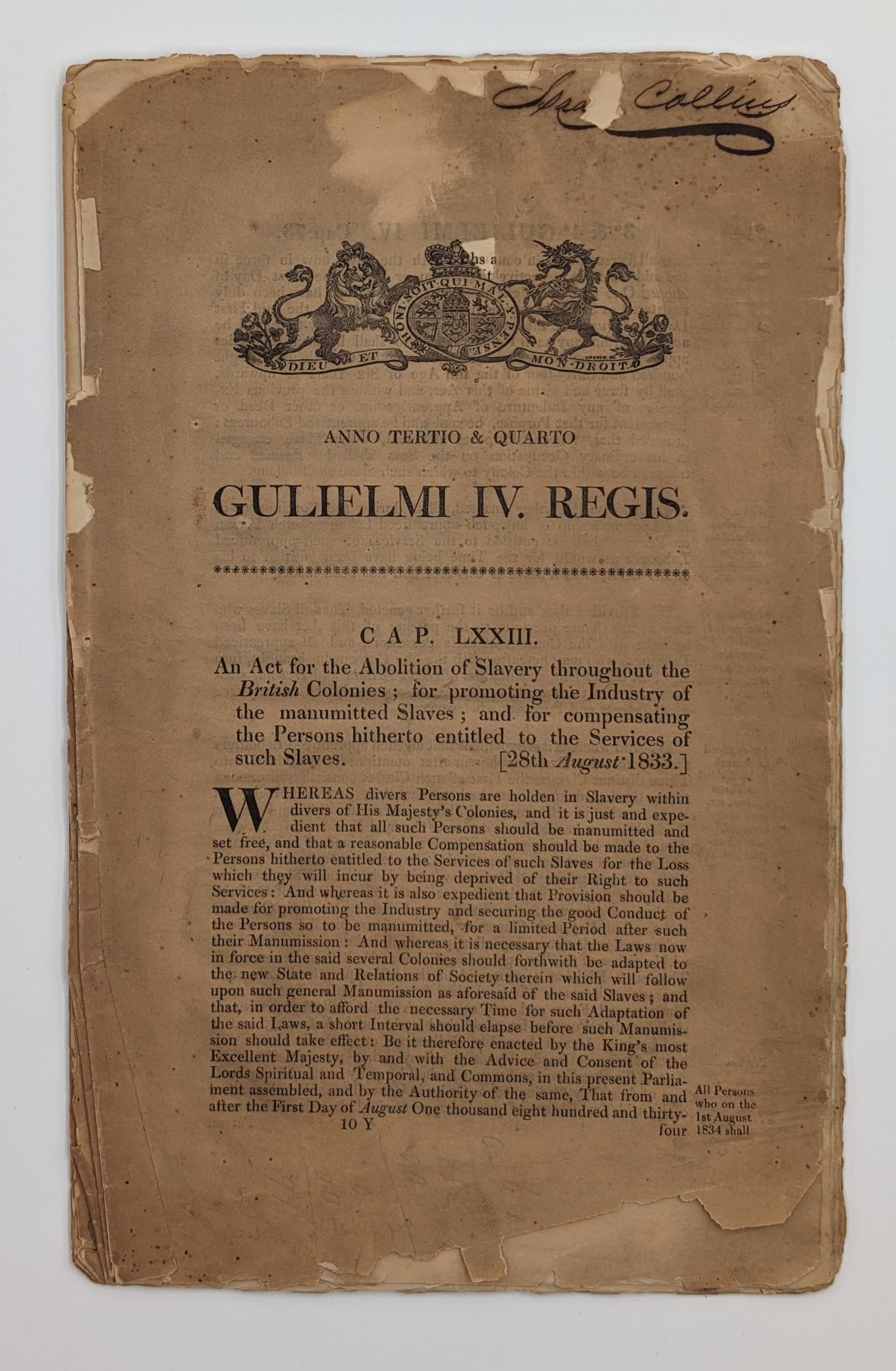
The Slavery Abolition Act of August 28, 1833 is easy to remember as a clean moral turning point: Parliament abolished slavery in much of the British Empire, and legal freedom followed. A close reading makes the achievement more complicated and more revealing. The Act did abolish slavery. But its own first page shows that emancipation was built as a bargain in which enslavers were compensated, formerly enslaved people were moved into compulsory "apprenticeship," and colonial governments were given time to adapt the machinery of labor and discipline.[1][2]
That sequence matters. The Act's long title is not only about abolition. It is also about "promoting the Industry" of the people to be freed and "compensating" those who had claimed a right to their services.[1] In one sentence, the statute names three political objects: ending slavery, managing Black labor after slavery, and paying the people who had legally owned other human beings. The order is a useful warning. Freedom enters the text, but it has to share the frame with property protection.
This is why the Act should be read less as a single declaration than as an administrative design. It answers a hard imperial question: how could Britain end slavery without making abolition look, to the planter class and its parliamentary defenders, like uncompensated confiscation? The answer was legally ingenious and morally jagged. Parliament changed the status of enslaved people, but it also preserved former owners' claims on labor for a period and paid them from public funds.[1][4][5]
The Preamble Makes The Bargain Visible
The preamble says that enslaved people should be "manumitted and set free," but in the same breath says "reasonable Compensation" should be made to those deprived of their claimed services.[1] That pairing is the key to the whole Act. The statute does not begin by centering repair for the enslaved. It begins by balancing freedom against the loss booked by owners.
The History of Parliament account gives the broader timeline: the British slave trade had been abolished in 1807, but slavery itself continued in the colonies until the 1833 Act set emancipation in motion from 1834.[3] That twenty-six-year gap is not a footnote. It explains why the 1833 Act is full of transition devices. Parliament was not simply discovering slavery's wrongness in 1833. It was finally legislating after decades in which slave labor had remained embedded in colonial production, West India political pressure, and imperial revenue habits.[2][3]
The same account stresses the delayed movement. Abolitionists re-emerged in the 1820s, slave resistance in the Caribbean shaped the political climate, and the 1832 Reform Act changed parliamentary balance by weakening some pro-slavery electoral interests.[3] The statute therefore arrived after moral argument, enslaved resistance, economic pressure, and parliamentary reform had converged. But convergence did not mean a clean settlement. It meant the state had enough political force to legislate, while still treating planter compensation as a necessary price of passage.[3][5]
Apprenticeship Was Not A Minor Detail
Section I is the most uncomfortable part of the Act's machinery. Instead of making all registered enslaved people immediately free on August 1, 1834, it says people aged six or older would become "apprenticed Labourers" without needing an indenture.[1] The word apprenticeship sounds like training. In this statute, it is a bridge that keeps coerced labor in place after the formal word slavery has been removed.
The Act then divides apprentices into labor classes: praedial attached, praedial unattached, and non-praedial.[1] That classification looks technical, but it tells us how carefully emancipation was made to follow plantation categories. Agricultural workers attached to land were treated differently from non-praedial workers. The Act set the outer limit for praedial apprenticeship at August 1, 1840, while non-praedial apprenticeship was to end by August 1, 1838.[1] A person could therefore be legally past slavery and still not yet in ordinary freedom.
The History of Parliament blog reduces this to the practical result: children under six were liberated, but adults were pushed into unpaid apprenticeship, and full emancipation in the British West Indies was not reached until 1838, when the apprenticeship system was ended early under pressure.[3] That early end is itself evidence. Apprenticeship was not a harmless administrative interval. It was controversial enough, and coercive enough, that its promised timetable could not fully survive.
The Act's labor rules show the contradiction. It capped required labor for praedial apprentices at forty-five hours a week, required maintenance such as food, clothing, lodging, and medical attendance, and created special justices to supervise the system.[1] These provisions imply protection, but they also confirm compulsion. A free worker does not need an emancipation statute to say how many unpaid hours may be claimed by a former owner. The protections mattered because the system still gave employers a legally enforceable right to labor.
Service Rights Survived The Word Slavery
The most revealing phrase may be Section II's rule that, during apprenticeship, the people who would have been entitled to an enslaved person's services before abolition remained entitled to that apprentice's services after abolition.[1] That is the hinge of the statute. The person is no longer a slave, but the service claim survives.
Section X goes further by making the employer's interest in those services transferable by sale, contract, deed, conveyance, will, or descent, while adding protections against separating family members.[1] Again, the Act combines restriction and preservation. It limits some of the most brutal consequences of treating people as property, but it does not fully break the property logic. It relocates it into a service right.
That is why the statute's freedom language must be read alongside its property language. Section XII says slavery would be "utterly and for ever abolished" from August 1, 1834, subject to obligations imposed by the Act.[1] The last clause is doing heavy work. Freedom is declared, but it is freedom under a schedule, under labor obligations, under magistrate supervision, and under colonial adaptation. The Act does not simply open a door. It builds a corridor.
Compensation Was The Fastest Part
The Act is far more generous and immediate when it turns to owners. Section XXIV sets aside 20 million pounds sterling for compensation.[1] HM Treasury's later Freedom of Information response states that this sum was equivalent to about 40 percent of total annual government expenditure in 1833.[5] The same response explains that the related borrowing was folded into the gilt program and fully repaid in 2015, with the long duration tied to the financial instrument rather than merely to the size of the original loan.[5]
Those details are not a modern distraction from the Act. They clarify its design. The people who had been enslaved received legal status change and, for many adults, years of apprenticeship. The owners received a public compensation scheme. The National Archives frames the record trail through compensation claims, because the paperwork of abolition produced a massive archive of who claimed money for losing enslaved labor.[2]
The asymmetry is stark: one group was made to wait inside managed labor; the other was paid because the state recognized the loss of claimed property. That does not erase the fact that abolition mattered. It makes the Act historically sharper. Britain ended a legal regime of enslavement while also turning public finance into a settlement mechanism for enslavers.[1][2][5]
The parliamentary debates show that this was not accidental. In the Lords debate of June 25, 1833, defenders of compensation and gradual transition treated property rights, colonial order, and labor discipline as inseparable from abolition's feasibility.[4] The statute that followed bears that argument in its bones. It is not a pure abolitionist text reluctantly blemished by compromise. It is compromise written as law.
The Close-Reading Judgment
The Act's historical importance lies in the tension between what it ended and what it preserved long enough to manage. It ended slavery as a lawful imperial status in most British colonies. It did not make freedom immediate for most adults. It did not compensate the formerly enslaved. It did not imagine emancipation primarily as repair. Instead, it converted slavery into a staged transition: abolition date, apprenticeship classes, special magistrates, labor limits, transfer rules, and owner compensation.[1][2][3]
That is why the first page deserves such close attention. It announces freedom, but it also tells readers whom the law felt obliged to reassure. Enslaved people appear as persons to be manumitted and then regulated. Enslavers appear as persons to be compensated. Colonial governments appear as systems needing time to adapt. The Act's greatness and its failure are therefore intertwined: it made slavery legally indefensible inside a large imperial system, but it made emancipation pass first through the claims of those who had profited from slavery.
The best short reading is this: the 1833 Act did not simply replace slavery with freedom. It replaced slavery with a timetable, and the timetable reveals the hierarchy of concern. Compensation was funded. Apprenticeship was enforced. Freedom arrived, but not in the first position.
Sources
- Peter Davis, "3° & 4° Gulielmi IV, cap. LXXIII," full text transcription of the Slavery Abolition Act 1833, including apprenticeship, abolition, and compensation clauses.
- The National Archives, "1833 Abolition of Slavery Act and compensation claims," official guide to the Act and the compensation-claim records.
- Joe Baker, "1833 Slavery Abolition Act: The Long Road to Emancipation in the British West Indies," History of Parliament Trust, 2024.
- UK Parliament, "Ministerial Plan For The Abolition Of Slavery," Historic Hansard, House of Lords debate, June 25, 1833.
- HM Treasury, "Slavery Abolition Act 1833," Freedom of Information response on the 20 million pound compensation fund and associated borrowing, published February 9, 2018.
- Open Boat Booksellers via AbeBooks, "An Act for the Abolition of Slavery throughout the British Colonies," photographed 1833 printed copy used as the article image source.