Dublin's General Post Office is powerful because it refuses to behave like a finished relic. The building on Sackville Street, now O'Connell Street, was a working post office before 24 April 1916, a rebel headquarters during Easter Week, a burned shell in May 1916, a rebuilt public building by 1929, and a recurring state ritual site.[1][2][4][5][6] Its memory does not sit in one plaque or one photograph. It accumulates because the building keeps being used.
That is the historical question worth asking. Why did the GPO become the most durable public stage of the Easter Rising when the rebellion itself was short, militarily suppressed, and spread across several Dublin positions? The answer is not simply that Padraig Pearse read the Proclamation nearby. It is that the site joined text, damage, reconstruction, and repeated ceremony in one place. The GPO lets Irish public memory hold a contradiction: the Rising failed in the week it happened, but the place where it failed became one of the places where later independence could be made visible.
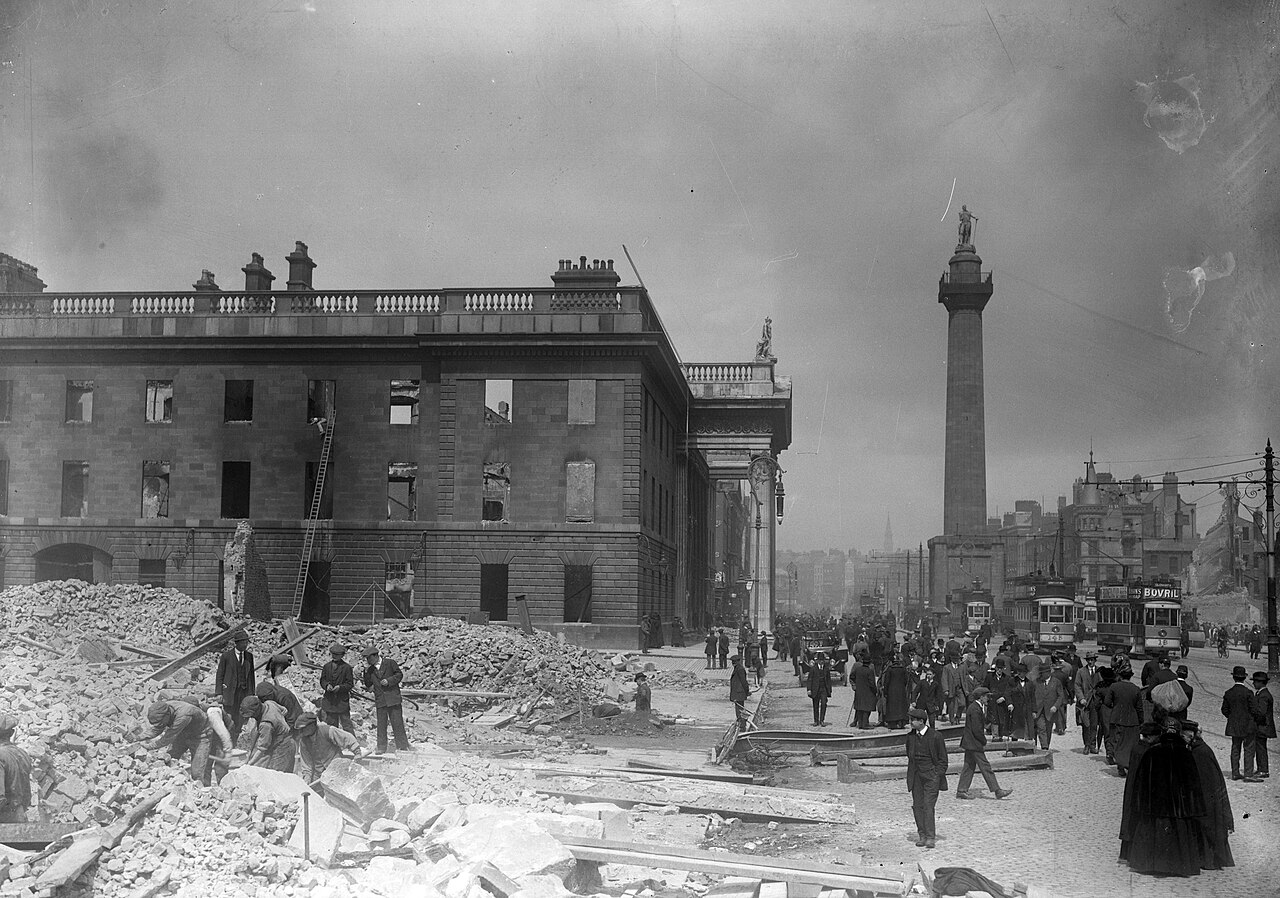
The cover photograph helps fix the first memory layer.[1] It does not show triumphant founders or a tidy monument. It shows a facade and skeleton: columns, tramlines, rubble, exposed interior space, and Nelson's Pillar still standing nearby. If the Proclamation gave the Rising a founding sentence, the ruined GPO gave it an image of cost.
A declaration needed a public wall
The Proclamation's text begins by addressing "Irishmen and Irishwomen" and presenting the rebels as a provisional government acting in the name of an Irish Republic.[3] That public address matters because it binds the building to a spoken political claim, not only to a military occupation. The GPO was not only where rebels worked from inside. It was where a claim was spoken outward.
The words are sweeping, but the setting was concrete: a seized communications building on Dublin's main street. The British National Archives gives the wider frame: on 24 April 1916, members of the Irish Volunteers and the Citizen Army occupied buildings in Dublin and proclaimed an Irish Republic.[4] That formulation is useful because it keeps the GPO from swallowing the whole event. The Rising involved multiple positions and actors. Yet the GPO had a special public logic. A post office is already an institution of messages, routes, paper, and state presence. Seizing it converted a communications building into a claim about sovereignty.
That is why the Proclamation should not be separated from the facade. A printed declaration can travel, be copied, be framed, and be read in classrooms. But at the GPO it also had an address. It attached itself to a public building whose ordinary purpose was moving messages through a state system. In memory terms, that made the act legible even to people who did not agree on the rebellion's wisdom.
The ruined shell made failure visible
The National Library of Ireland identifies the article's cover image as the GPO and O'Connell Street following the Easter Rising, part of the Keogh Photographic Collection, May 1916.[2] The Wikimedia Commons file page gives the fuller description: the shell of the GPO on Sackville Street in the aftermath of the Rising, photographed by Keogh Brothers.[1] That photograph matters because it gives the event a physical aftermath more legible than casualty tables or proclamations alone.
In memory terms, ruins do two things at once. They prove destruction, and they invite argument about meaning. The GPO shell could be read in 1916 as evidence of rebellion's recklessness, of imperial force, of urban damage, or of sacrifice. Later commemoration did not erase those competing readings so much as layer them. The image remains tense because the street is not empty of ordinary life. Tram tracks and commercial facades sit beside a gutted symbolic building. The city has to continue around the wound.
That is why the photograph is stronger than a cleaner monument image. A monument tells viewers that a meaning has already been approved. The ruined GPO shows meaning before it has settled. The facade survived while the interior was hollowed out. The public face of the building remained, but the inside had been transformed by fire and bombardment. As a memory object, that is almost too exact: the form of the old public order still standing, with a new political claim burned into its emptiness.
Rebuilding turned the site into a usable memorial
The GPO's later force depends on the fact that it was not preserved only as a ruin. Visit Dublin's site history notes that the building was destroyed except for the front portico and facade, then rebuilt and reopened in 1929.[5] That choice matters. A permanent ruin would have made the site easier to mourn but harder to inhabit. Rebuilding allowed the GPO to become a double object: a working civic building and a commemorative surface.
This is where the GPO differs from many memorial places. It does not ask the visitor to step entirely outside ordinary life. People can pass, post, queue, shop nearby, meet on O'Connell Street, enter the museum, or attend a ceremony. The building's memory is therefore not sealed away from urban motion. It is repeatedly interrupted by the same city life that the 1916 photograph already shows continuing around the damage.
Visit Dublin also notes that bullet holes remain visible in the large columns outside.[5] That detail is small but important. The rebuilt GPO did not become a blank replacement. It retained a physical prompt that interrupts ordinary street use. A passerby can encounter the Rising not as a distant anniversary but as marks in stone at hand height.
Annual ritual keeps the building public
The state ceremony keeps returning the Rising to the building's front. The Irish Defence Forces' account of the annual 1916 commemoration says the parade takes place at the GPO on Easter Sunday morning and normally includes the President, Taoiseach, Minister for Defence, Dublin's Lord Mayor, Garda representatives, and Defence Forces personnel.[6] It describes a sequence: troops on parade outside the GPO, a presidential guard of honour, prayers of remembrance, the Proclamation read on the steps at noon, the National Flag lowered, a presidential wreath-laying, public viewing areas, large screens, and an Air Corps flypast.[6]
That sequence is memory choreography. The Proclamation is not only displayed as a document; it is read aloud. The flag is not only present; it is lowered and raised in time. The public is not only told what happened; it is asked to occupy the street. The GPO is not only cited as a landmark; it becomes the background against which the state performs continuity with a rebellion that was once defeated.
There is a risk in that ritual. Annual ceremony can make a difficult event too smooth. It can turn conflict into pageantry and convert contested history into a national script. But the GPO's material history keeps resisting total smoothness. The building was a post office before it was a headquarters. The Proclamation was a political claim before it was an icon. The facade survived because the inside burned. The rebuilt building remains useful, not merely sacred.
The GPO therefore works best when it is understood as a memory machine with moving parts. Text matters: the Proclamation. Damage matters: the May 1916 shell. Reconstruction matters: the 1929 reopening into civic use. Repetition matters: the annual habit of returning to O'Connell Street. None of those layers is sufficient alone. Together they explain why this one building can carry so much more than a six-day insurrection.
The lesson is not that buildings remember by themselves. People choose routes, ceremonies, captions, museums, photographs, and silences. But some buildings make those choices harder to evade. The GPO stands where declaration met destruction, and where later public life had to decide whether to rebuild over the event or rebuild around it. Ireland did both. That is why the GPO still remembers 1916 by staying useful.
Sources
- Wikimedia Commons, "File:The shell of the G.P.O. on Sackville Street after the Easter Rising (6937669789).jpg" - archival Keogh Brothers photograph, May 1916, used as the article image.
- National Library of Ireland, "The 1916 Rising: Personalities and Perspectives" - online exhibition identifying the GPO and O'Connell Street photograph from the Keogh Photographic Collection, May 1916.
- CAIN Web Service, Ulster University, "Proclamation of the Irish Republic, 24 April 1916" - full text of the Proclamation.
- The National Archives (UK), "Ireland's Easter Rising 1916" - research guide summarizing the occupation of Dublin buildings and proclamation of an Irish Republic on 24 April 1916.
- Visit Dublin, "General Post Office" - site history noting the GPO's 1916 role, surviving bullet holes, destruction except for the facade and portico, and 1929 reopening.
- Irish Defence Forces, "1916 Commemoration" - annual ceremony outline for the GPO parade, Proclamation reading, flag lowering, wreath-laying, public viewing, and flypast.