The Komagata Maru incident is often remembered as a ship turned away from Canada. That is true, but it is too small. The sharper historical mechanism is that Canadian officials made the border float in Vancouver harbour. In May 1914, 376 British subjects of Indian descent reached Burrard Inlet aboard the Japanese steamship Komagata Maru. Instead of treating arrival as the start of ordinary landing inspection, officials kept the passengers offshore, denied most of them entry, restricted access to counsel and supplies, fought the case in compressed legal form, and finally forced the ship back across the Pacific under military pressure.[1][3]
That sequence mattered because it exposed how racial exclusion could operate without saying its full purpose in plain statutory language. The key rule was the "continuous journey" requirement, adopted in 1908, which demanded that immigrants arrive by direct passage and through ticket from their country of birth or citizenship.[2] In practical terms, this made migration from India to Canada nearly impossible because no direct steamship route existed. The legal phrase sounded neutral. The transportation geography made it selective.
The Komagata Maru therefore did not test only one ship's admissibility. It tested a whole machinery of exclusion: route design, ticketing, cash requirements, port procedure, food and water control, court timing, community fundraising, and naval force. The incident's causal chain is useful because it shows how a border can be enforced before a person ever steps onto land.
The rule turned distance into law
The first hinge was administrative rather than dramatic. Canada's continuous-journey rule appeared to regulate travel form: immigrants had to come by an uninterrupted journey from their country of origin or citizenship and hold a through ticket.[2] But the Canadian Museum of Immigration at Pier 21 explains why the effect was much narrower than the wording: the rule could block migrants from India because ocean travel normally required stops, transfers, and tickets purchased in stages.[2]
The money requirement reinforced the same barrier. The Canadian Museum for Human Rights notes that Indian immigrants were required to possess $200, far above the amount demanded of white immigrants, while the continuous-journey rule worked against anyone trying to travel from India without a direct service.[3] These were not random hurdles. They converted empire into a trap. The passengers were British subjects, but their imperial subjecthood did not give them a workable route through Canadian immigration law.
That is why the mechanism begins before the ship reached Vancouver. The exclusion system had already been built into shipping networks and ticket counters. A person could be formally eligible enough to attempt the journey and practically blocked by the geometry of the route. Law did not need to name every racial target if it could make the required journey unavailable.
The Panama Maru precedent hardened the system
The Komagata Maru also arrived after an important legal scare for immigration officials. In October 1913, the Panama Maru reached Victoria with passengers whom officials identified under the racial vocabulary of the time as "Hindus," though many were likely Sikh.[4] Some were landed, while others were detained under the same kind of exclusionary framework: continuous journey and money requirements.[4]
Pier 21's account of the Panama Maru case shows the bureaucracy learning from friction. A British Columbia court decision in November 1913 found technical problems with the orders-in-council being used against those passengers, and immigration authorities moved quickly to shore up the rules.[4] By early 1914, the same exclusionary tools had been revised and hardened. When the Komagata Maru arrived, officials were not improvising from scratch. They were applying a recently repaired apparatus.
That repair matters. The border's force did not lie only in prejudice at the dock. It lay in a feedback loop between bureaucratic defeat and legal redesign. When one version of exclusion failed, the state adjusted the wording and procedure so the next challenge would face a tighter wall.[4] This is one reason the Komagata Maru incident should be read as a mechanism rather than a one-off scandal.
The harbour became the inspection room
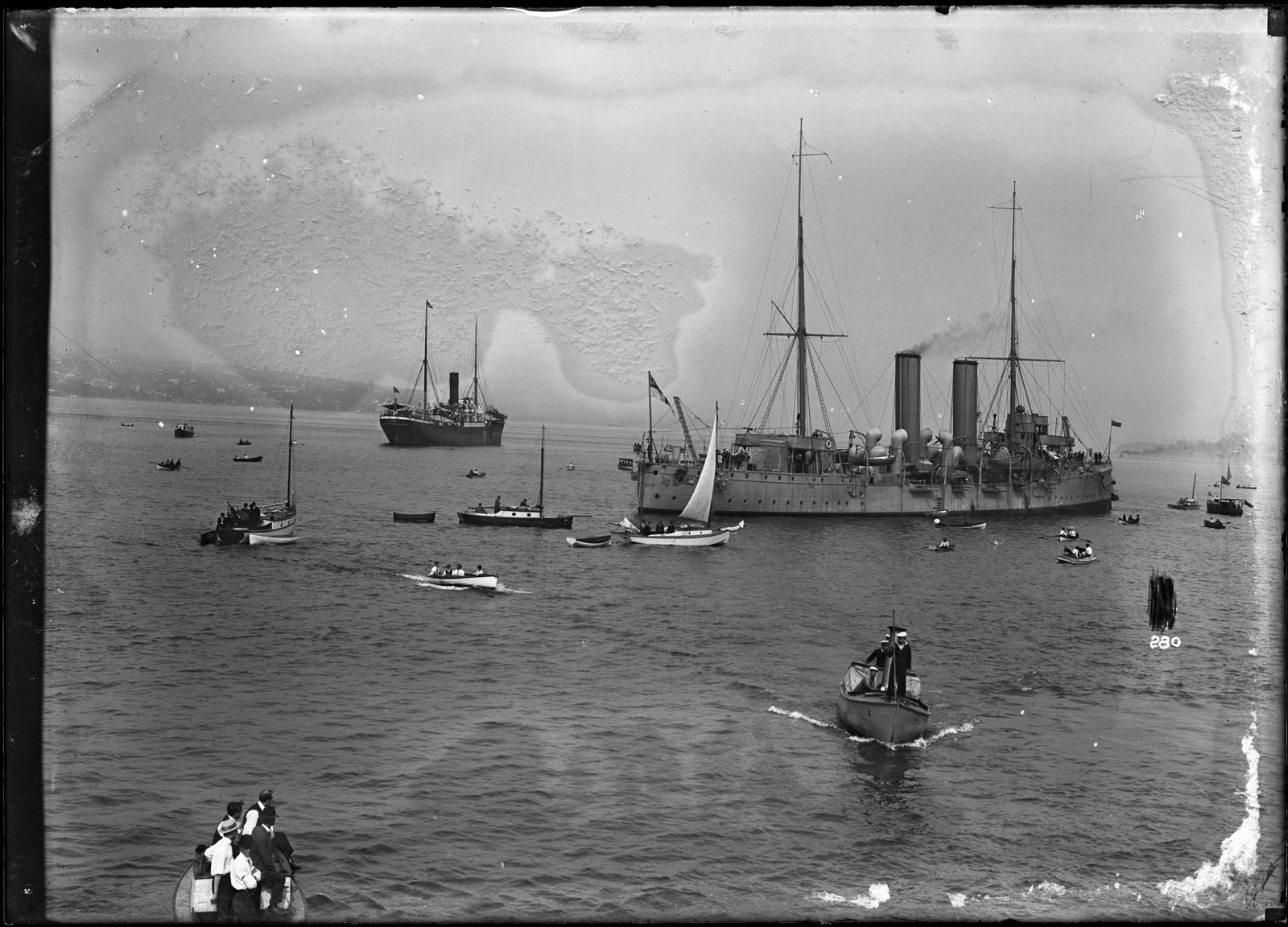
On May 23, 1914, the vessel reached Burrard Inlet with 376 passengers: 340 Sikhs, 24 Muslims, and 12 Hindus, according to Parks Canada.[1] The ship carried people, crew, and coal, but it was not allowed to become a normal arrival. Parks Canada's national historic event page states that the ship was not permitted to berth and that officials denied all passengers entry for the next two months.[1]
That refusal to berth was central. It made the ship itself into a controlled holding space. A land border inspection room has doors, counters, records, guards, and a visible chain of custody. In Vancouver harbour, those functions were improvised around a vessel. The ship's distance from shore limited movement, limited communication, limited access to food and water, and made community support harder to deliver.[1][3]
The image of passengers crowded on deck is therefore not merely illustrative.[6] It shows the spatial trick at the heart of the incident. The passengers were close enough to be seen by Vancouver, close enough to become a public controversy, and close enough for local South Asian supporters to mobilize around them. But they were kept far enough away that the ordinary meaning of arrival could be denied. The border was no longer a line at the edge of land. It was an enforced gap of water.
Legal challenge became legal compression
The passengers and Vancouver's South Asian community did not simply accept deportation. They organized a legal challenge, and J. Edward Bird, who had been involved in earlier litigation, argued on behalf of passenger Munshi Singh.[3][4] The case became the channel through which the ship's broader claim was tested.
The form of the test mattered. The passengers were not given a long, individualized process that could examine every person's status, resources, purpose, and claim. Instead, the crisis narrowed around a legal question about the validity and application of the immigration regime. On July 6, 1914, the judges ruled against the passengers, and the ship's legal position collapsed.[3][5]
This is the fourth hinge: procedure compressed human claims into a test case. That does not mean law was irrelevant. It means law was part of the machinery. A legal case could produce legitimacy for removal while leaving the larger racial design intact. The court's adverse decision did not create the exclusion system, but it allowed officials to move from standoff to expulsion with a stronger institutional cover.
Provision control turned waiting into pressure
The standoff was not passive. Waiting became a pressure tactic. The Canadian Museum for Human Rights describes officials trying to deny Gurdit Singh permission to land, constraining his access to money, obstructing legal meetings, and rationing supplies so severely that passengers sometimes went long periods without food or water.[3] The point was not only to keep people offshore. It was to make offshore life increasingly impossible.
This is where the mechanism becomes especially clear. A border does not have to deport immediately if it can create conditions under which departure becomes the only viable outcome. Control food, water, legal access, berth access, and money access, and the ship becomes an enforcement device. The passengers' bodies bear the cost of the state's delay.
That pressure also shows why local community support mattered. Parks Canada notes that Vancouver's South Asian community united to fight deportation.[1] The support campaign challenged the isolation of the vessel. It tried to reconnect passengers to land through money, lawyers, public argument, and political attention. But the state still controlled the decisive surfaces: entry permission, harbour authority, and military escalation.
Naval force supplied the final edge
After the legal defeat, the crisis moved toward removal. The Canadian Museum for Human Rights states that on July 23, 1914, two months after arrival, the ship was escorted out of Canadian waters by HMCS Rainbow.[3] Parks Canada's commemoration page likewise frames the departure as the outcome of a lost legal struggle and forced return, while a Government of Canada backgrounder notes that the ship left Vancouver harbour that same day with the majority of its passengers aboard.[1][5]
Military presence was not an ornamental detail. It supplied the final edge of the mechanism. The continuous-journey rule supplied the legal barrier. The harbour standoff supplied the holding space. The court decision supplied procedural legitimacy. Provision control supplied pressure. Naval force made refusal executable.
The return did not end the violence. The ship reached India in late September 1914. The Canadian Museum for Human Rights recounts that British authorities suspected the passengers of revolutionary intent; an altercation followed, shooting began, and deaths and imprisonments followed.[3] The incident had therefore linked two imperial border regimes: Canadian exclusion at Vancouver and British colonial suspicion in India. The passengers were treated as inadmissible in one place and dangerous in another.
What the mechanism reveals
The Komagata Maru incident matters because it strips away the comforting idea that racial exclusion always depends on blunt racial language at the front door. The Canadian system at work in 1914 used technical requirements, route impossibility, cash thresholds, berth denial, legal compression, supply control, and armed escort. Each piece could be described administratively. Together, they formed a racial border.
That is why the phrase "continuous journey" deserves close attention. It seems to describe movement. In practice, it produced immobility. It made the lack of a direct steamship route into a reason to deny landing. It transformed geography into evidence against the traveler. The passenger's failure was prearranged by the transport system the law demanded.
The harbour setting made the logic visible. For two months, Vancouver could see the people whom Canada was refusing to receive. The state did not need to make them disappear immediately. It held them in sight and out of reach, turning public water into a controlled border zone. That is the incident's enduring lesson: exclusion can be built from small administrative parts until a ship full of people becomes a floating legal exception.
Parks Canada designated the Komagata Maru incident a national historic event in 2014, emphasizing that the passengers and their supporters challenged racist and exclusionary immigration policies.[1] That commemoration is important, but the mechanism should not be softened into apology alone. The historical force of the incident lies in how ordinary the tools looked: ticket rules, money rules, port rules, court rules, supply rules. The border floated because many institutions helped keep it afloat.
Sources
- Parks Canada, "The Komagata Maru Incident of 1914 National Historic Event" - official designation page with passenger count, arrival date, harbour standoff, and historical significance.
- Canadian Museum of Immigration at Pier 21, "Continuous Journey Regulation, 1908" - background on the direct-route and through-ticket rule and its use against migration from India.
- Matthew McRae, "The story of the Komagata Maru," Canadian Museum for Human Rights, April 28, 2017 - narrative account of Gurdit Singh, voyage dates, legal challenge, conditions aboard, return to India, and later apologies.
- Steve Schwinghamer, "'The Immigration Act a weapon': Panama Maru and the Exclusion of Immigrants, 1913," Canadian Museum of Immigration at Pier 21, updated January 28, 2022 - legal and bureaucratic context for the continuous-journey and money requirements before the Komagata Maru.
- Government of Canada / Parks Canada, "The Komagata Maru Incident of 1914" - backgrounder on the ship's May 23 arrival, two-month standoff, July 23 departure, and national historic significance.
- Wikimedia Commons, "File:Komagata Maru incident VPL 6229 (11326202133).jpg" - Vancouver Public Library archival photograph used as the article image.