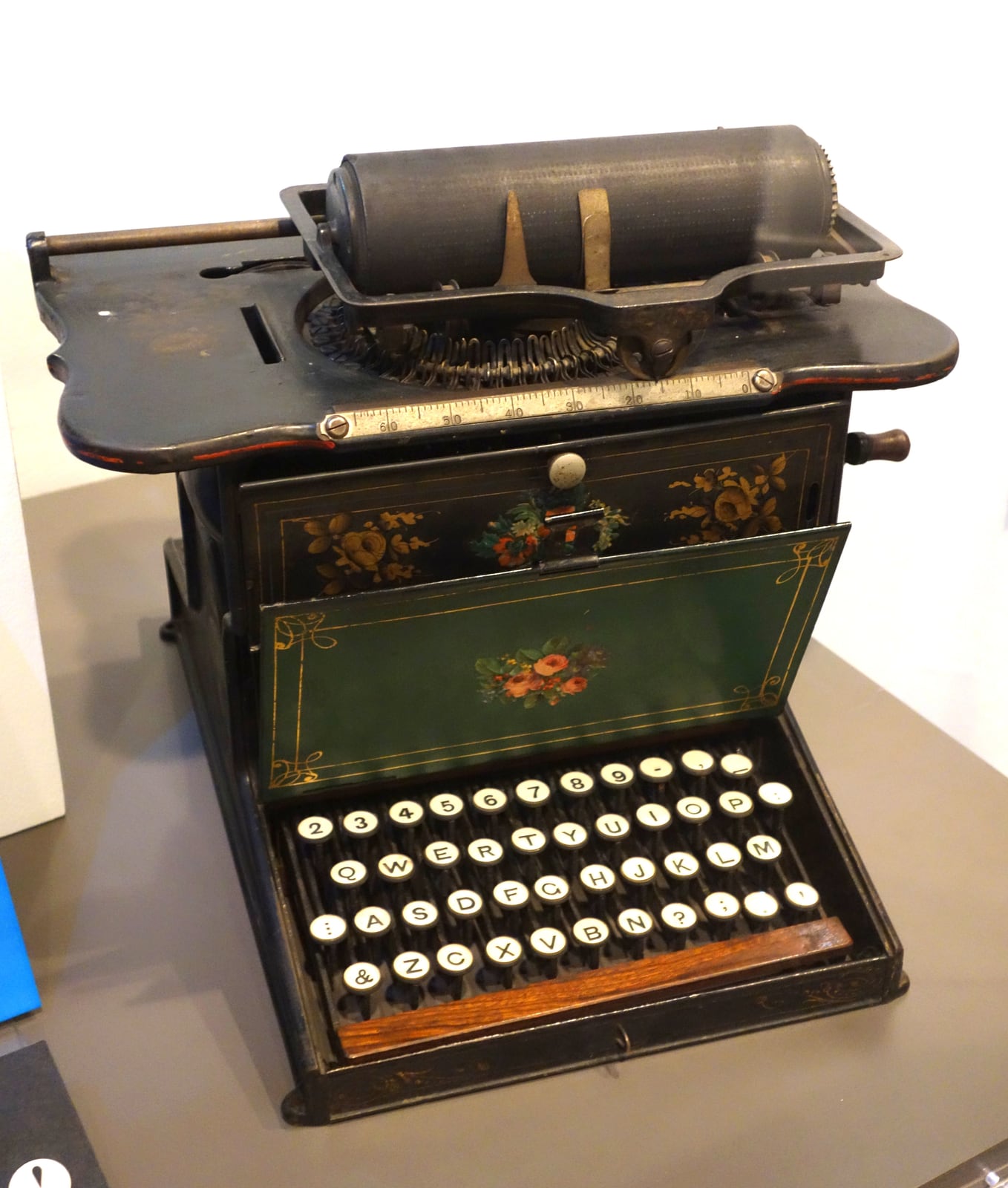
The familiar part of the first successful typewriter is the keyboard. The decisive part is what happens after a key goes down.
In patent no. 79,265, issued on June 23, 1868, Christopher Latham Sholes, Carlos Glidden, and Samuel W. Soule described a machine in which a finger drove one steel typebar upward, but that single motion was only the beginning. The paper had to remain flat at the instant of impact, move by exactly one letter afterward, shift by one line when the carriage returned, and meet a fresh patch of ink ribbon before the next strike. Their five claims divide those jobs among levers, ratchets, nested frames, springs, pins, spools, cords, pulleys, and weights.[2]
That list answers a sharper historical question than “Who invented the typewriter?” Mechanical writing devices already existed, and the document itself is titled an improvement in type-writing machines. The question the patent can answer is narrower: what had to be coordinated before ordinary communication could be produced one key at a time?
Read closely, the patent is less a claim on the idea of mechanical writing than a choreography for paper. The typebars converge on one fixed printing point; almost everything else moves around them.
The strike had to arrive at one exact point
The inventors began with a circular brass disk, four or five inches across, cut with radial grooves. A typebar rested in each groove, pivoted at the disk's outer edge. Pressing a piano-like key lifted the corresponding bar so that the raised letter at its inner end struck the center of the circle. The bar then fell back onto a cushion.[2]
This geometry solved a convergence problem. A machine could contain many letters, but every letter had to reach the same place with its face square to the page. If one bar arrived high, low, or at an angle, the line would wander or the impression would be incomplete. The patent therefore paired the grooved disk with an adjustable platen above the central point, intended to make each type meet the paper “evenly and squarely.”[2]
The first claim protected the direct chain from key lever to typebar. But the companion patent, no. 79,868, issued three weeks later on July 14, 1868, described a different linkage using rods and levers between keys and bars.[3] The two documents preserve experimentation, not a frozen origin. The inventors were already trying alternate ways to produce the same controlled strike.
That distinction matters. The historical achievement was not any single lever shape. It was the stable relation among a selectable character, a common impact point, and paper positioned to receive the blow.
Spacing happened when the key came back
A printed character is not yet writing. Without controlled spacing, the next character lands on top of it.
The machine's answer was an escapement. A toothed ratchet bar ran with the paper carriage while a forked lever alternately caught its teeth. The keyboard did double duty: pressing a key launched a typebar and moved a crossbar beneath the mechanism; releasing the key reversed that motion and let weights pull the carriage by one notch. The patent insists that the paper move a “regular, uniform, and exact distance” every time a key is struck.[2]
The sequence is the important part. The carriage was held still while the type met the page. It advanced while the bar fell away. A typist did not need to judge a letter's width or push the page after each mark; the machine converted the release of one key into readiness for the next.
The space between words was folded into the same logic. The patent specified one extra key without a typebar. Its job was to operate the spacing mechanism while printing nothing. In the July companion patent, that blank action is even more explicit: a separate handle or key moves the carriage one letter-width without making an impression.[3]
Blankness had become a mechanical output. The machine did not merely put letters onto paper. It produced the measured absence that made letters readable as words.
A line required a second axis
Letter spacing moves across a page. Line spacing must move at a right angle to it. The June patent handled both with a carriage made from two open frames. The larger frame traveled laterally for a line of text; the smaller frame slid transversely to position the next line. Sholes, Glidden, and Soule described those motions as east–west and north–south, language that makes the page sound like a small mapped territory.[2]
A row of equally spaced pins and a spring-loaded pawl controlled the second movement. When the carriage was returned to the right, the pawl passed one pin and pushed the inner frame by the preset distance between lines. Returning the carriage therefore did two jobs: it restored the starting edge and indexed the paper for the line below.[2]
This was not yet the cylindrical platen familiar from later machines. In the 1868 design, paper lay on a flat moving bed beneath the printing point. The American Society of Mechanical Engineers' landmark history traces the subsequent redesign: a cylinder appeared in 1869, its motions were rearranged again in early 1872 so paper of any length could pass through, and by the end of that year the machine had assumed much of the form that entered production.[5]
The changing platen makes the continuity easier to see. Flat frame or cylinder, the core problem remained two-dimensional: move one character-width for composition, then one line-height for continuation.
The ribbon ran on the carriage's clock
Ink introduced another synchronization problem. Repeatedly striking one place on a stationary ribbon would exhaust it, producing a dark first character and increasingly faint successors.
The fifth claim of patent 79,265 tied ribbon feed to carriage movement. Two spools held the ribbon. Cords, a weight, cone pulleys, a band, a shaft, and a ratchet transferred a small part of the carriage's travel into rotation of the receiving spool. Each typed character therefore pulled a fresh section of ribbon under the platen. The cone pulleys allowed the feed rate to be adjusted as the amount of ribbon on each spool changed.[2]
Here again, the invention lies in a dependency. The operator did not advance the ribbon as a separate task. The same event that created horizontal spacing also refreshed the ink supply. One keystroke left the paper, carriage, and ribbon prepared for the next.
The machine still demanded intervention. A hand or foot mechanism returned the carriage, paper had to be loaded and clamped, and the operator could not continuously see the line being formed because the type struck upward beneath the writing surface.[2][5] “Automatic” would be too strong. The patent automated a sequence within a larger manual practice.
The photographed machine is a descendant, not the patent model
The Remington No. 1 in the cover photograph was made between 1873 and 1878. It has a cylindrical platen, four rows of round keys, a compact metal frame, and floral decoration borrowed from the visual language of sewing machines.[1] None of that should be projected unchanged into the boxlike machine drawn in the 1868 patent.
The gap between them contains the work that made manufacture possible. On March 1, 1873, James Densmore contracted with E. Remington & Sons to have its mechanics rework the design and produce at least a thousand machines. Remington's William Jenne and Jefferson Clough adapted the apparatus for quantity production, replacing the earlier wooden housing with metal and reducing its size. The first commercial machines reached the market in 1874.[5][6]
The patent was therefore neither a blueprint copied straight onto a factory line nor an irrelevant curiosity superseded by “the real” invention. It fixed a system of relations that survived redesign: keys selected typebars; the bars converged beneath a platen; an escapement measured character space; the carriage managed the page; and the ribbon refreshed itself in step with the writing.
The ornamented museum object makes that survival visible. Its green panel and painted flowers are marketing; beneath them, the circular basket of typebars and the large moving platen still organize writing around a common strike point.[1][5]
QWERTY was an outcome, not the patent's argument
Looking backward from a laptop makes it tempting to treat the typewriter's history as the origin story of QWERTY. The 1868 patents resist that shortcut. Their claims concern typebar guidance, key linkage, carriage spacing, paper restraint, line movement, and ribbon feed—not a lasting arrangement of letters.[2][3]
The layout changed repeatedly during development. Smithsonian's history reports that Sholes and Glidden worked through roughly thirty test models before settling on QWERTY and notes an unresolved disagreement over why: one explanation emphasizes separating frequently paired typebars to reduce collisions; another emphasizes the needs of telegraph operators transcribing Morse code.[6] The familiar keyboard is clearly drawn in Sholes's later patent no. 207,559, granted on August 27, 1878, but its claims still focus on carriage, platen, escapement, ribbon, and return mechanisms rather than on ownership of the letter order.[4]
That evidence does not support the neat legend that QWERTY was simply designed to make typists slow. More importantly for the 1868 document, it shows that a keyboard layout could remain unsettled while the machine's deeper grammar was already legible.
The patent's real unit is the cycle
The five claims of patent 79,265 can look like a parts list. Read in operating order, they describe a cycle:
- A finger selects a key.
- A typebar rises to the shared printing point.
- Springs keep the paper flat for the impression.
- The released key lets the carriage advance one character.
- That advance draws fresh ribbon into position.
- At the line's end, carriage return also indexes the page downward.
No single step invented mechanical writing. Together they reduced a difficult sequence of judgments—where to strike, how far to move, when to refresh ink, where the next line begins—to repeatable motions.[2][3]
That is why the paper deserves the headline. The typist's visible action was choosing a letter. The machine's quieter achievement was moving the writing surface through a precisely timed path so that thousands of separate blows could become a document.
The Remington No. 1 did not make the writer mechanical. It made the interval between one intention and the next dependable.
Sources
- Wikimedia Commons, “Remington No. 1 typewriter … Wisconsin Historical Museum” — source page for the real-object photograph, with model identification, capture date, original dimensions, and CC0 provenance.
- C. Latham Sholes, Carlos Glidden, and Samuel W. Soule, U.S. patent 79,265, “Improvement in Type-Writing Machines” (June 23, 1868) — primary text and drawings for the direct key action, two-axis carriage, escapement, line advance, paper restraint, and ribbon feed.
- C. Latham Sholes, Carlos Glidden, and Samuel W. Soule, U.S. patent 79,868, “Improvement in Type-Writing Machines” (July 14, 1868) — companion primary document showing an alternate key linkage, explicit space key, carriage, and line-spacing mechanism.
- C. Latham Sholes, U.S. patent 207,559, “Improvement in Type-Writing Machines” (August 27, 1878) — later primary document whose drawings show the QWERTY keyboard while its claims address the machine's carriage, platen, escapement, ribbon, and return systems.
- American Society of Mechanical Engineers, Sholes & Glidden “Type Writer” historic mechanical engineering landmark report (2011) — technical development from the 1868 flat carriage through cylindrical platens, the 1873 Remington contract, blind writing, mass production, and office adoption.
- Nick Yetto, “Where Did the QWERTY Keyboard Come From?” Smithsonian Magazine (September/October 2023) — development chronology, changing experimental layouts, disputed QWERTY explanations, and the 1874 commercial launch.