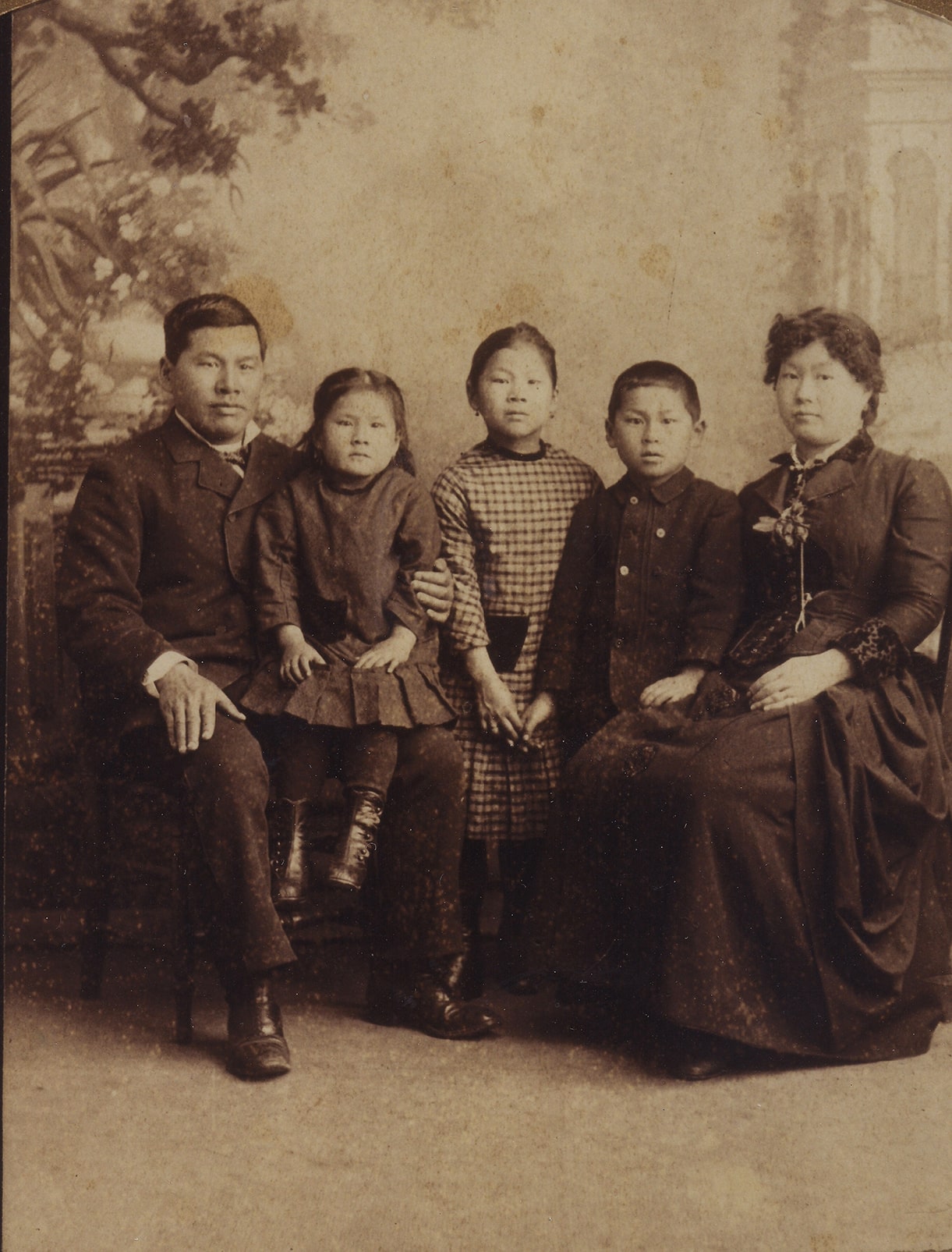
Around 1884–85, while their lawsuit moved through the California courts, the Tape family sat for a studio portrait. Joseph sits at the left with Emily on his knee; Mary sits at the right. Eight-year-old Mamie stands in the center beside her brother Frank. The painted backdrop, formal clothes, and composed arrangement belong to the visual grammar of a middle-class family portrait.[4][5][7]
The photograph has often been used to show how thoroughly the Tapes had adopted the habits of white middle-class San Francisco. That description is historically relevant: the family's English speech, neighborhood, clothes, music lessons, and household culture shaped both their expectations and the way newspapers described them.[4][5] But the portrait becomes misleading if treated as an entrance examination—as though Mamie deserved a public education because her family looked acceptably American.
Mary Tape's school fight exposes that trap. The Tapes presented every credential that exclusionists claimed Chinese people lacked. The schoolhouse door remained closed because officials treated Chinese ancestry, not conduct, as decisive. When the family won in court, California changed the statute. When school officials offered new excuses, Mary answered in public. Her short campaign in 1884 and 1885 is therefore not a simple prehistory of Brown v. Board of Education. It is a microhistory of how a legal victory can be genuine, how an institution can route around it, and how one woman named the difference.
The request was local before it was a test case
Mary had arrived in San Francisco from China in 1868, at about eleven years old, without her parents. The Ladies' Protection and Relief Society took her in, taught her English, and gave her the name Mary McGladery. In 1875 she married Jeu Dip, who had likewise come to California as a child and took the name Joseph Tape. Their first child, Mamie, was born the following year.[4][5]
By the early 1880s, Joseph operated a drayage business and worked as an interpreter and broker. The family lived in Cow Hollow, outside Chinatown, among relatively few Chinese neighbors. Mary painted landscapes, later joined the California Camera Club, made photographic slides, and learned to use a magic lantern. Their home contained musical instruments, books, pictures, and Joseph's preserved birds.[5][7]
That biography matters because it explains the scale of the original demand. In the autumn of 1884, Mary was not seeking admission to an abstract institution. She tried to enroll Mamie at Spring Valley Primary School, the public school near their home. Principal Jennie Hurley refused her under the San Francisco school board's policy against admitting children of Chinese ancestry.[4][5]
Public schooling for Chinese children had been unstable for decades. San Francisco intermittently maintained a separate school in Chinatown, then stopped funding it in 1871. California's revised school law of 1880, however, said every school must be open to all resident children of the prescribed ages, subject to specified exclusions. It did not then authorize the exclusion of Chinese children.[1][5][6]
Joseph, acting as Mamie's guardian, sought a writ compelling the school to admit her. Mary had initiated the enrollment and remained the campaign's most forceful public voice, but the case entered the reports under her daughter and husband: Mamie Tape, an Infant, by her Guardian ad Litem, Joseph Tape v. Jennie M. A. Hurley et al.[1]
The court enforced the law that existed
The Tapes won in the Superior Court on January 9, 1885. San Francisco appealed. On March 3, the California Supreme Court affirmed the judgment.[1][4]
Justice John Sharpstein's opinion asked a narrow question: whether a California-born child of Chinese parentage, living in San Francisco and within school age, was entitled to enter her district's public school. The answer followed the statute. Its admission clause was broad enough to include children not expressly barred by law, and the court knew of no provision excluding children by race or nationality. Mamie, the opinion concluded, had the “same right to enter a public school that any other child has.” Excluding her would violate state law and the United States Constitution.[1]
This was a real ruling. It rejected the board's claim that officials could simply treat Chinese children as outside the public-school system. It recognized Mamie as a rights-bearing child rather than a visitor asking for administrative indulgence. The judgment also showed the power of an ordinary word—all—when a public body had acted as though it meant all except Chinese.[1][6]
But the opinion did not hold that every form of racially separate schooling was unconstitutional. It enforced the law as written. That left legislators free to rewrite the law, and San Francisco officials immediately asked them to do so.[2][6]
Nine days converted defiance into authority
On March 12, 1885, nine days after the Supreme Court decision, California approved chapter 117 of that year's statutes. The amendment retained the general promise that every school be open to resident children, then added power to establish “separate schools for children of Mongolian or Chinese descent.” Once such a school existed, the same provision commanded that Chinese or Mongolian children not be admitted to any other school.[2]
The change is a compact lesson in institutional evasion. Before March 12, the board had excluded Mamie without statutory authority. After March 12, it could create a separate school and convert the same result into a lawful administrative arrangement. The court had opened a door by reading the existing rule honestly; the legislature installed a second door and assigned it by ancestry.
School officials then refused Mamie again, citing vaccination paperwork and an overcrowded classroom as well as the new segregated arrangement. The surviving sources do not require us to decide whether each practical objection was invented from nothing. Mary's point was that the objections arrived inside a settled project: officials who had opposed Mamie's admission on racial grounds were now producing one barrier after another to preserve the outcome.[3][5]
That distinction keeps the episode from becoming a story about one villainous principal. Hurley turned Mamie away, Superintendent Andrew Moulder pressed for legislative relief, the school board organized the separate school, and state lawmakers supplied the missing authority. Exclusion survived because responsibility was distributed across a system.[2][4][6]
Mary made the workaround visible
Mary wrote to the Board of Education on April 15, 1885. The Daily Alta California printed her letter the next day under the heading “A Chinese Mother's Letter.” Its irregular spelling and punctuation have sometimes been treated as quaint features of a newly learned English. Read as argument, they do something sharper.[3]
She begins by refusing the board's parade of reasons: “Is it a disgrace to be Born a Chinese?” She then tests its distinction between an objection to Mamie personally and an objection to Chinese ancestry. If officials did not object to this particular child, why not admit her to the school nearest her home? The question strips “policy” of its neutrality. The barrier followed Mamie even after she had met the family's own demanding standards of dress, language, residence, and conduct.[3]
Mary's argument was not identical to a modern rejection of respectability politics. She stressed that her children dressed differently from many children in Chinatown and declared Mamie “more of a American” than some of the officials opposing her. Those claims reveal the limits of the family's assimilation strategy as well as its emotional force. Mary demanded equal treatment while using cultural distance from other Chinese families as evidence.[3][4]
The most important move in the letter is that she discovers the failure of that strategy in public. However a Chinese person lived or dressed, she wrote, officials still hated them once they knew their ancestry. She had tried to make family practice legible as Americanness. The board answered that race overruled practice. Her promised refusal—Mamie would “Never!!!” attend the new Chinese school—made the workaround impossible to mistake for fulfillment of the victory.[3]
Material necessity proved harder than rhetoric. Mamie and Frank ultimately attended the segregated Chinese Primary School. That outcome does not empty Mary's refusal of meaning. It records the difference between choosing a school and taking the only publicly funded education officials would make available.[4][5]
The camera complicates the family portrait
Mary's later work as an amateur photographer changes how the cover image can be read. She was not merely the arranged subject of other people's pictures. By the 1890s, she was making photographs, experimenting with exposure, producing slides, and participating in a camera club. Most of her surviving photographs depict her family.[7]
That practice does not tell us who pressed the shutter for the 1884–85 studio portrait. Its photographer is not securely identified in the institutional records used here. It does, however, place Mary within a family that actively made and preserved its own visual record. The Tapes were not visible only because a court case or a white newspaper noticed them.[4][5][7]
The portrait should therefore be allowed to hold two truths. It documents how the Tapes fashioned a place within middle-class American life. It also shows why assimilation could not solve a boundary defined by descent. Their clothes made an argument to contemporaries, but the right at stake did not properly depend on clothes.
A victory is not the same as an open door
California continued to authorize separate schools for children of Asian ancestry for decades. The state did not repeal its school-segregation provisions until 1947, after Mendez v. Westminster challenged the segregation of Mexican American children. Brown v. Board of Education followed at the federal level in 1954.[4][6]
Those later landmarks can make Tape v. Hurley look either heroic because it came early or futile because it did not integrate Mamie's school. Both judgments flatten what happened. The Tapes forced California's highest court to say that officials had violated the law. Their opponents then had to expose the machinery required to preserve exclusion: a telegram, a statute, a separate school, enrollment excuses, and compulsory routing by race.
Mary's letter preserved the moral inventory that the legal report leaves out. A court asks whether an official possessed authority. A mother asks what that authority does to a child at a neighborhood door.
The case was won. The rule was changed. The barrier survived. Holding all three statements together is not a way of diminishing the victory; it is the only way to see its scale. Mary Tape made the state reveal that equal words were insufficient when institutions retained the power to redesign the path beneath them.
Sources
- California Supreme Court, Tape v. Hurley, 66 Cal. 473, 6 P. 129 (March 3, 1885), reproduced in the Chinese Historical Society of America's Mamie Tape Curriculum Guide, pp. 41–43 — primary opinion stating the question, statutory basis, caption, and holding.
- California Legislature, Statutes of California and Amendments to the Codes, 1885, chapter 117, pp. 99–100 — official archive page linking the primary volume containing the March 12 amendment on separate Chinese schools.
- Organization of American Historians, “Primary Source: Mary Tape, an Outspoken Woman,” OAH Magazine of History 15, no. 2 (Winter 2001), pp. 17–19 — documentary presentation of Tape's April 1885 letter to the San Francisco Board of Education.
- National Park Service, “Mary Tape” — sourced biography, litigation chronology, afterlife, and public-domain record for the 1884–85 Tape family portrait used as the article image.
- Museum of Chinese in America, “Mary, Joseph, and Mamie Tape” — family microhistory, school chronology, and institutional description of the portrait and the segregated Chinese Primary School.
- Joyce Kuo, “Excluded, Segregated and Forgotten: A Historical View of the Discrimination of Chinese Americans in Public Schools,” Asian American Law Journal 5 (1998) — legal-historical account of Chinese American school exclusion and the limits and aftermath of Tape v. Hurley.
- California State Capitol Museum, “Mary Tape,” Lasting Impressions: Early Photography in California — institutional account of Tape's camera-club membership, slide-making, exposure experiments, magic-lantern work, and surviving family photographs.