The sewing machine looks, in hindsight, like the kind of invention that should have moved cleanly from workshop to factory: a needle, a shuttle, a feed motion, a table, a treadle, a price, then mass production. The history was messier. In the United States of the 1850s, the machine became practical before the market became workable. Elias Howe, Isaac Singer, Wheeler & Wilson, Grover & Baker, and other makers each held or claimed pieces of the mechanism. A manufacturer who wanted to build a reliable machine could not simply choose one inventor and start producing. The useful machine was a bundle of partial solutions, and the bundle was covered by overlapping patent rights.[2][3][4][5]
That is why the "Sewing Machine War" is more than a quaint patent-law anecdote. It shows a causal mechanism that still feels modern: when an invention requires multiple complementary claims, the hard problem is not only technical design. It is assembly of permission. The breakthrough came in 1856, when Howe and three major firms formed the Sewing Machine Combination, widely described as the first patent pool in American industry. The agreement did not invent the sewing machine. It changed the cost of using the inventions together.[3][4][5]
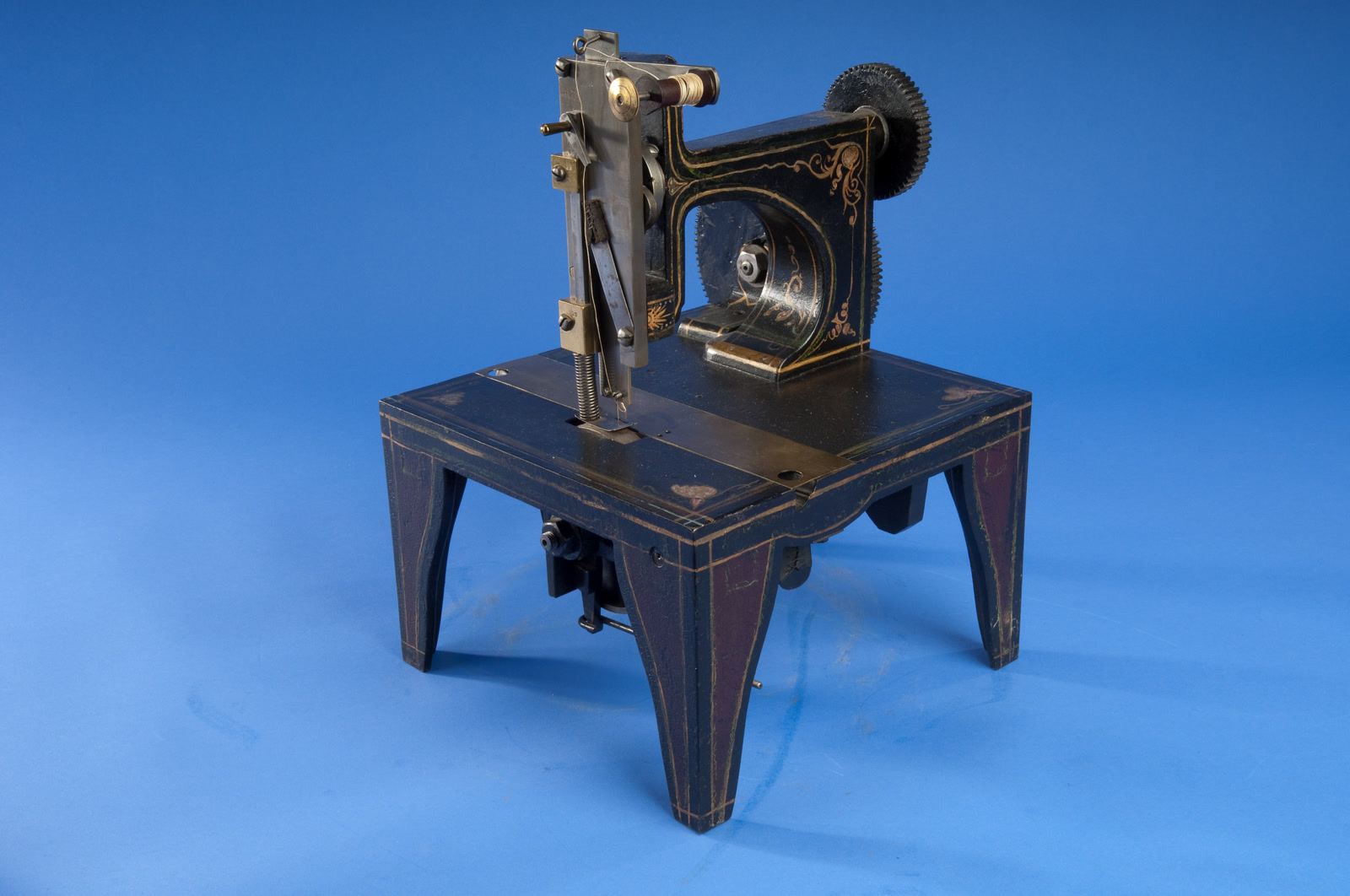
Image context: the cover image is a real photograph of Isaac Singer's 1851 patent model, preserved through Smithsonian and Wikimedia records. It is useful here because the object makes the article's core argument visible: the machine was not one abstract idea. It was a dense arrangement of needle, shuttle, thread control, feed, frame, gearing, and operator interface, each capable of becoming a legal choke point.[1][2]
The machine was assembled from partial solutions
Howe's 1846 patent mattered because it solved a central stitch problem. His specification described two threads, a needle carrying one thread through the cloth, and a shuttle carrying the second thread through the loop so that the seam formed on both faces of the fabric.[6] The Library of Congress frames the patent as the major lockstitch advance, while later legal histories emphasize why that claim became commercially powerful once manufacturers needed the needle-shuttle combination to build practical machines.[3][5]
That distinction is crucial. A patent can be commercially powerful even when the patentee is not the best manufacturer. Howe owned an essential relation between needle, shuttle, and lockstitch. Other inventors then improved the surrounding machine. Singer's 1851 patent model, for example, used a straight, eye-pointed needle and a reciprocating shuttle, with cast-iron parts filed and ground by hand.[2] His patent text also focused on practical operating details: drawing the stitch tight, controlling thread by a friction pad, placing the thread supply on an adjustable arm, and feeding cloth by a grooved friction wheel instead of piercing it with pins.[7]
The result was not a winner-take-all invention story. Howe's lockstitch was essential, but Singer's improvements made the machine easier to operate as a commercial object. Wheeler & Wilson and Grover & Baker held other important claims. Smithsonian Magazine's account explains the situation in patent-thicket terms: several parties could lay claim to key parts of a working machine, so development became entangled in lawsuits and licensing demands.[4]
The technical machine therefore produced a legal machine. To sew at scale, a firm needed metal, labor, distribution, and customers. It also needed a path through patents.
Litigation converted invention into a bottleneck
The war phase began when the practical value of those claims became obvious. Howe's patent issued on September 10, 1846.[6] Singer's patent issued on August 12, 1851.[7] By the early 1850s, sewing machines were no longer only experimental curiosities. They were plausible industrial products for clothing, shoes, upholstery, and later domestic use. That made every unresolved claim more expensive.
Howe's position was unusual. He was not simply blocking the field from the outside. The Library of Congress account and Mossoff's legal history point to the same shift: Howe's commercial leverage increasingly came from enforcing and licensing the patent rather than from building the dominant manufacturing company.[3][5] In other words, Howe became powerful at the permission layer. Singer and other companies became powerful at the manufacturing and marketing layer. Each side needed what the other side could obstruct.
This is the first causal step: complementary invention created reciprocal dependence. Howe could not turn his patent into full industrial dominance by himself. The manufacturers could not safely commercialize the better machines while Howe's lockstitch claim stood in the way. Litigation burned money and attention. Smithsonian Magazine quotes the practical effect in plain terms: firms were spending resources fighting rather than improving and selling machines.[4]
The bottleneck was not that patents existed. It was that essential patents were fragmented across actors who all had plausible leverage. Adam Mossoff's legal history frames the Sewing Machine War as the first American patent thicket: a dense set of overlapping rights that could frustrate commercial development of a new product.[5] That framing is useful because it avoids a simple morality tale. The same patent system that rewarded inventors also created a coordination problem once the invention became a multi-part product.
The pool changed the unit from claim to license
The decisive move came from Orlando B. Potter of Grover & Baker, who proposed that the competing parties combine their business interests rather than keep fighting. Smithsonian Magazine describes the idea: create an agreement with a single reduced license fee, then divide the proceeds among the patent holders according to their contributions.[4] In 1856, Howe, Singer, Wheeler & Wilson, and Grover & Baker formed the Sewing Machine Combination.[3][4][5]
That agreement changed the unit of action. Before the pool, a manufacturer faced a sequence of gates: Howe's lockstitch, Singer's improvements, feed mechanisms, shuttle details, and other claims. After the pool, the buyer of permission could deal with the package. Smithsonian Magazine says the pool merged nine patents, with the four stakeholders receiving shares of earnings from each machine.[4] Mossoff's legal history gives the broader institutional meaning: the pool resolved the thicket by making private coordination, rather than continuing litigation, the operating basis of the industry.[5]
The mechanism is easy to state and hard to build: lower the transaction cost of assembling rights without pretending the rights have vanished. Howe still got paid. Singer and the firms still protected their investments. Smaller manufacturers could license the necessary package rather than negotiate separately with every essential claimant. The point was not harmony. It was routinized permission.
That is why the Sewing Machine Combination should be read as a governance invention. It made the market legible. A manufacturer could know the fee. A patent holder could know the revenue channel. A consumer could eventually buy a machine produced under a less chaotic legal environment. The machine did not become cheaper and more available because law disappeared. It became cheaper and more available because law was reorganized into a repeatable license.
Scale required marketing as well as mechanics
The pool did not by itself explain Singer's later dominance. It removed a major legal drag, but mass adoption also required manufacturing discipline, pricing, and sales architecture. Smithsonian Magazine stresses that Singer's staying power came less from Isaac Singer personally than from the company's business organizers, especially Edward Clark, who developed advertising and a hire-purchase plan for customers who could not afford the full price at once.[4]
That matters because a sewing machine was a large capital purchase before it became a household familiar. The legal settlement made production less risky. The business model made purchase less impossible. Together they converted a complicated shop machine into a scalable commodity. The causal chain runs like this: technical complements created a useful machine; fragmented patents created a litigation bottleneck; the pool converted bottlenecks into a license; manufacturing and installment selling converted licensed machines into a mass market.[2][3][4][5]
The image of Singer's patent model can mislead if it is treated as the whole story. The object is elegant and specific, but it is not self-sufficient. Its commercial future depended on court decisions, contracts, rival firms, royalty formulas, marketing copy, trained operators, and buyers willing to trust a machine that changed the tempo of textile work. A patent model could prove an inventive claim. It could not, alone, produce an industry.
The lesson is not simply pro-patent or anti-patent
The sewing-machine story is often tempting to use as a ready-made argument in modern patent debates. It resists that use. If one wants to say patents block progress, Howe's litigation and the 1850s thicket supply evidence. If one wants to say patents promote bargaining and reward inventors, the same story supplies evidence. Mossoff's account emphasizes exactly that tension: the first privately formed patent pool arose against a background of strong patent rights, not because those rights had already been weakened by public regulation.[5]
The historian's boundary should be clear. The Sewing Machine Combination did not prove that every patent pool is good, every thicket solves itself, or every royalty structure helps innovation. It did show that fragmented invention rights can become an industry-level coordination problem, and that private ordering can sometimes turn mutually blocking claims into a usable market standard.[3][4][5]
It also showed that the end of litigation is not the same thing as the end of power. The pool concentrated important claims in a coordinated group. It made production easier, but it also controlled entry through license terms. The immediate gain was a reduction in wasteful conflict. The longer question was how much control the pool gave to incumbents before the last patent expired in 1877.[5]
That balance is what makes the episode historically useful. The sewing machine was not born from one lone inventor, nor was it delayed by one villain. It emerged from a crowded field where several people solved different parts of the same problem, then discovered that the practical machine needed a legal architecture as carefully designed as its gears. The 1856 pool worked because it treated invention as a system. Once permission became systematized, manufacturing could finally behave like manufacturing.
Sources
- Wikimedia Commons, "File:Singer Sewing Machine Patent Model, No. 8,294, 1851.jpg" - source page for the real photographic image of Singer's 1851 patent model used as the article image.
- Google Arts & Culture / Smithsonian National Museum of American History, "Sewing Machine Patent Model - Isaac M. Singer" - object record for Singer's patent model, Patent No. 8,294, construction, materials, and lockstitch mechanism.
- Library of Congress, "Elias Howe Issued a Patent for the Sewing Machine" - business-history guide to Howe's 1846 patent, lockstitch advance, litigation, and the later Sewing Machine Combination.
- Smithsonian Magazine, "How Singer Won the Sewing Machine War" - institutional history of the patent thicket, Orlando Potter's proposal, the nine-patent pool, reduced licensing fees, and Singer's business model.
- Adam Mossoff, "The Rise and Fall of the First American Patent Thicket: The Sewing Machine War of the 1850s," Arizona Law Review 53 (2011) - legal-historical analysis of the sewing-machine thicket, the 1856 pool, and its operation to 1877.
- Google Patents, "US4750A - Improvement in sewing-machines" - Elias Howe's 1846 patent text and publication record.
- Google Patents, "US8294A - Improvement in sewing-machines" - Isaac M. Singer's 1851 patent text and publication record.