Herman Hollerith's 1889 patent does not read like a prophecy about computers. It reads like a document written by someone who had stared at clerical work long enough to know exactly where it broke. Its title, "Art of Compiling Statistics," sounds broad, but the text is wonderfully concrete: cards, holes, printed positions, pins, mercury cups, counters, sorting boxes, and the repeated problem of keeping one person's facts from sliding into another person's tally.[1]
That concreteness is why the patent is worth reading closely. The usual shorthand says Hollerith mechanized the 1890 U.S. census and helped create the punched-card lineage that eventually fed corporate data processing and IBM. That is true, but it skips the mechanism. Hollerith's key move was not simply to make counting faster. It was to convert each enumerated person into a separate physical record that could be counted, re-sorted, checked, and recombined without rewriting the whole census each time.[1][2][3]
The census needed that kind of change. The Census Bureau's history of the 1890 enumeration says the 1880 results took almost a decade to tabulate, and the 1890 census then asked more than earlier counts had: farm and home ownership, indebtedness, Union veterans, widows, race categories, and a separate family sheet, among other expansions.[2] More questions did not merely mean more totals. They meant more possible cross-tabulations, more chances for clerical error, and more pressure on a temporary office expected to turn millions of household visits into public statistics.
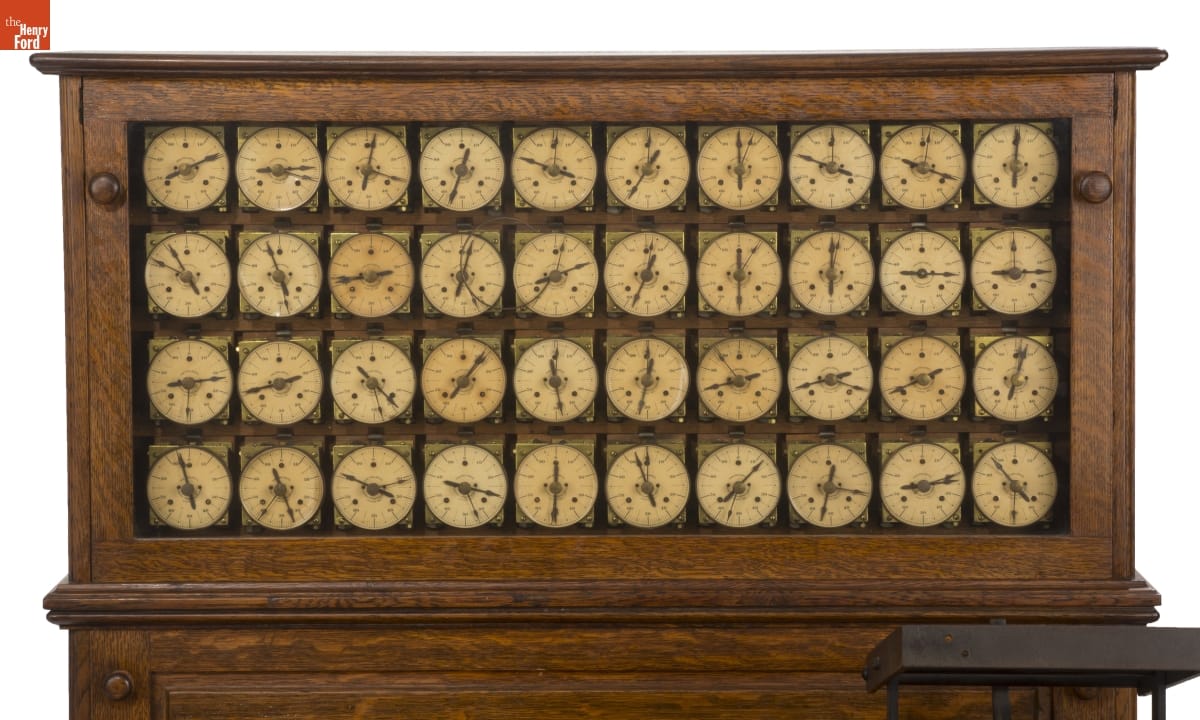
Image context: the cover image is a real photograph of The Henry Ford's 1890 Hollerith electric tabulator. It is useful here because the machine's dials are not decorative. They show the patent's core bargain: move information from schedules to cards, let circuits increment counters, then use the physical cards again for another question rather than beginning the count from scratch.[4]
The Patent Begins With a Format Problem
Hollerith's specification was issued on January 8, 1889, after an application filed in June 1887.[1] Early in the document he describes prior work that used a continuous paper strip or web, with index points arranged in sequence. The new patent turns away from that format. A continuous strip can carry records, but it is awkward when the job requires repeated classification: count by sex, then by age, then by marital condition, then by combinations of those facts.[1]
The patent's decisive substitution is the separate card. Instead of one long record, Hollerith proposes an individual strip, card, or tablet, printed with the relative positions where holes should be punched. The line that matters most is plain: each properly punched card becomes a "permanent record of the individual."[1] In modern terms, the patent separates data capture from data query. In nineteenth-century terms, it lets a clerk preserve one person's schedule-derived facts as a portable, sortable object.
That sounds obvious only because the card later became familiar. In the patent, it solves several problems at once. A printed card template tells the operator where each category belongs. Duplicate plates make corresponding positions line up across the whole series. A mistake can be found on one card instead of buried inside a roll of paper. A set of cards can be prepared away from the tabulating machine and then brought to it later. Hollerith even emphasizes that the cards can be made by "unskilled operatives," because the intelligence of the system has been moved into the printed layout, the punching positions, and the machine's fixed contacts.[1]
That is the first historical insight in the patent: mechanization began before the machine read anything. It began by disciplining the record.
A Hole Had To Be a Place
The patent treats holes not as marks in general, but as marks whose meaning depends on standardized position. A hole in one space may mean male; another may mean female. One series can record age, another birthplace, another month of death, another cause. Hollerith's example comes from Baltimore mortality statistics in 1886, where cards encoded month, sex, civil condition, race, age, occupation, birthplace, residence ward, and cause of death.[1]
That example matters because it shows that the census breakthrough grew out of an earlier municipal data problem. Hollerith was not inventing an abstract calculating device and looking for a use. He was building a system for bureaucratic facts that came in recurring categories. A death certificate, a census schedule, or a household record could be transformed only if the categories were regular enough to be mapped onto fixed spaces.
The cost of that regularity was conceptual as well as clerical. A person became countable through categories already chosen by the institution asking the questions. The 1890 census categories were historically specific: the Census Bureau notes new questions on ownership and indebtedness, veterans and widows, and race categories that included terms and distinctions belonging to that period's racial regime.[2] Hollerith's system did not decide those categories, but it made them easier to multiply. Once a category had a place on the card, the machine could make it travel through many tables.
That is the second insight: punched-card tabulation was not neutral speed. It was speed applied to a state-defined grammar of people.
The Press Made Reading Into Contact
The machine section of the patent is wonderfully physical. A card sits between plates. A movable platen carries springing pins. Where a hole exists, a pin passes through into a mercury-filled receptacle below, completing an electrical circuit. Where there is no hole, the paper blocks the pin.[1] The Census Bureau's component guide describes the same principle in plainer historical language: the card reader used hinged plates, spring-loaded pins, and mercury wells to read the holes on paper cards.[5]
This was not electronic computing in the later sense. IBM's history page describes the device as an electric-powered counting machine, and that limitation is part of the story.[7] The 1890 machine did not need to think in order to change census work. It needed to convert a human-coded hole into a reliable increment on a dial, again and again, while preserving the card for another pass or another classification.
The Henry Ford's object record captures the basic chain: after the 1880 census tabulation bottleneck, Hollerith's system transferred data to punched cards; pins passed through holes into mercury-filled wells; the completed circuit registered data on the dials.[4] That chain is why the rows of dials look almost like clocks. They are time made administrative: each pointer marks a category count accumulating from a sequence of individual cards.
The patent's close-reading lesson is that "reading" was a controlled collision between paper and electricity. The card was not just storage. It was a switchboard that a person could hold.
Sorting Was the Other Half of Counting
Counting alone would have made Hollerith useful. Sorting made him transformative. The patent gives long attention to the division of record-cards into groups, and to the risk that one misplaced card could corrupt later computations.[1] The proposed answer is a sorting box with indicators controlled by electromagnets, so each card can signal the division where it belongs.[1]
That detail prevents a common misunderstanding. The point of the punched card was not merely to reach a grand total faster. The point was to make the same population answer different questions. First separate by sex. Then pass each group through the apparatus to count marital condition. Then recombine or subdivide again. Hollerith describes the number and diversity of possible statistical items as almost unlimited because each individual record can become the basis for another compilation.[1]
The Census Bureau's 2016 history page shows why that mattered in practice. In an 1888 competition using St. Louis data, two rival devices took 44.5 and 55.5 hours to sort the data into categories; Hollerith's device did the sorting task in 5.5 hours.[3] The numbers are not just a speed anecdote. They identify the bottleneck the patent had solved: classification after data capture.
This is where the article's central claim sits. Hollerith did not make the census faster by replacing people with machines. Clerks still copied schedule data to cards. Operators still handled cards, presses, and boxes. The breakthrough was that human labor and machine action were divided differently. People translated schedules into standardized holes. The machine converted holes into counts and sorting signals. The cards preserved the link between individual record and aggregate table.
The 1890 Census Became a Reusable Data Body
The 1890 census began enumeration on June 2, since June 1 was a Sunday.[2] It used 175 supervisors, required personal visits to dwellings and families, and for the first time gave enumerators detailed maps so they could cover assigned boundaries.[2] Those field details matter because the tabulator did not remove the messy front end of census work. It acted after the household visit, after the schedule, after the clerical transfer from schedule to card.
Once the cards existed, however, the back end changed. The Census Bureau says Hollerith won the contract to process and tabulate 1890 data after his competition results, and that the machines helped produce 25 census volumes, hundreds of bulletins, a statistical compendium, a statistical atlas, and annual Statistical Abstract volumes.[3] The bureau also says the 1890 data appeared 18 months sooner than the 1880 data, despite the larger statistical burden.[3]
The afterlife confirms the deeper change. A Library of Congress account of Hollerith and the 1903 Philippine census notes that the 1890 system reduced tabulation time to about two and a half years, but also made possible new ways of sorting people that had not been practical before.[6] That second point is the more unsettling legacy. A faster total is a managerial gain. A faster cross-tabulation is a new kind of administrative sight.
By 1902, the Census Bureau had become a permanent agency; by the 1950s, it was replacing mechanical tabulators with computers such as UNIVAC I.[3] The card, the hole, and the counter did not remain the endpoint. They became a durable stage in a longer history of record processing.
What the Patent Lets Us See
Read as a primary source, Hollerith's patent is less heroic than the usual invention story and more interesting. It shows a system assembled from many small controls: print the card consistently, punch at fixed positions, preserve each individual as a separate record, let pins test holes, let circuits move counters, let indicators guide sorting, and use the cards again for another question.[1]
It also shows why data history should not be told only from the machine outward. The machine mattered because the census had already become a massive act of classification. The 1890 schedules asked more questions, created more categories, and pushed the state toward a data burden that hand tabulation could not comfortably absorb.[2] Hollerith's answer was not to make the state ask fewer questions. It was to give the state a better way to ask many questions of the same population.
The patent's historical force lies in that boundary. Hollerith did not invent counting, statistics, bureaucracy, or electrical apparatus. He made a practical bridge among them. A person became a card; a card became a circuit event; a circuit event became a dial movement; a tray of cards became a population that could be divided and redivided. The census became readable by electricity because it first became legible as punched paper.
Sources
- Herman Hollerith, "Art of Compiling Statistics," U.S. Patent No. 395,781, January 8, 1889 - patent specification reproduced by the U.S. Census Bureau.
- U.S. Census Bureau, "About the 1890 Decennial Census" - enumeration rules, expanded questions, technological advancement, and 1921 fire note.
- Jason G. Gauthier, "History and the Census: Herman Hollerith and Mechanical Tabulation," U.S. Census Bureau, January 1, 2016 - competition results, 1889 patent, publication output, and later machine use.
- Google Arts & Culture / The Henry Ford, "Tabulating Machine, 1890" - artifact record and photographic source for the article image.
- U.S. Census Bureau, "The Hollerith Machine" - component guide to the pantograph, card reader, tabulator, and sorter.
- Library of Congress Manuscripts Blog, "The Power of the Punch Card: Herman Hollerith and the Philippine Census of 1903," November 10, 2021 - post-1890 afterlife of punched-card tabulation and classification.
- IBM, "The punched card tabulator" - historical overview of Hollerith's electric counting machine, punched-card process, census competition, and later IBM lineage.