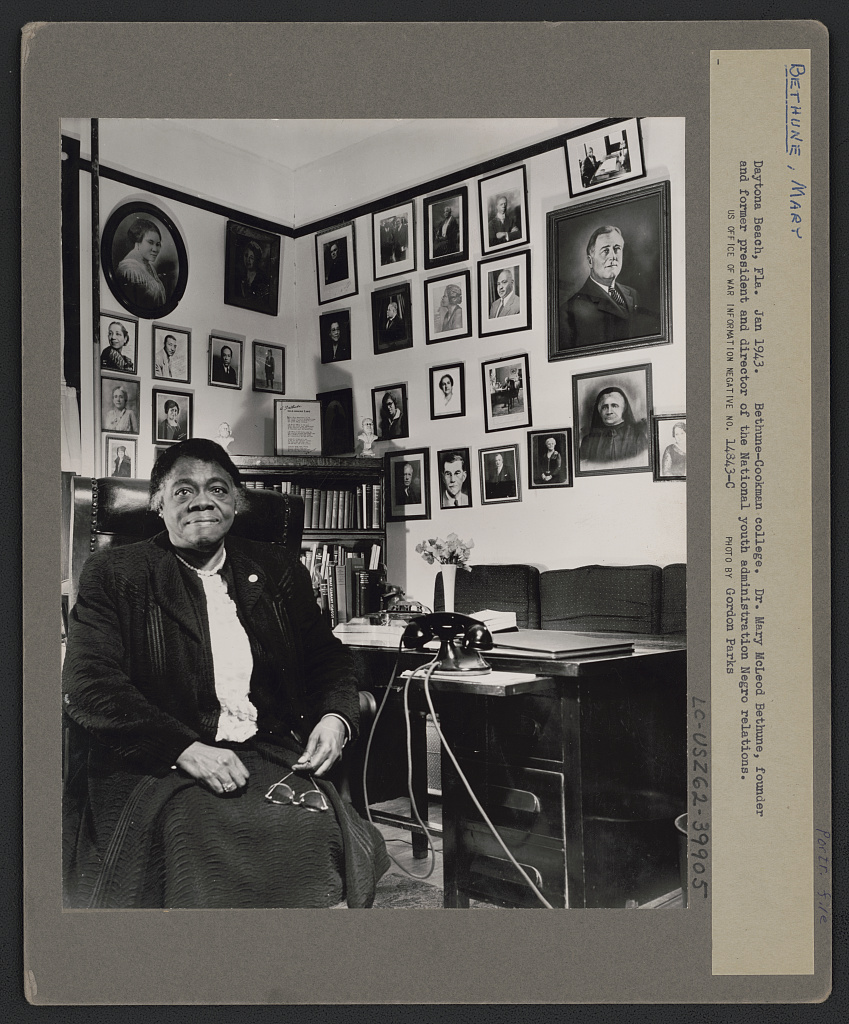
Gordon Parks photographed Mary McLeod Bethune in January 1943 seated inside her Bethune-Cookman College office. The picture looks quiet until the room starts to speak: a telephone on the desk, papers ready for use, framed portraits filling the wall, Bethune's hand resting near her eyeglasses, and a caption identifying her as founder, former president, and director of Negro Relations for the National Youth Administration.[1] It is an office portrait, but it is also a map of a method.
Bethune's career is often summarized as a heroic climb: born in 1875 near Mayesville, South Carolina, the fifteenth child of formerly enslaved parents; founder of a school in Daytona Beach in 1904; first president of the National Council of Negro Women in 1935; adviser to presidents; public memorial figure after her death in 1955.[2][5] Those facts are true, but they can make her power sound like personal ascent alone. The sharper historical question is smaller and more mechanical: how did Bethune keep turning rooms into institutions?
This microhistory follows the spaces she made useful. A borrowed classroom became a school. A women's-club network became a national council. A federal desk became a pressure point inside the New Deal state. A red-brick Washington townhouse became a headquarters, meeting room, archive, and memory site.[2][3][4] Bethune's genius was not only charisma. It was the disciplined conversion of physical rooms, paperwork, correspondence, social visits, and organizational ritual into durable public authority.
The School Began As A Workroom
The Daytona school story is sometimes repeated as uplift folklore: Bethune opened the Daytona Literary and Industrial Training Institute for Negro Girls on October 3, 1904 with $1.50, five girls, and her young son as the first students.[2][6] The detail lasts because it is vivid. But if it is left as inspiration only, it misses the institutional fact. Bethune did not merely begin with little money. She built a system in which little money had to become desks, food, lessons, cleaning routines, donors, public trust, and a case for expansion.
Bethune-Cookman University remembers the early school through improvised materials: pencils made from charred wood, ink from elderberries, and mattresses from moss-stuffed corn sacks.[6] The National Park Service gives the same opening a longer arc. The school grew from that small beginning into a high school, merged with Cookman Institute in 1923, became accredited by the Association of Colleges and Secondary Schools of the Southern States in 1931, and became Bethune-Cookman College, with Bethune as the first African American woman to serve as a college president.[2]
That sequence matters more than the founding anecdote. Bethune was making education administratively durable in a region where Black education was underfunded, segregated, and politically vulnerable. A classroom could not stay a symbol. It had to become an institution that kept records, attracted money, acquired buildings, answered accreditation standards, and convinced parents that their daughters' schooling was a practical route to public life.[2][4]
The State Archives of Florida's primary source set helps keep the story grounded in material life. Its photographs and documents include school lines, sewing and needlework classes, meal preparation, annual catalogs, letters, and later records of Bethune's civic work.[4] Those are not side details. They show why the desk in Parks' 1943 photograph should be read backward toward Daytona: Bethune's authority was built through the repeatable administration of daily work.
Clubs Became A Chain Of Command
Bethune's move from school founder to national organizer did not require abandoning the classroom habit. It required enlarging it. While working in Daytona Beach, she entered local and state women's organizations, then became president of the Florida Federation of Colored Women in 1917, helped establish the Southeastern Federation of Colored Women's Clubs in 1920, and was elected national president of the National Association of Colored Women in 1924.[2][5]
This is the unglamorous middle of the biography, and it is where much of the mechanism sits. A women's club was not only a moral circle or social association. It was a communications network, fundraising machine, local intelligence system, leadership school, and legitimacy engine. Bethune learned how to move from town to state to nation by making women who were often denied formal public authority function as political actors through meetings, dues, letters, resolutions, and programs.[2][5]
The National Council of Negro Women, founded on December 5, 1935, was Bethune's answer to the problem of scattered strength.[2][5] The Smithsonian's Searchable Museum describes her goal as creating a "central Wheel" that could unite and channel the work of women's organizations across the country.[5] That phrase is useful because it shows her organizational imagination. She was not trying to replace every spoke. She was trying to make them turn together.
The distinction matters. Bethune's leadership was strongest when it converted dispersed local labor into national leverage. Women who ran clubs, schools, church auxiliaries, voter drives, relief work, and community programs already had power, but it was often treated as background service. NCNW gave that work a shared name, a Washington-facing address, and a way to speak into federal politics without pretending that one woman alone represented everyone.[3][5]
The Federal Desk Was A Narrow Opening
In 1936, Franklin Roosevelt made Bethune director of the Division of Negro Affairs in the National Youth Administration, a position Florida Memory identifies as part of her influential work in the Roosevelt administration during the Great Depression and World War II.[4] The Library of Congress image caption gives the same federal identity in visual form: Bethune appears as a college founder and as a former NYA official in the same room.[1]
That overlap is the point. Bethune's federal access did not replace her educational and club work. It depended on it. She entered Washington with a constituency, a record, and a habit of institution-building. The Smithsonian account places her among Black Cabinet figures and emphasizes her work across higher education, women's associations, and government.[5] The NPS biography similarly notes her role as adviser to four presidents and her vice presidencies in the NAACP and National Urban League.[2]
Still, the federal desk was a narrow opening, not a solved democracy. Bethune worked inside agencies and administrations that operated within the limits of segregation, political compromise, and wartime racial hierarchy. Florida Memory notes that during World War II she fought for African American women's inclusion in the Women's Army Auxiliary Corps and for a WAAC training facility in Daytona Beach.[4] That fight shows both her access and its boundary. If inclusion had been automatic, she would not have had to press for it.
This is why the office portrait should not be read as respectability theater. The telephone and correspondence mattered because access had to be exercised repeatedly. A federal title created a channel, but Bethune had to keep filling it with names, cases, appointments, coalition pressure, and reminders that Black youth and Black women were not peripheral to national policy.[4][5]
The Council House Made Authority Visible
The most concentrated room in the story was the Council House at 1318 Vermont Avenue NW in Washington, D.C. Bethune wanted NCNW to stop operating from her rented apartment. In 1943, she moved to purchase a three-story townhouse for $15,500 on behalf of the organization, secured a small down payment with help from friends, and benefited from a major donation by Marshall Field. NCNW members furnished and updated the building, then dedicated it during the annual meeting in October 1944.[3]
The house did three things at once. It gave NCNW a business headquarters. It gave Bethune a Washington residence. It gave Black women's public work a material address close enough to federal power to matter.[3] The NPS teaching materials ask students to consider the house's location in relation to the White House for a reason: geography was part of the strategy. A national council needed a place where visitors, dignitaries, correspondence, programs, and board work could gather instead of scattering back into private apartments.[3]
Bethune herself understood the building symbolically but not sentimentally. In her 1949 retirement article for Women United, excerpted by the National Park Service, she remembered the earlier makeshift desks in her Ninth Street apartment and then described the headquarters as proof that women had made themselves heard.[3] The strongest point is not the elegance of the reception room or the conference table. It is the movement from improvised domestic labor to an institutional room that could host policy work, international visitors, and organizational continuity.
The Council House also exposes the limits of any lone-founder story. Bethune spearheaded the purchase, but the building only worked because NCNW members raised funds, furnished rooms, staffed offices, wrote letters, hosted meetings, and continued the work after she stepped aside.[3] Biography here becomes collective infrastructure. The leader mattered because she made a place where other leaders could act.
The Archive Was Part Of The Argument
Bethune's institution-building did not end with programs. It reached into historical preservation. The National Park Service's Council House materials state that Bethune was among the early African American leaders who recognized the need to preserve records, especially records concerning African American women. The site later held the National Archives for Black Women's History, with personal papers, organizational records, and thousands of photographs documenting Black women's twentieth-century work.[3]
That archival turn fits the whole biography. Bethune understood that public authority disappears if it leaves no record. The same logic connects the school catalog, the club minutes, the NYA correspondence, the Council House files, and Parks' photograph. Each form says that Black women's work belonged in history as evidence, not merely as memory or tribute.[1][3][4]
This is why Bethune's later commemoration is more than honor culture. The NPS biography tracks memorialization from her 1973 induction into the National Women's Hall of Fame, to the 1974 Lincoln Park memorial dedicated on the ninety-ninth anniversary of her birth, to the 2022 National Statuary Hall statue, where she became the first African American to represent a state in that collection.[2] The Smithsonian account likewise treats her Capitol statue as part of a longer afterlife of Black women's civic memory.[5]
Those monuments matter, but the deeper continuity is institutional. Bethune did not wait for the nation to remember her before she made records, headquarters, schools, and councils. She built the memory system while doing the work. That is why the Council House is not just a preserved residence. It is a historical argument in brick: Black women's organizing required rooms, addresses, archives, and public thresholds.[3]
The Desk Was Never Small
Mary McLeod Bethune's desk looks small only if power is imagined as a podium, office title, or single presidential meeting. Her career asks for a different scale. A desk can receive a parent, sign a school document, answer a donor, send a federal memo, convene a women's council, preserve a photograph, or prepare a speech. A room can hold five schoolgirls or a national board. A house can become a headquarters and then an archive.
The microhistory therefore changes the biography's center of gravity. Bethune's greatness was not that she escaped ordinary administrative work on the way to symbolic leadership. It was that she made ordinary administrative work politically potent. Between 1904 and 1955, she turned classrooms, desks, clubs, federal offices, correspondence, and the Council House into channels through which Black women's public authority could travel.[2][3][4][5]
Parks' photograph catches that achievement without needing to dramatize it. Bethune sits in an office crowded by images of others. She is alone in the chair, but not isolated. The room is full of predecessors, allies, students, files, calls, and obligations. That is the historical lesson: she made the desk a public instrument because she never treated the desk as hers alone.
Sources
- Library of Congress, "Daytona Beach, Florida. Bethune-Cookman College. Dr. Mary McLeod Bethune..." - Gordon Parks' January 1943 photograph record and source for the article image.
- National Park Service, "Mary McLeod Bethune" - biographical overview covering Bethune's birth, school, organizational leadership, federal prominence, retirement, death, and commemoration.
- National Park Service, "The Mary McLeod Bethune Council House: African American Women Unite for Change" - Teaching with Historic Places lesson on NCNW, the 1943 house purchase, the 1944 dedication, and Bethune's 1949 retirement article.
- Florida Memory, "Primary Source Set: Mary McLeod Bethune" - State Archives of Florida overview and document set on Bethune's school, federal work, WAAC advocacy, and later life.
- National Museum of African American History and Culture, "Mary McLeod Bethune: A Force for Change" - museum essay on Bethune, NCNW, Black women's political power, federal advising, and legacy.
- Bethune-Cookman University, "Dr. Mary McLeod Bethune" - official founder page on the 1904 school opening, first students, improvised materials, and early growth.