The Seneca Falls Convention is often remembered as the beginning of organized American feminism, and that memory is directionally right.[2][3] But the sharper historical question is not only why the meeting of July 19-20, 1848 matters. It is why the document drafted for it still reads with such force. Elizabeth Cady Stanton's Declaration of Sentiments did not merely borrow famous language from the Declaration of Independence in order to sound grand.[1][4] It used that borrowed constitutional grammar to redefine what counted as political injury. Marriage, property, wages, religion, public speech, and the vote were no longer scattered complaints about women's status. They were reorganized as evidence that one half of the polity had been denied the rights of citizens.[1][2][4]
That is why the document's most famous sentence, "all men and women are created equal," is only the beginning of its argument.[1][4] The deeper move comes afterward, when Stanton converts social dependence into a list of injuries with legal and institutional shape. The declaration insists that deprivation is not private misfortune, not bad custom alone, and not a matter to be solved through better manners. It is a structure backed by law, church authority, labor exclusion, and disfranchisement.[1][2] Read closely, the document is less a plea for sympathy than a brief for jurisdiction: women are entitled to stand inside the nation's language of consent, representation, and rights because the government already claims authority over their lives.
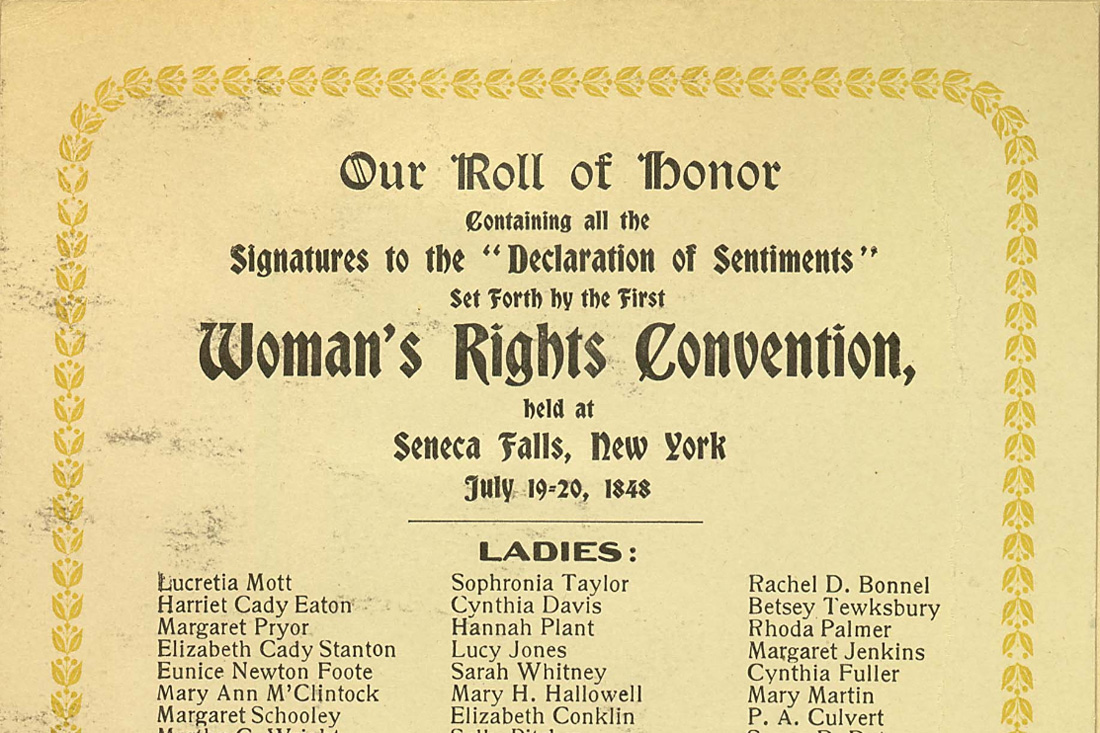
The surviving signature page used here makes that point visible.[6] It reminds the reader that this was not only Stanton's text in abstraction. It became a public instrument, signed at a convention that drew nearly 300 attendees and ultimately gathered 100 signers, including 68 women and 32 men.[3][4] A close reading should therefore attend not just to the prose's elegance but to the political choice embedded in it: this was language written for collective ratification.
1) Why Stanton borrowed the founding script
The declaration begins by echoing the cadence of 1776: "When, in the course of human events," then the requirement to "declare the causes" that impel a people to change their condition.[1][4] That opening is not ornamental. Stanton was signaling that women's claims belonged inside the same justificatory tradition Americans already used to explain legitimate resistance to power.[2][4] The National Park Service notes that Stanton deliberately used Thomas Jefferson's declaration as the template for the new text, and the Constitution Center emphasizes the same point: the document draws authority from the founding and then redirects it toward women's freedom and equality.[2][4]
The crucial shift is in the subject. Instead of thirteen colonies standing against a king, the document speaks for "one portion of the family of man" forced to assume a different station among the peoples of the earth.[1] That phrase widens the scale immediately. Women are not being described as a special interest asking for local reform. They are presented as a people whose political standing has been artificially lowered. The familiar logic of natural rights, consent, prudence, accumulated abuse, and public declaration is then made to serve that claim.[1][4]
This is why Linda Kerber's observation, quoted by the Park Service, matters so much: by tying women's complaints to the country's most distinguished political statement, Stanton implied that women's demands were not extraneous to the American project but latent within it.[2] The document is radical precisely because it treats exclusion as contradiction. If governments derive just powers from the consent of the governed, then women cannot remain permanently governed without equal civic standing and still leave the national creed intact.[1][4]
2) The grievance list turns domestic life into public evidence
The declaration's middle section does the heavy historical lifting. After the adapted preamble, Stanton writes that "the history of mankind is a history of repeated injuries and usurpations on the part of man toward woman," then promises to "let facts be submitted to a candid world."[1] That line matters because the document does not rest with philosophical assertion. It itemizes grievance.
Some of those grievances are about the vote and formal lawmaking, but many concern what nineteenth-century Americans often treated as private or customary spheres. "He has made her, if married, in the eye of the law, civilly dead." "He has taken from her all right in property, even to the wages she earns." "He has monopolized nearly all the profitable employments."[1] Read in sequence, these are not random abuses. They map out a system in which marriage law, property law, labor access, and pay all converge to keep women dependent. The Park Service's interpretive essay captures this well when it summarizes the declaration as an indictment of inferior legal status, economic subordination, and restricted civil capacity.[2]
The close-reading point is that Stanton refuses to leave these conditions in the realm of custom. She drags them into the realm of public proof. The document says, in effect, that if law can define a married woman as subordinate, redirect her wages, close professions, and deny representation, then these are political injuries whether or not they happen inside the household.[1][2] The declaration's power comes from collapsing the supposed boundary between private dependence and public citizenship. It insists that the household is already politically saturated because the state has already entered it.
The same strategy appears in the religious and intellectual complaints. Stanton accuses male authority of assigning woman "a sphere of action" and of destroying her confidence in her own powers.[1] The rhetoric becomes broader here, but the pattern is the same: exclusion is represented as institutionally produced, not naturally given. The document is not merely saying women deserve respect. It is saying that subordination has been organized.
3) Why the vote becomes the hinge of the whole text
The sharpest sentence in the declaration may be the one that calls suffrage "this first right of a citizen."[1] That wording is worth pausing over. Stanton could have treated the ballot as one reform among many. Instead, she places it at the center of the civic argument. The elective franchise is important not because it solves every injury instantly, but because it determines who counts in legislation at all. Once the declaration says women have been deprived of "this first right of a citizen," the rest of the grievances become easier to read as consequences of political exclusion rather than isolated hardships.[1][4]
That helps explain why the suffrage resolution was the most controversial piece of the program in July 1848.[5][7] The Library of Congress notes that Frederick Douglass attended the convention and spoke forcefully in support of Stanton's suffrage resolution, while the National Archives identifies Seneca Falls as the point at which women's voting rights became central to the wider movement that followed.[5][7] Douglass's role matters because his intervention clarifies what was at stake: if women remained outside the franchise, every other appeal would still approach the state from the position of dependent petitioners.
The declaration itself makes exactly that argument. "Having deprived her of this first right of a citizen, the elective franchise," it says, woman is left "without representation in the halls of legislation" and is therefore oppressed on all sides.[1] The vote, in other words, is not presented as a symbolic prize. It is the mechanism by which all the other injuries become harder to reproduce. Stanton is locating the ballot at the junction between citizenship and remedy.
4) What the document could see, and what it could not
The declaration's force should not tempt us into flattening its limits. The Park Service is careful on this point. Its interpretive essay argues that Stanton dramatized the denied citizenship claims of elite women while also obscuring major differences in the lived experiences of women across racial, class, and regional lines.[2] It further notes that Native societies shaped some early feminist thinking, that African Americans in New York were only a generation removed from slavery, and that there is no evidence Black women were invited to the convention.[2]
That does not cancel the declaration's historical importance. It clarifies it. The document was powerful because it created a language in which women could name legal and civic injury in the United States. But it did so from a bounded vantage point, one that universalized "woman" while unevenly representing which women were actually centered in the room.[2] A strong reading has to hold both facts at once: the text widened the nation's political vocabulary, and it did not fully escape the exclusions of the world that produced it.
This is also why the declaration still reads as an unfinished rather than completed political script. It opened a claim, not a settled settlement. Its grammar of rights would prove durable precisely because later activists could use it, revise it, and argue against its blind spots.[2][7]
5) Why July 1848 still matters
Seneca Falls did not deliver immediate victory. The National Archives reminds us that the movement begun in 1848 did not secure the Nineteenth Amendment until 1920, after a seventy-two-year campaign of conventions, petitions, speeches, organizational splits, and tactical reinvention.[7] If we read the declaration only as the first chapter of a triumphant march to the vote, we miss what made it historically distinctive in the first place.
Its real achievement was conceptual. It transformed dependence into evidence. It took conditions that could be dismissed as custom, family arrangement, or moral tradition and submitted them as proof of blocked citizenship.[1][2][4] It also understood that the ballot was not just another demand but the point at which representation, law, and remedy met.[1][5] That is why the document still feels alive on the page. It does not ask the reader to admire female virtue. It asks the reader to decide whether a republic can keep speaking in the language of consent while denying one half of the people admission to "the rights and privileges which belong to them as citizens."[1]
Read that way, the Seneca Falls declaration matters not because it predicted every later feminism or contained a complete theory of equality. It matters because in 1848 it found a way to make legal subordination legible as a public contradiction. The document's enduring force lies in that conversion. It took what many Americans treated as ordinary dependence and made it visible as a political wrong.[1][2][7]
Sources
- Women's Rights National Historical Park, "Declaration of Sentiments" - full text of the 1848 declaration and resolutions.
- U.S. National Park Service, "The Declaration of Sentiments" - interpretive essay on drafting context, legal subordination, and movement limits.
- U.S. National Park Service, "Women's Rights in Seneca Falls" - convention context and the launch of the organized movement.
- National Constitution Center, "Seneca Falls Declaration" - source overview and excerpt highlighting the Declaration of Independence frame.
- Library of Congress, "Frederick Douglass Speaks in Support" - exhibition note on Douglass's backing for the suffrage resolution at Seneca Falls.
- Wikimedia Commons, "File: Declaration sentiments foote lrg.jpg" - signature page image from the U.S. Library of Congress.
- National Archives, "Woman Suffrage and the 19th Amendment" - background on the movement's long path from Seneca Falls to ratification.