Nellie Bly is easy to remember as a stunt reporter: a young journalist plays mad, gets inside Blackwell's Island, writes a sensation, becomes famous. That version is true as far as it goes, but it leaves out the mechanism that made the episode historically durable.
The sharper question is this: why did one undercover assignment in 1887 produce more than lurid copy? The answer lies in the way Bly converted what had been hidden and deniable into something city officials could no longer treat as rumor. She named the route into confinement, the doctors who processed her, the food, the cold, the bathing routine, the ward supervision, and the fact that sane women could be trapped inside the same machinery.[1][2][3]
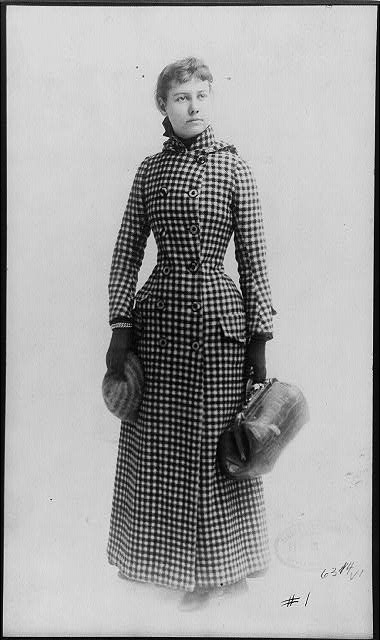
Image context: the hero image is a Library of Congress portrait of Nellie Bly from the late nineteenth century, useful less as celebrity icon than as a reminder that the Blackwell's Island investigation was done by a working newspaper reporter inside Joseph Pulitzer's New York World system.[5]
Five timeline anchors
- September 22, 1887 - Bly records that the World asked whether she could have herself committed to an insane asylum and report what she found.[1]
- Late September 1887 - moving under the name "Nellie Brown," she passes through the Temporary Home for Females, police court, Bellevue Hospital, and then Blackwell's Island.[1][3]
- October 10, 1887 - the first illustrated installment, "Behind Asylum Bars," appears in the World.[2]
- October 16, 1887 - the follow-up installment, "Inside the Madhouse," extends the exposé into a citywide serial event.[2]
- 1894 - seven years after publication, the Women's Lunatic Asylum on Blackwell's Island closes; between the exposé and closure, public funding and scrutiny had already shifted.[2]
Those dates show why this belongs in biography/microhistory rather than anecdote. The episode has a clear protagonist, but the real object is institutional passage: how one woman moved through a chain of urban authority and came back with evidence.
The assignment worked because it tested the gate, not just the ward
The first historical payoff appears before Bly ever reaches the island. In Ten Days in a Mad-House, she describes the assignment as an experiment in administrative credibility: could a woman with no family advocate nearby, performing distress and confusion in a boarding environment, be certified insane by the city's intake system?[1]
The answer was yes, and that mattered more than any single shocking scene inside the asylum.
Under the alias Nellie Brown, Bly persuades the women around her that she is unstable, then faces a sequence of officials who are supposed to separate fraud, illness, danger, and poverty. Instead, the process keeps ratifying itself. The Temporary Home passes the case onward. A policeman escorts her into court. A judge accepts the medical route. Physicians at Bellevue observe her and still approve transfer to Blackwell's Island.[1][3] As Bly later put it, once she stopped performing and spoke sanely, the system often read sanity itself as further proof of derangement.[1]
This is the first major historical claim the sources support: Bly's exposé was powerful because it did not only accuse nurses of cruelty. It demonstrated a diagnostic and custodial chain with weak exit points. A city could dismiss one patient's suffering as anecdotal. It was harder to dismiss the revelation that the intake pathway itself could lock a sane reporter inside.
What she saw on Blackwell's Island was structured neglect, not isolated abuse
Once Bly arrives at the Women's Lunatic Asylum, the reporting shifts from procedural vulnerability to daily material evidence.
Her memoir and the PBS excerpt drawn from it dwell on details that are almost bureaucratic in their specificity: repeated cold baths, thin clothing, badly prepared food, long bench-sitting, inattentive medical rounds, rough handling by some nurses, and a ward routine organized more around discipline and convenience than treatment.[1][3] She is especially sharp on the food because it reveals hierarchy. Patients are expected to swallow badly cooked, barely seasoned meals, while staff have access to better provisions.[3]
That documentary texture explains why the articles traveled so far. Bly was not writing in abstract moral language about "inhumanity." She was writing in enumerated, inspectable fragments:
- how a sane woman got in,
- what she was fed,
- how often doctors actually examined patients,
- how helpless women without outside advocates remained once committed.[1][3]
This mattered because late nineteenth-century asylum defense often depended on informational asymmetry. Superintendents and city authorities could say criticism came from the unbalanced or the sentimental. Bly's reporting reduced that asymmetry. It supplied a witness who was literate, deliberate, and able to map the institution from intake to release.
Publication changed the scale of the evidence
The assignment also worked because Pulitzer's paper knew how to stage it. The Library of Congress account notes that the exposé first appeared as a two-part illustrated series in October 1887 before moving into book form later that year.[2] That sequence is important. A hidden institution became a public serial. Readers were not receiving a private affidavit or a reform pamphlet. They were consuming a metropolitan event, with suspense between installments and vivid detail that invited discussion well beyond reform circles.[2][3]
This is where the "stunt" label helps and misleads at the same time.
It helps because Bly's editors clearly understood spectacle. Her use of disguise, the alias Nellie Brown, and the promise that the World would get her out were all parts of a circulation strategy.[2][4] But the label misleads if it suggests that spectacle and evidence were separable. In this case, spectacle was the delivery system for evidence. Without the daring premise, the story would likely not have reached mass readership. Without the evidentiary detail, it would have dissolved into mere sensation.
The historical weight of Bly's method lies in that combination. She used performance to gain entry, then abandoned performance in favor of description. The reporting survived because readers and officials could imagine inspection, budgets, and administrative blame attaching to what she described.
Reform did not mean instant cure, but it did change the city's obligations
After Bly's release, the story did not end with applause. She writes that she was called before the grand jury soon after leaving the island.[1] The Library of Congress summary ties the reporting to a concrete fiscal response: the budget appropriation for the Department of Public Charities and Corrections increased from $1.5 million to $2.34 million, with $50,000 specifically designated for Blackwell's asylum.[2]
That does not prove that Blackwell's Island was remade overnight. It does show something narrower and historically sturdier: the exposé changed the city's obligation to account for the institution. Once appropriations, hearings, and newspaper scrutiny entered the story, Blackwell's Island ceased to be only a closed humanitarian problem and became an inspectable public one.
The National Women's History Museum is right to connect the episode to the rise of investigative journalism, but the reform side of the story should be described carefully.[4] Bly did not invent oversight, psychiatry, or municipal reform. What she did was force city government to treat asylum conditions as a matter of evidence and publicity at the same time. That combination gave reformers leverage they did not have when complaints remained private or easily discredited.
The strongest caution: this was reform through publicity, not a full redesign of psychiatry
There is a temptation to tell this story as a clean triumph. The record supports a more disciplined reading.
Interpretation A sees Bly as the decisive reformer: the reporter who entered a hidden institution, revealed cruelty, and forced money and scrutiny into the system.[1][2][4]
Interpretation B is narrower: Bly exposed one institution with extraordinary skill, but her method still depended on the same sensational newspaper culture that made women reporters marketable as novelties. Publicity improved conditions and accelerated oversight, yet it did not solve the deeper nineteenth-century problem of how poverty, gender, migration, and mental illness were entangled inside municipal custody.[2][3][4]
The strongest reading is a synthesis. Bly did not solve the asylum question. She made it harder for city government to pretend the question was unseeable.
That is why this episode still matters. History is full of reform moments that begin when suffering becomes visible. The rarer and more consequential moments are the ones that make suffering legible in administrative terms: names, dates, routes, budgets, routine, responsibility. Bly's Blackwell's Island reporting belongs to that second category.
Sources
- Nellie Bly, Ten Days in a Mad-House; or, Nellie Bly's Experience on Blackwell's Island (Project Gutenberg edition).
- Library of Congress, "Behind Asylum Bars: Nellie Bly Reporting from Blackwell's Island."
- PBS American Experience, "Nellie's Madhouse Memoir."
- National Women's History Museum, "Nellie Bly."
- Library of Congress Prints and Photographs Division, "(Portrait of Nellie Bly)."