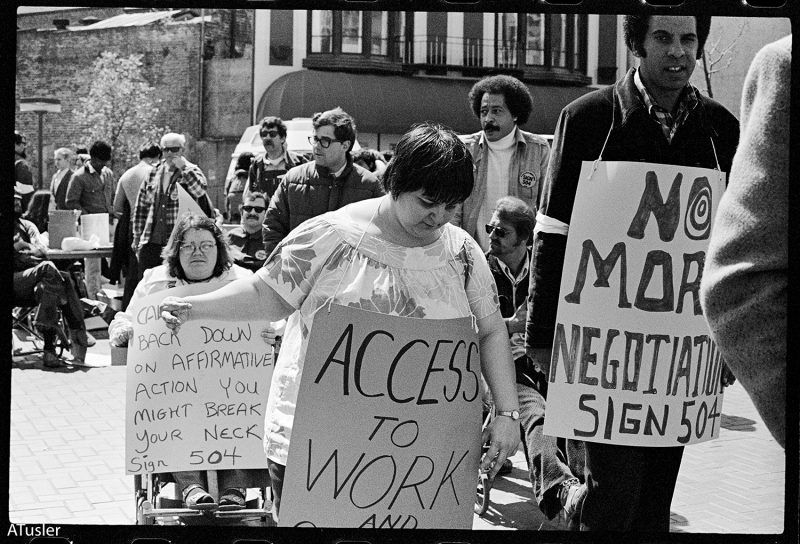
The 1977 Section 504 sit-in is often remembered as a triumphant prelude to the Americans with Disabilities Act. That is true, but it can make the action sound too smooth, as if a later law were already waiting at the end of the hallway. The more useful reconstruction starts with a narrower and harder question: how did a group of disabled activists turn a delayed federal regulation into a deadline the Carter administration could no longer ignore?
The answer was not just moral pressure. It was a sequence. Section 504 of the Rehabilitation Act had been enacted in 1973, but the promise was weak without implementing rules that told schools, hospitals, universities, transit systems, and other federally funded programs what nondiscrimination required in practice.[2][4] By April 1977, activists believed the government was not merely slow; it was at risk of weakening the rules before publication.[2][3] The sit-in worked because it turned that bureaucratic drift into a physical occupation with logistics, publicity, allies, and a Washington escalation path.
A short clause needed a working machine
Section 504 was brief, but its implications were large. Its central rule barred exclusion, denial of benefits, or discrimination against an otherwise qualified disabled person in programs or activities receiving federal financial assistance.[4] That language mattered because it framed disability as a civil-rights category, not only a medical, charity, or rehabilitation concern.[2] But language alone did not tell a school how to handle access, a hospital how to change procedures, or an agency how to enforce compliance.
That gap explains the anger in 1977. The National Park Service account emphasizes that disabled people had waited four years for regulations, while organizations facing compliance costs pushed back against publication.[2] The DREDF-hosted transcript of The Power of 504 adds the activist view from inside the campaign: the demand was not a softer promise, but signed rules that would make Section 504 usable.[3]
This was the first hinge in the reconstruction. The dispute was not over whether Section 504 existed. It was over whether the federal government would make it operational. Activists understood that a civil-rights clause without enforceable machinery could leave access dependent on local goodwill, narrow interpretations, or one-off litigation. The regulation was the missing machine.
April 5 made delay visible
The ultimatum came to a head on April 5, 1977. NPS lists demonstrations at HEW offices in San Francisco, Washington, Seattle, Los Angeles, Denver, Chicago, Dallas, Atlanta, New York, Boston, and Philadelphia.[2] Most of those actions were short. San Francisco became the exception because protesters moved from rally to occupation at the federal building at 50 United Nations Plaza.[2][7]
That building mattered. A march can be watched, waited out, or praised without conceding anything. An occupied federal office forces a different rhythm. HEW officials now had to deal with people who were not leaving, and the protesters had to solve the practical problem of staying. The sit-in became a test of government delay against disabled people's capacity to build a temporary institution inside the state.
The day count differs across accounts because sources mark the occupation's endpoints differently. NPS and DREDF describe a 26-day San Francisco occupation; the Department of Labor's timeline summarizes a 150-person sit-in lasting 28 days.[2][3][6] The exact count is less important than the sequence: April 5 made the demand visible, April 28 brought Joseph Califano's signature, and the San Francisco occupation persisted across the month-long pressure campaign rather than dissolving after one news cycle.[2][6]
Occupation became an access problem in reverse
The genius and burden of the San Francisco sit-in was that it made access concrete by forcing everyone to confront daily dependency, architecture, care, equipment, and communication. NPS describes a cross-disability occupation that included wheelchair users, blind and Deaf participants, and people with many other disabilities.[2] That breadth was politically powerful, but it also made the office occupation demanding.
Inside, the protesters needed food, medications, attendants, sleep arrangements, hygiene, interpreters, communication routes, and medical support.[2][3] Those needs were not incidental hardships around the real protest. They were the protest's evidence. If a federally controlled space could not readily sustain disabled bodies during an emergency occupation, that revealed the wider problem Section 504 was meant to address: public systems had been built as if access were exceptional.
NPS describes committees inside the office handling food, hygiene, medical needs, and publicity.[2] That internal organization changed the sit-in from a symbolic refusal into a working demonstration of cross-disability political capacity. The protesters were not asking the government to pity vulnerability. They were showing that the barriers were administrative, architectural, and social, and that disabled people could name them with precision.
Outside support kept the inside alive
No occupation lasts on principle alone. The San Francisco action depended on outside support that made endurance possible. NPS notes support from groups including the Black Panther Party, while the DREDF transcript preserves participants' emphasis on collective care, pressure, and the coalition work that kept the occupation politically alive.[2][3]
That support changed the government's calculation. Removing a few isolated protesters is one kind of political problem. Confronting a cross-disability coalition supported by local allies, labor contacts, community groups, press attention, and family networks is another. The sit-in made disabled people visible as organizers, but it also made the relationships around disability visible: attendants, interpreters, drivers, cooks, lawyers, unions, churches, radical organizations, and sympathetic officials all became part of the access infrastructure.
The photograph used for this article captures that outside-facing demand.[1] The signs do not ask for sympathy. They ask for a signature and for access to work. That phrasing is historically important because it locates disability rights inside ordinary civic and economic participation. Section 504 was not being fought over as a special favor. It was being fought over as the condition for entering public life on enforceable terms.
Washington turned the occupation into national pressure
The San Francisco sit-in also had to break out of local containment. The DREDF transcript and NPS account both show the campaign as a national pressure action rather than an isolated Bay Area event.[2][3] That detail matters because it shows the campaign's mechanics. The activists did not simply wait in San Francisco for national attention to arrive. They carried the authority of the occupation into a wider federal argument.
In Washington, activists pressed senators, demonstrated around Carter administration appearances, and sought wider East Coast coverage.[3] This was the second hinge. The San Francisco occupation created moral and logistical credibility; the Washington delegation converted that credibility into pressure at the federal center where Califano's decision had to be made.
The Carter administration had framed itself around openness and public access. The activists' public pressure forced a contradiction into view: an administration that wanted to be seen as accessible was delaying regulations about access.[2][3] That was not merely theater. It made disability civil rights a test of federal follow-through.
April 28 changed the legal clock
On April 28, 1977, Califano signed the Section 504 regulations.[6] The Department of Labor timeline states that the regulations extended civil rights to disabled people in programs or activities receiving federal financial assistance, including employment services.[6] The regulatory text then appeared in the Code of Federal Regulations as 45 CFR Part 84, with the source note tracing the rule to 42 FR 22677, May 4, 1977.[5]
This publication step is why the sit-in mattered beyond memory. The activists did not merely win a meeting, a promise, or a commemorative phrase. They helped force the administrative act that turned a statutory sentence into enforceable standards. The distinction is crucial. A right becomes more usable when people know where to file a complaint, what obligations recipients have, and how discrimination is defined in practice.
The victory was still bounded. Section 504 did not instantly make public life accessible. Enforcement remained uneven, and later disability-rights campaigns had to fight over transportation, education, employment, communication, and architectural barriers again and again.[3] But the 1977 regulations gave those fights a federal civil-rights footing. They changed the argument from "please include us" to "the law already requires access."
Why this reconstruction matters
The Section 504 sit-in succeeded because several clocks were forced to synchronize. The legal clock had been running since 1973, when Section 504 entered federal law.[4] The bureaucratic clock stalled while regulations sat unresolved.[2][3] The protest clock started on April 5, 1977, when actions began across the country.[2] The occupation clock continued in San Francisco long enough to create pressure, discipline, and public evidence.[2][3] The Washington clock accelerated the demand at the national level.[3] The regulatory clock changed on April 28 and then entered the CFR record in early May.[5][6]
That sequence is the history. The sit-in was not powerful because disabled people simply occupied a building. It was powerful because they occupied the exact gap between law and implementation. They made delay visible, made access practical, made endurance collective, and made the federal government answer the question it had postponed: would disability civil rights remain a promise, or would they become rules that institutions had to obey?
Sources
- Tom Olin Collection, "504 Sit In Collection by Anthony Tusler" - source page for the archival 1977 protest photograph used as this article's image.
- Alyssa Eveland, "504 Protest: Disability, Community, and Civil Rights," National Park Service - history of the April 1977 protests, 50 UN Plaza occupation, cross-disability organizing, and Section 504 context.
- DREDF, The Power of 504 English transcript - activist documentary transcript preserving participant accounts of the Section 504 campaign and sit-in.
- Legal Information Institute, "29 U.S. Code § 794 - Nondiscrimination under Federal grants and programs" - current statutory text of Section 504.
- GovInfo, "45 CFR Part 84 - Nondiscrimination on the Basis of Handicap in Programs or Activities Receiving Federal Financial Assistance" - current CFR PDF for the regulatory structure rooted in the 1977 Section 504 regulations.
- U.S. Department of Labor, "Section 504 of Rehabilitation Act" - Department of Labor historical timeline entry on Califano signing the Section 504 regulations on April 28, 1977.
- Online Archive of California, "HEW Sit-In (Section 504 protest), April 21, 1977" - Bancroft Library collection guide entry documenting negatives from the San Francisco HEW sit-in.