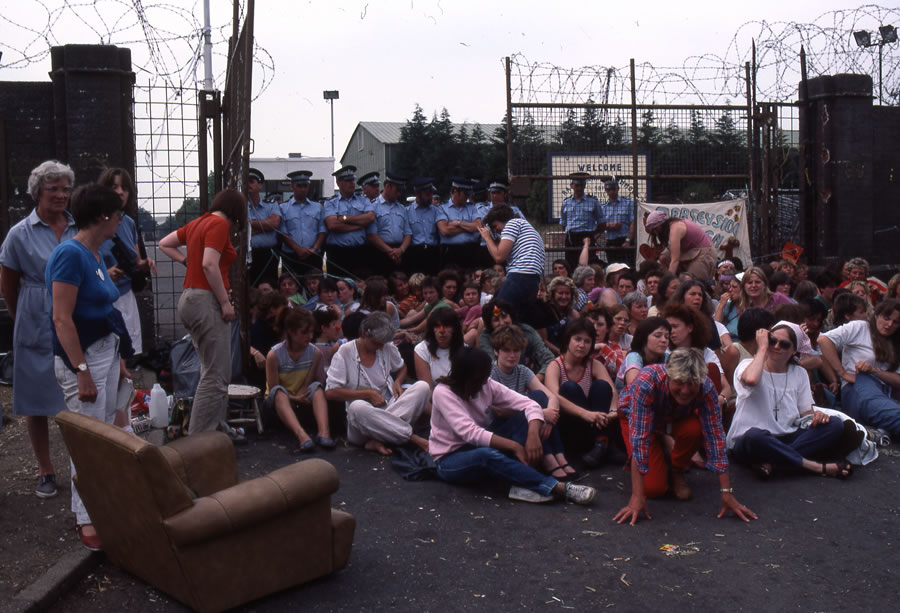
Greenham Common is usually remembered as an anti-nuclear protest camp. That is accurate, but too neat. The camp's historical force came from the way it made protest difficult to contain in one archive. It was a political action, a domestic improvisation, a feminist experiment, a police problem, a media image, a Cold War footnote, a legal nuisance, a landscape scar, and eventually a commemorative garden. Its memory survived because it refused to stay in the places where official history expected to file it.
The question Greenham still asks is not simply whether the women were right about cruise missiles. It is how a perimeter fence became a public record. Beginning in 1981, women built a presence around RAF Greenham Common that turned military infrastructure into a daily stage: gates were named, watched, blocked, decorated, cut, repaired, and remembered.[2][3] The missiles left; the base closed; the land changed use. Yet Greenham stayed visible because memory had already been distributed across objects, stories, photographs, court papers, oral histories, archaeological traces, and the peace garden later built on the common.[4][5][6]
The camp began as a march, then became a clock
Greenham's first time marker was not the famous perimeter action, but a long walk. The Greenham Common Women's Peace Camp history site places the beginning in 1981, when the group Women for Life on Earth travelled from Cardiff toward Greenham Common after NATO's decision to deploy U.S. ground-launched cruise missiles in western Europe.[2] By September 5, 1981, the marchers had reached the base and began pressing for debate about the planned deployment.[2]
The shift from march to camp mattered. A march has an itinerary. A camp has a clock. Once women remained at the fence, the protest changed from a single petitioning event into a 24-hour challenge to the idea that nuclear basing could be administratively quiet.[2] In February 1982, the camp became women-only, sharpening its public identity and making gender part of the argument rather than an incidental demographic fact.[2] The point was not only to oppose weapons. It was to ask who was expected to live with the risk, who was allowed to define security, and whose bodies could occupy the margin of a military site without being dismissed as background.
That is why Greenham's domestic material matters. Tents, benders, kettles, food, blankets, stoves, songs, banners, and childcare were not soft details around a hard political issue. They were the means by which endurance became legible. The camp made continuance itself a tactic: staying through cold, arrests, mud, eviction, boredom, and public ridicule turned the fence into a running register of conflict.[4][5]
The perimeter became the archive
RAF Greenham Common was not a symbolic base. Greenham Common Control Tower's heritage account describes the Cold War missile role as a built system: 96 U.S. cruise missiles assigned to Greenham, the GAMA fortified alert area, six large shelters, and a high-security compound around the weapons infrastructure.[3] That physical arrangement shaped the protest. Women did not gather around an abstract policy. They gathered around a bounded military landscape built to protect mobile nuclear systems.
The fence gave the camp its grammar. A gate could be named. A section could be decorated. A breach could become a news image. A blockade could become a court case. The official perimeter tried to separate secure military space from civilian life; the camp made that separation visible every day. The December 1982 Embrace the Base action, when thousands of women linked around the perimeter, worked because the fence was both target and measuring device.[2] It showed the base as a shape the public could physically read.
That is also why the photograph used for this article matters. It does not show a missile. It shows a gate crowded by women, police, banners, and watching bodies.[1] The image preserves the political argument at the level where most of the camp's history happened: not in cabinet language, but in repeated encounters over access, legitimacy, discipline, and who had the right to occupy the edge of the state.
Missiles left faster than memory did
The Cold War hardware gives Greenham another sequence of dates. Cruise missiles began arriving in Britain in the early 1980s, and the 1987 Intermediate-Range Nuclear Forces Treaty set the framework for eliminating U.S. and Soviet ground-launched missiles in the 500-to-5,500-kilometer range.[7] The Control Tower history places the Greenham missile system inside that later drawdown, after which the base's military role declined and the site was eventually returned to civilian use.[3]
Those dates can make the camp look like a pressure campaign with a clean endpoint: missiles arrive, women protest, treaty follows, missiles leave. The historical truth is more complicated. The INF Treaty came from superpower negotiation, alliance pressure, verification politics, weapons arithmetic, and late-Cold-War diplomacy.[7] Greenham did not single-handedly remove the missiles. A memory history should not inflate protest into sole causation.
But it would be equally wrong to reduce the camp to atmosphere around decisions made elsewhere. Greenham changed the public record of what basing meant. It made nuclear deployment a local, gendered, visible, continuously contested fact. It put ordinary maintenance of a military perimeter under moral pressure. It supplied images and testimonies that made the cruise-missile debate harder to treat as a purely strategic abstraction.[1][4]
Oral history keeps the camp unstable
Greenham is hard to commemorate because the camp was never one voice. LSE Digital Library's Greenham Women Everywhere collection includes oral-history testimonies collected between 2019 and 2021, with audio, transcripts, and photographs where available.[4] The project extends the archive by gathering memories, objects, and testimonies from participants rather than letting one institutional summary close the file.[4]
That plurality is not a weakness. It is the point. A military archive can file dates, plans, building phases, deployments, removals, and disposal. A protest archive has to hold disagreement, fatigue, humor, fear, friendship, conflict with police, arguments among activists, media hostility, and the mundane skill of living outside. The camp's meaning sits in the gap between those record types.
Oral history is especially important because Greenham's most durable actions were often repetitive rather than singular. A blockade can be dated. A mass encirclement can be photographed. But the daily work of keeping a camp alive is harder to preserve. Testimony records habits: how food was found, how newcomers learned gate names, how evictions were handled, how songs traveled, how fear and boredom coexisted, how the same fence looked different at night, in rain, after arrests, or after a successful action.[4]
Archaeology found the politics of staying
One of the strongest reasons Greenham remains historically interesting is that it has also become an archaeological site. The University of York's Greenham Common work treated the peace camp not as a vanished mood but as a material landscape, studying traces left by occupation and protest.[5] That approach matters because it gives weight to things that formal politics often treats as incidental: where people slept, cooked, stored materials, crossed paths, and reused the ground.
Archaeology also complicates nostalgia. A commemorative story can polish the camp into pure bravery. Material traces are less tidy. They point to improvisation, discomfort, waste, repair, weather, and the unequal labor that made symbolic actions possible. The camp's anti-nuclear message depended on mundane infrastructure. Someone had to keep fires going, move supplies, replace shelters, find dry clothing, and make the site survivable enough for politics to continue.
Seen this way, Greenham's memory is not only in the dramatic set pieces. It is in the evidence that protest required maintenance. The camp turned temporary structures into a long-duration claim, and that duration left marks in the soil as well as in newspapers.[5]
The peace garden did not close the argument
The later Greenham Peace Garden gives the site a commemorative form, but it does not make the history quiet. The garden marks the camp and preserves an altered version of its central image: gathering around a shared fire, remembering a protest that was itself built from presence and recurrence.[6] It is not the same as the camp. It is a managed place of memory after the danger, mud, arrest risk, and missile infrastructure have gone.
That distance is useful if it is handled honestly. Commemoration should not pretend that the garden can reproduce the camp's pressure. What it can do is keep the question open: how should a democratic society remember citizens who made a military perimeter morally noisy? Greenham's answer is scattered on purpose. Look at the gate photograph, the GAMA monument record, the oral histories, the archaeology, the treaty documents, and the garden together. None of them is sufficient alone.
The camp made protest hard to archive because it made protest into a place. Its achievement was not only that women opposed cruise missiles from 1981 into the post-INF years. It was that they forced a supposedly secure boundary to produce records in public: records of policing, endurance, gender, Cold War fear, domestic labor, and memory. Greenham Common matters because the fence did not just contain a base. For nearly two decades, it held an argument.
Sources
- Wikimedia Commons, "File:MDP Greenhamcommon1982.jpg" - source page for the archival photograph of women protesters and police at the main gate of RAF Greenham Common used as this article's image.
- Greenham Common Women's Peace Camp, "History" - public-history chronology of the 1981 arrival, camp duration, women-only identity, and commemorative site.
- Greenham Common Control Tower, "Our Heritage" - heritage account of the Cold War base, 96 cruise missiles, GAMA shelters, and later site history.
- LSE Digital Library, "Greenham Women Everywhere" - collection page for oral-history testimonies gathered between 2019 and 2021, with audio, transcripts, and photographs where available.
- University of York Department of Archaeology, "Greenham Common" - project page on archaeological work treating the camp as a material landscape of protest.
- Greenham Common Peace Garden, "About the Garden" - public-history page on the commemorative garden at Yellow Gate, the campfire sculpture, and the 1981-2000 memory site.
- Federation of American Scientists, "Intermediate-Range Nuclear Forces Treaty" - treaty background, missile-range category, and arms-control context for cruise-missile removal.