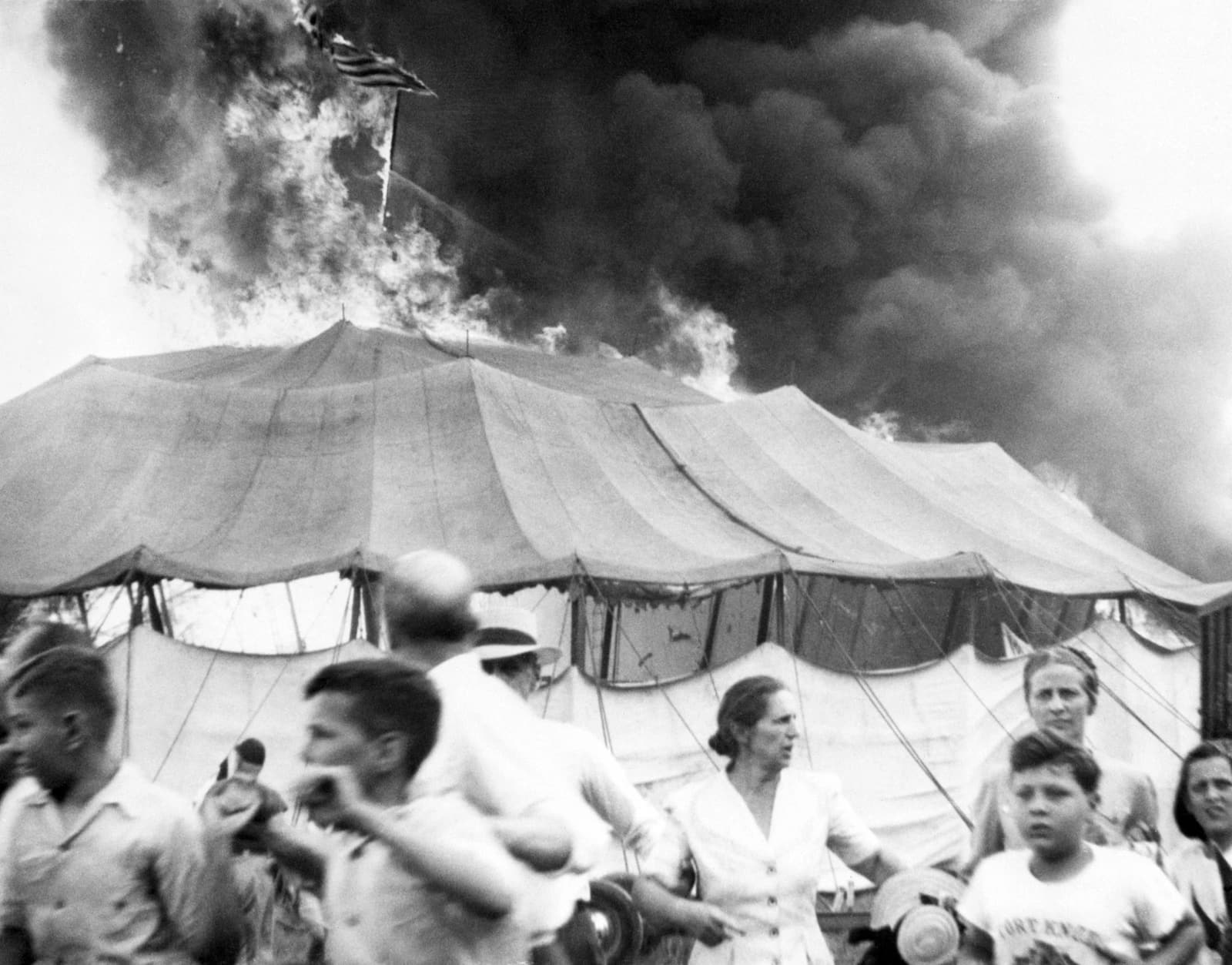
The Hartford circus fire is often remembered through the question no investigation has ever made fully neat: what started it? A dropped cigarette, a match, and later arson claims have all moved through the story. The sharper historical question is different. Why did a small fire, first noticed during a matinee on July 6, 1944, become one of the deadliest public-assembly disasters in American history within minutes?[1][2][4]
The answer sits in the mechanism. The Ringling Bros. and Barnum & Bailey big top on Barbour Street gathered roughly 6,000 to 8,000 spectators, many of them women and children, in a temporary structure whose waterproofing, exits, internal obstructions, and emergency preparation gave the crowd almost no margin once the canvas caught.[1][2][3] At least 167 people died and more than 700 were injured.[4][5] The spark mattered. But the catastrophe was built by everything that made the tent fast to burn and slow to leave.
That distinction matters because it keeps the event out of folklore. Hartford was not a freak accident in a harmless entertainment space. It was a public performance where a temporary building carried the risk profile of a large assembly hall, while inspection, staffing, exit width, flame behavior, and crowd movement did not add up to a working safety system.[2][3]
Timeline anchors
- July 5, 1944: the circus arrived in Hartford after logistical delays; one scheduled afternoon show was canceled, and the next day's matinee drew a large wartime crowd.[4]
- July 6, 1944, about 2:15 p.m.: the afternoon show began under the main tent on Barbour Street.[4]
- About 2:40 p.m.: spectators and workers noticed fire near the southwest end of the tent, around the time the Flying Wallendas were preparing for their act.[4]
- Within roughly 10 minutes: the main canvas burned, support ropes and poles failed, and the big top collapsed onto people still trying to escape.[1][3][4]
- 1945-1950: criminal cases, prison sentences, settlements, and safety reforms turned the fire from local trauma into a national code lesson.[1][4]
The fuel was overhead
The key fact is not only that the big top burned. It is where the fuel was located. The dangerous material was not a pile in one corner that could be isolated; it was the tent itself, stretched above and around the audience.
Connecticut History describes the waterproofing as paraffin wax thinned with gasoline, a treatment that helped the canvas shed weather but made flame spread brutally fast once ignition reached it.[1] NFPA's contemporary report, written in 1944, treated the main tent as a huge temporary structure: approximately 425 feet long, 180 feet wide, and covering about 74,000 square feet.[3] In ordinary use, those dimensions created spectacle. In a fire, they meant the burning surface was the ceiling, the walls, and the visual field by which people had to orient themselves.
That is why water buckets and on-site trucks could not change the outcome once flame took the treated fabric. NFPA judged the circus's firefighting equipment inadequate as life protection after ignition and noted that fire extinguishers were not distributed around the tent for quick use.[3] Connecticut History similarly notes that the circus's fire trucks were far from where they needed to be and that extinguishers remained inaccessible in storage.[1] The failure was not simply that nobody tried. The failure was that the available tools were mismatched to a fast-burning envelope above thousands of people.
Exits became a geometry problem
The second mechanism was exit geometry. A crowd does not leave a burning structure by desire alone. It leaves through widths, paths, sightlines, steps, openings, and decisions made in the first seconds of recognition.
The NFPA report is especially useful because it reads the circus ground as a life-safety layout, not just as a tragedy scene. Applying the Building Exits Code, it calculated that the crowd would have needed 91 units of exit width; its post-fire study found at most 43 units actually provided.[3] The report also found that some side exits narrowed sharply at the point of egress, while the broad front aisle was not reliably available because animal chutes and performance use interfered with it.[3]
This is where the circus form became dangerous. The big top was designed around rings, performance entrances, animal movement, reserved seating, bleachers, and spectacle. Those features made sense for a show. Under fire conditions, they became filters. Connecticut History notes bottlenecks at exits, animal cages blocking routes, and spectators cutting holes through canvas when the designed paths failed.[1] History.com's short reconstruction adds the overhead terror that made route-finding harder: burning canvas fell on spectators before the tent ropes and poles gave way.[4]
The deadliness of the fire therefore cannot be explained by panic as if panic were a moral defect in the crowd. Panic was partly produced by the space. Burning fabric fell from above, smoke and flame changed the meaning of every route, and the most familiar exit was near the likely origin area.[1][4] People were not choosing irrationally from a menu of clear options. They were being forced to solve a layout problem while the layout was collapsing.
Inspection did not become control
The third mechanism was administrative. The tent existed in a gray zone between temporary entertainment and high-occupancy building. That made responsibility easier to divide than to enforce.
NFPA's report says a city building inspector was present before the stands were up and issued a permit, but it also states that this inspection appears to have focused on zoning-type requirements rather than exit width or canvas flameproofing. It further notes that Hartford's Fire Prevention Bureau received no official notice from the building department that the circus was operating.[3] That handoff failure matters because the city had fire-prevention capacity. The problem was that capacity did not arrive at the exact temporary structure before the crowd did.
The circus also carried its own habits. NFPA described a show world that had used similar arrangements in many cities and treated them as routine.[3] That word is historically important. Routine can be a safety asset when it means practiced discipline. It can also be a hazard when it turns a large, flammable, temporary assembly into a familiar object that officials and operators stop seeing as a new risk every time it is erected.
Hartford's later reforms show what the fire exposed. Connecticut History reports that the state enacted strict safety regulations for public performances after the disaster.[1] History.com records the parallel legal and compensation aftermath: the circus eventually agreed to pay $5 million, and several organizers were convicted on manslaughter charges.[4] Those responses did not answer only the ignition question. They answered the system question: who inspects, what must be flame-resistant, how many exits must work, and who is responsible before a crowd enters?
The ignition mystery is real but not enough
The cause of the initial fire remains uncertain. Connecticut History presents the most widely accepted theory as a carelessly tossed cigarette near the men's toilet partition, but it also recounts later claims by Robert Dale Segee, a former circus worker, and his eventual recantation.[1] History.com keeps the boundary plain: the cause was unknown, even though Segee later confessed to setting the fire and was sentenced in Ohio for other arson-related crimes.[4]
That uncertainty should stay in the article rather than be smoothed away. A history that pretends the ignition is solved overstates the record. But the uncertainty does not make the broader mechanism uncertain. Fires begin in many ways. Public-safety systems are judged by whether a small ignition can remain small, whether occupants receive clear routes out, and whether a temporary structure behaves like a managed assembly space rather than a combustible container.
On that standard, Hartford failed before the spark. The paraffin-treated canvas made growth rapid.[1][3] Exit capacity and path design were insufficient for the audience load.[3] Animal chutes and crowd routing turned movement into compression.[1][3][4] Fire protection was not positioned to stop the life-safety disaster once the tent ignited.[1][3] Administrative notice and inspection did not align around the actual hazards of the erected big top.[3]
What the photograph preserves
The archival AP photograph used here is not a generic disaster image.[5] It catches the tent in the middle of transformation: the big top still visible as a recognizable circus structure, but already behaving as fuel. Spectators are not fleeing an abstract event. They are fleeing a familiar entertainment architecture that has suddenly changed roles.
That is the historical lesson. The Hartford circus fire was not deadly because a circus is inherently unsafe, or because crowds are inherently irrational, or because one unknown spark carried magical force. It was deadly because a public assembly depended on temporary materials and temporary coordination that did not deserve the trust the crowd had to place in them.
The best way to remember Hartford, then, is not as the day an American circus burned. It is as the day a city learned that a temporary tent can be a building, a canvas roof can be a fuel load, a performance aisle can be an exit bottleneck, and routine can be the most dangerous word in the inspection file.
Sources
- Connecticut History, "The Hartford Circus Fire" - narrative overview of the July 6, 1944 fire, paraffin-gasoline waterproofing, blocked routes, firefighting preparation, criminal aftermath, compensation, and state safety reforms.
- Connecticut State Library, "Hartford Circus Fire Archival Records" - State Archives guide to investigation, settlement, claimant, casualty, and related archival records.
- Warre Kimball, "Hartford Circus Holocaust," The Quarterly, National Fire Protection Association, July 1944 - contemporary fire-protection report on tent dimensions, exit-width analysis, animal runway obstructions, inspection handoff, fire equipment, and corrective measures.
- History.com Editors, "Fire engulfs circus big top in Hartford, killing 167" - concise chronology of the fire, casualty figures, falling canvas, paraffin-gasoline treatment, compensation, convictions, and Segee aftermath.
- Wikimedia Commons, "File:Hartford circus fire.jpg" - Associated Press archival photograph metadata for the article image.