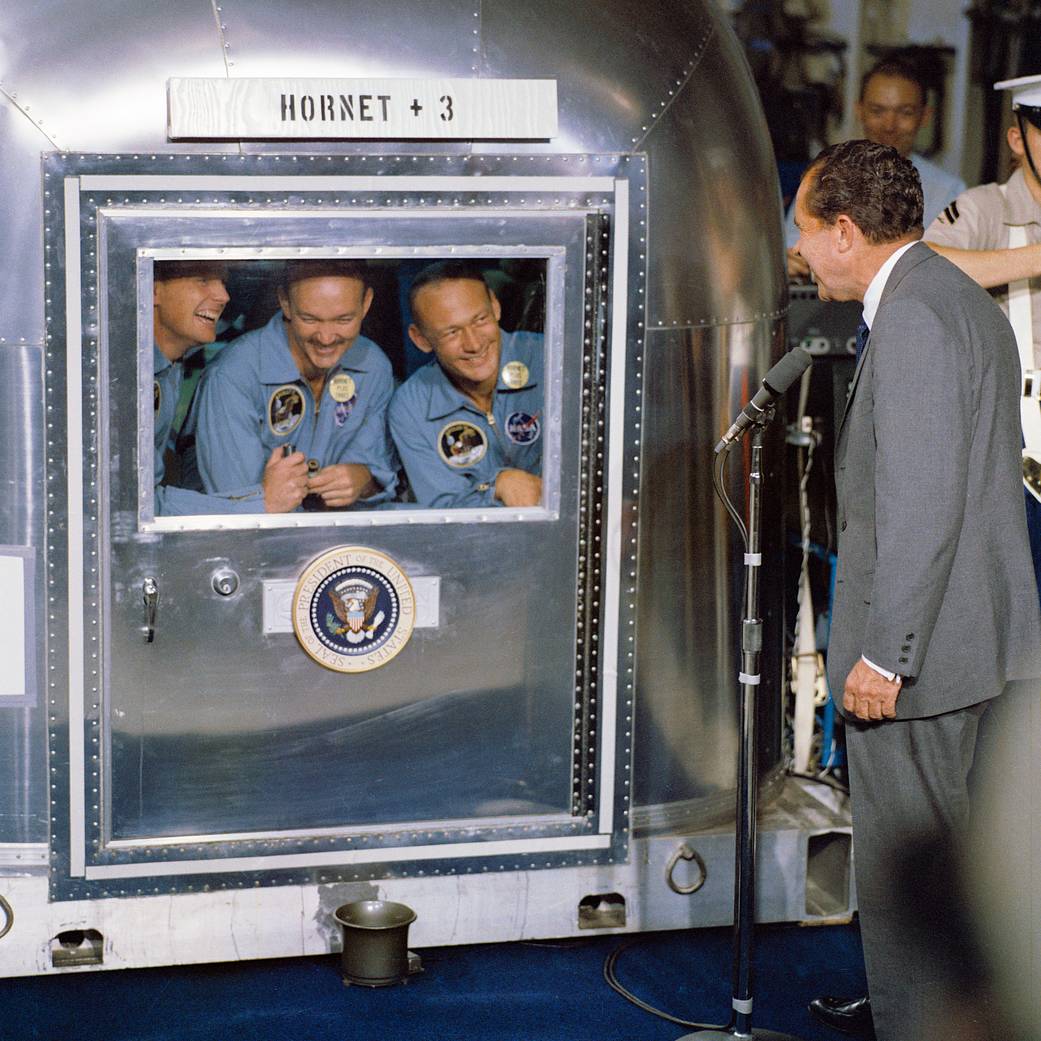
The strangest image in Apollo 11's homecoming is not the splashdown, the Navy recovery, or the ticker-tape parade that followed. It is President Richard Nixon talking to Neil Armstrong, Michael Collins, and Buzz Aldrin through the window of a trailer on the deck of USS Hornet.[4][6] If Apollo 11 quarantine is remembered at all, it is often treated as a quaint overreaction, a relic of Cold War nerves and science-fiction imagination. That reading misses the harder historical point. NASA did not need high confidence that the Moon carried dangerous life. It needed a system that could survive a period of not knowing.[2][3][5]
That is why the quarantine program matters. It was not built around proof of a lunar threat. It was built around the governance problem created by a remote but not yet dismissible possibility of back-contamination.[2][3][5] The 21-day rule, the Biological Isolation Garments, the Mobile Quarantine Facility, the transfer locks for samples, and the Lunar Receiving Laboratory all worked together as one bridge between splashdown and evidence.[1][3][5] Apollo 11 quarantine therefore makes the most sense not as moon-germ panic, but as a controlled sequence for managing uncertainty until release criteria could be met.
Image context: the cover works because it compresses the article's whole claim into one frame. The astronauts are already safe, famous, and back on Earth, yet access to them is still mediated by quarantine glass. Triumph and biosafety are happening at the same time.[6]
Timeline anchors
- 1964: the National Academy of Sciences recommended quarantine precautions for astronauts and samples returning from lunar landing missions because a harmful biological hazard, though considered remote, could not yet be ruled out.[2]
- 1966: the Interagency Committee on Back Contamination began overseeing the contamination-prevention plan that NASA would operationalize through recovery procedures, the MQF, and the Lunar Receiving Laboratory.[2][5]
- July 24, 1969: Apollo 11 splashed down in the Pacific; the crew donned isolation gear, entered the Mobile Quarantine Facility aboard USS Hornet, and the postflight quarantine began.[1][4][5]
- July 25-26, 1969: the first and second shipments of lunar samples and related materials reached Houston; scientists opened the first sample box in the LRL about 48 hours after splashdown.[3][4]
- July 27, 1969: Armstrong, Collins, and Aldrin arrived at Ellington Air Force Base inside the MQF and entered the Lunar Receiving Laboratory to complete their quarantine.[3][4]
- August 10, 1969: doctors declared the Apollo 11 crew medically fit and free of infection, ending their 21-day quarantine.[3]
- January 1970-February 1971: after studies from Apollo 11 and 12 indicated no hazard, the Interagency Committee agreed stringent rules could be dropped for future missions, but NASA still kept quarantine through Apollo 14 before ending crew quarantine altogether.[3][5]
1) The program existed because "remote" was not the same as "dismissed"
NASA's own retrospective on the first Mobile Quarantine Facility states the problem plainly. In 1964, the National Academy of Sciences recommended a quarantine program for returning lunar crews and samples because, although most scientists considered the risk of back-contamination remote, contemporary knowledge could not rule it out.[2] The Lunar Receiving Laboratory article makes the same point from the facility side: some scientists worried that astronauts or samples might bring back potentially harmful microorganisms, and the LRL was built as part of the planetary-protection answer to that unresolved question.[3]
This distinction matters. "Remote" is not the same thing as "irrelevant." Institutions that operate under public consequence cannot treat low-probability hazards as nonexistent just because evidence is incomplete. The quarantine program was NASA's way of refusing both extremes at once. It did not declare the Moon biologically dangerous. It also did not pretend the uncertainty had already vanished.[2][3][5]
The 21-day quarantine rule shows how practical that logic was. The official quarantine-program history explains that the interval came from observation of terrestrial disease agents: most capable of invading a host and producing evident symptoms would do so within 21 days of exposure.[5] In other words, NASA did not invent a mystical lunar number. It borrowed an operational rule from known disease behavior on Earth and used that rule as a provisional boundary for an unknown case.[5]
That is the first mechanism in the story. Apollo 11 quarantine translated a hypothetical extraterrestrial hazard into an earthly administrative clock. Once the clock existed, NASA could design transport, housing, sample handling, medical exams, and release procedures around it.[2][3][5]
2) The Mobile Quarantine Facility turned splashdown into a controlled transport chain
The Apollo 11 press kit shows that quarantine was never an afterthought bolted onto the recovery. It was written into the mission's return architecture before launch.[1] After splashdown, the crew would don biological isolation gear, fly to Hornet, and enter the Mobile Quarantine Facility, which would then carry them through the trip back to Houston.[1][4] The MQF was not symbolic theater. NASA had tested it at sea, in aircraft, and with simulated crew transfers before Apollo 11, precisely because the vulnerable span ran from ocean recovery to the Lunar Receiving Laboratory.[2]
The hardware reflected that purpose. NASA's MQF history explains that the trailer maintained negative pressure, carried its own living facilities, and included a decontamination airlock as well as a collapsible tunnel to connect with the Command Module without breaking the isolation barrier.[2] The point was not simply to confine astronauts. The point was to preserve a biologically controlled corridor while people, film, medical samples, and Moon rocks moved at different speeds toward different destinations.[2][4]
That sorting function becomes clear in the Houston return sequence. NASA's recovery account states that John Hirasaki retrieved the lunar sample containers, film magazines, and crew medical samples from Columbia through the tunnel linking the spacecraft and the MQF.[4] He sealed them in plastic, sent them through a transfer lock with sodium hypochlorite decontamination, and NASA then dispatched the material on separate aircraft so the first sample box could reach Houston quickly.[4] The crew, by contrast, stayed inside the MQF aboard Hornet, then through Pearl Harbor, and then on the C-141 flight to Ellington before entering the LRL.[4]
That division is the article's second mechanism. Quarantine worked because NASA broke the return into parallel lanes instead of one lump. Samples, film, spacecraft, and astronauts did not all need the same treatment at the same time. The system preserved biological isolation while still accelerating the highest-value scientific material toward examination.[2][4]
3) The Lunar Receiving Laboratory converted uncertainty into measurable release criteria
If the MQF solved the transport problem, the Lunar Receiving Laboratory solved the decision problem. NASA's LRL history describes Building 37 as both quarantine barrier and scientific workplace.[3] The Crew Reception Area housed the astronauts, support staff, and eventually the Command Module during the quarantine period; the Sample Operations Area used gloveboxes and vacuum systems to protect the samples from Earth contamination while also protecting Earth from any hypothetical biological risk; the Radiation Counting Laboratory and biological test areas pushed the material through time-critical checks.[3]
That dual purpose is the real key. The LRL was not a prison with lab equipment attached. It was a release machine. Astronauts lived inside it, debriefed behind glass, and received daily medical checks.[3] Meanwhile, the sample chain moved forward: the first box of Apollo 11 material reached the LRL on July 25, and scientists opened it inside a glovebox at 3:55 p.m. on July 26, roughly 48 hours after splashdown.[3][4] Some material then went to radiation counting and biological assessment; film magazines were sterilized so the images could be developed without collapsing the contamination protocols.[3][4]
That is why Nixon at the window matters historically. The quarantine program did not pause the mission's public life until a private scientific verdict arrived. It made public life and scientific caution coexist. The astronauts could greet the president, speak to their families, and begin technical debriefs, but every one of those acts had to happen through a designed barrier until the program could justify release.[3][4][6]
In that sense, Apollo 11 quarantine was less about confinement than about evidence production. It created a place where three clocks could run together without interfering with one another: the clock of crew health observation, the clock of biological assessment for lunar material, and the clock of preserving pristine samples for science.[3][5]
4) The end of quarantine proves the program was conditional, not superstitious
The strongest evidence against the "moon-germ panic" reading is the way the program ended. When Armstrong, Collins, and Aldrin left quarantine on August 10, 1969, doctors judged them medically fit and free of infection.[3] NASA's later LRL history adds an important wrinkle: even though scientists found no evidence of lunar microorganisms in Apollo 11 samples, quarantine remained in place for Apollo 12 and Apollo 14 because those crews landed in different parts of the Moon.[3]
That continuation is easy to misread as stubbornness. It was really the logic of the program carrying itself to its own evidentiary threshold. The formal quarantine history states that the crews of Apollo 11, 12, and 14 experienced no health problems from exposure to lunar material, and that exhaustive studies of Apollo 11 and 12 indicated no hazard to Earth's biosphere.[5] On that basis, the Interagency Committee on Back Contamination concurred in January 1970 that stringent quarantine rules could be abandoned for future lunar missions, but the program remained in force through Apollo 14 before being dropped.[5]
That sequence matters because it shows a program governed by release criteria rather than by myth. NASA did not keep quarantine forever to save face. Nor did it terminate the rules the moment Apollo 11 landed safely. It held the system in place long enough to test material from more than one landing site, then removed the most stringent crew-quarantine layer once the evidence base looked strong enough.[3][5]
The surviving sample-protection procedures underline the same point. Even after crew quarantine ended, NASA still handled lunar material carefully so scientists could receive uncontaminated specimens.[5] The original program had always been doing two jobs at once: protecting Earth from a hypothetical import risk and protecting the Moon rocks from terrestrial contamination.[2][3][5] One concern faded; the other remained scientifically useful.
The bounded conclusion
Apollo 11 quarantine deserves to be remembered as one of the mission's most revealing pieces of institutional design. It took a low-probability but high-consequence uncertainty and turned it into a sequence: isolation garments, a sealed trailer, transfer locks, aircraft routing, negative-pressure rooms, gloveboxes, daily exams, and explicit release criteria.[1][2][3][5] That sequence let NASA avoid two bad options. It did not treat the unknown as proof of catastrophe, and it did not treat ignorance as permission for carelessness.
Seen that way, the glass-window photograph stops looking comic.[6] It records a precise historical posture. Humanity had already walked on the Moon, but the return from that triumph still had to pass through a controlled interval in which evidence caught up with achievement. Apollo 11 quarantine mattered because it made that interval governable.
Sources
- NASA, Apollo 11 Press Kit - planned recovery and quarantine procedures, including transfer from splashdown to USS Hornet and the Mobile Quarantine Facility.
- NASA, "55 Years Ago: The First Mobile Quarantine Facility Arrives in Houston" - the 1964 recommendation, the Interagency Committee on Back Contamination, MQF design, testing, and purpose.
- NASA, "Building on a Mission: The Lunar Receiving Laboratory" - LRL design, Apollo 11 sample handling, crew arrival, daily quarantine life, and the continuation of quarantine through Apollo 14.
- NASA, "50 Years Ago: Apollo 11 Returns to Houston" - detailed sequence for moving crew, spacecraft, samples, and film from USS Hornet to Houston while maintaining biological isolation.
- NASA Technical Reports Server, "The Lunar Quarantine Program" in Biomedical Results of Apollo - 21-day rationale, operational assumptions, release criteria, and the decision to end stringent quarantine after Apollo 14.
- NASA, "Apollo 11 Crew In Quarantine" - source page for the archival photograph of Nixon greeting the crew through the Mobile Quarantine Facility window.